Bylaws and business meetings: a 1L experiential module

Ruth Anne Robbins, Distinguished Clinical Professor of Law, Rutgers Law School

The first year of law school rightfully has been criticized for overly prioritizing the litigation model and for making it the central focus of our teaching. This emphasis lulls students into believing that the judicial audience is the primary consumer of legal communications. To counteract that skewing, those of us teaching in the 1L curriculum are often exhorted to find ways to discuss transactional forms of legal writing. But, contract-drafting is not easily built into a curriculum already bursting at the seams with the must-have’s that we cram into the lower-credited experiential classes of the 1L year.

Enter the idea of dedicating part of two or three classes to small-organization bylaws and business meetings. The bylaws of a small organization are constitutional, so this type of teaching module fits in nicely with what they are learning in other introductory courses. And while some students may know a little bit about bylaws and business meetings from previous experiences in college, religious groups, or other volunteer activities, most students probably won’t have a great deal of knowledge. Learning about these ideas will appeal to them because of the immediate applicability to the very student-run organizations in which, as rising 2Ls, they are poised to assume leadership positions.

I begin by asking those students with a little bit of knowledge to help me outline, on the board, the setup and order of a business meeting. Typically, at least one or two students in a group of 20 will be able to walk others through it with a little bit of prompting. We talk about why a roll call must happen right after the call to order and opening ceremonies. Ask your own students how many of them know something about quorum—you may be startled to learn how few students do. Teaching them what quorum is and how it relates to business-agenda items engages the students and almost immediately makes them realize just how practical this module is.

Discussions about business meetings naturally leads to a conversation about the rudiments of Robert’s Rules of Order and how voting happens on an agenda item.[1] I have sometimes run a class or two in a business-meeting format, inviting students to make formal motions about some of the softer deadlines in the course. As part of that, students must calculate quorum to hold class at all. I always ask them the lowest number of votes it would take to carry a vote, assuming we had exactly quorum present. Students are awoken to the fact that in a class of 20 students, 6 students might be able to bind the other 14. (That is: quorum for a group of 20 students is 11. And if only 11 are present, a simple majority to carry a vote is 6). “It’s important to show up and have your vote counted,” I have remarked. The message isn’t lost on them.

Students also have the opportunity to step into role for actual representation work. A few years ago, knowing this module, our Women’s Law Caucus president approached me and asked if the 1Ls in my class might provide some advice about issues her executive board had identified in their bylaws. Naturally, I immediately agreed. To prepare students for their client, they first looked at a larger set of bylaws I had worked on for a local high school boosters organization. I changed a few items to take the bylaws out of compliance with the New Jersey statutes governing non-profit organizations (a relatively easy statutory scheme). Fifteen questions later, they knew enough to issue-spot in the much simpler student-organization bylaws. Then, in small groups, they looked at the Women’s Law Caucus bylaws and a week later offered their recommendations to the officers. Who adopted almost all of the advice.

This was such a feel-good moment for all involved that I have made it an annual module. Depending on the year, I have had students conclude with a client letter written by the small groups together, or I have simplified it even further and simply had the 1L students meet with the organization’s officer in class to offer their verbal recommendations (I act as scribe for the  officer in those circumstances). Each year I walk away impressed with the speed of absorption my 1L students have for this material. They take the representation seriously, and I think that they also enjoy it. I am likewise impressed with the 2L and 3L student’ willingness to serve as the client for my 1Ls even though it will net them extra work down the road as they work through the bylaws-amending process. I think they also feel that they learn valuable lessons by being the client. Having just completed this year’s project, I already have received a request from an organization’s new president to have my next year’s 1L students put her organization’s bylaws under their microscope.

This assignment is win-win for all involved. It is low-stakes for the 1L students, but it engages them in professional identity development, statutory analysis, problem-solving, and client-counseling skills. The module provides a pragmatic experience—who among us hasn’t been part of a business meeting or bylaws consultation?—and it offers a different perspective on legal practice. To put it simply: it’s relatively easy, it’s fun, and it’s real-world. I highly recommend it to others.

[1]The essentials of Robert’s Rules can be found online although the 11thedition is still a to-purchase item.

MAKING IT PERSONAL

I’ve been a devotee of Parker Palmer ever since I read The Courage to Teach.[1]  I often think of his statement: “We Teach Who We Are.”[2]   In January, David Brooks, Op-Ed columnist for the New York Times, echoed a similar sentiment.  Brooks’ piece, entitled Students Learn from People They Love,[3] told of how a class he taught at Yale softened around him after he had to cancel office hours a few years ago, having shared with his students that he “was dealing with some personal issues and a friend was coming up to help me sort through them.”  Recognizing something that many of us have long known, Brooks drew the connection between emotional relationships and learning.  Thus his Palmer-like statement: “[W]hat teachers really teach is themselves—their contagious passion for their subjects and students.”[4]

But we teachers are much more than our passion for our subjects and our students. We are human beings who bring into our teaching the accumulation of all the innate and environmental influences and experiences of our entire lives.  While these influences implicitly affect how we teach, each of us strikes a balance of how much of the personal we explicitly bring into our interactions with students, both in the classroom and outside.  My tendency is to share a great deal about myself, to share my personal stories.

I am an advocate of holistic lawyering, of the essentiality of understanding that a client comes into a lawyer’s office with a host of needs, only some of which are legal.  The lawyers I regard as most effective, the ones I most admire, are those who recognize their clients’ multiplicity of extra-legal challenges and, where appropriate, address them, if only by suggesting or referring to other professionals.

In writing this blog entry, I came to realize that I might appropriately call myself a holistic teacher. I’m not only committed to teaching my students the knowledge, skills, and values of the profession they are studying to enter.  I care about how they will bring their entire beings into their careers.  All of their signature strengths as well as their challenges.  If they are struggling in any part of their lives, it will likely bleed into their performance as students and, ultimately, left unaddressed, into their careers as lawyers.

I teach a general civil externship seminar.  I have the luxury of inviting my students to focus on key aspects of successful lawyering generally taught, if at all, only in clinics and externships.  These include, above all, the people skills so essential to effective lawyering:  communication; cultural competence; emotional intelligence; self-care; and finding realistic and healthy balance among work, family, friends, and self.

A joke I tell about myself and often share with students in distress is if a student comes into my office complaining of a hangnail, I recommend talk therapy, because it has been so helpful in my own life.  I have long been open about my history of episodic clinical depression, and have shared it with students and others struggling with their own mental demons.[5]   Sometimes, however, I wonder if I risk crossing the line between teacher and therapist.

Here’s a recent example.  I have been working on a pro bono case with a student now in her last semester.  We’ll call her Susan; not her real name.  Several times Susan had promised to get me a draft of a letter to a Congressperson for my review by a certain date and had not done so.  I had told her that I understood she had a lot else on her plate, and just to send me an email if she wasn’t able to get it to me by the date she had promised.  A week or so ago, she assured me that wouldn’t be necessary; she would absolutely get it to me by the end of the following weekend.  That didn’t happen.  Last week Susan and I were talking after a lunch hour program about her upcoming interview for post-bar exam employment at a firm with which she was currently externing.  It was an encouraging and upbeat conversation.  At the end, I gently mentioned that I had neither received the draft letter or an email explaining she was unable to get to it.   She confessed that she had begun to draft the email, but was just too anxious to finish it.  Apparently, this was not an isolated instance; she has long been plagued by anxiety.  A deeper conversation ensued about the importance of being in communication for the career she was entering.  I mentioned something I often said to students, that they wouldn’t have gotten as far as they had if they didn’t have an awful lot going for them.  But if something wasn’t working and they were unable to fix it on their own, there was no shame in seeking professional help.  Susan shared that she knew this, and also that she had stopped going to therapy several years ago when her therapist had suggested she might benefit from anti-anxiety medication.  Susan was and is adamantly opposed to psychiatric medication.  I stressed the importance of not burying her head in the sand, that the choice of whether to take medication would be her own but that not doing anything to solve a seemingly intractable problem was not a rational choice.  I reminded her of my own mental health history.  She later wrote, thanking me for the advice.

I write all of this with admitted ambivalence.  I even question whether it belongs in the “Best Practices” Blog.  For I struggle with my tendency to so readily recommend therapy to my students.

There are times when crafting my journal prompts, I have to remind myself to relate them to my students’ lives as externs and the lawyers they are becoming.  An example, from our exploration of Emotional Intelligence:

  1. Reflect on how well you think you know yourself, your MO (modus operandi). For example, are you aware of what your immediate response is to an upsetting or difficult situation?  Are there automatic responses you have that you would like to change?  Specifically, do any of these responses tend to create problems for you professionally, to keep you from being the law student or lawyer you most want to be? If so, what steps can you take to change them?

and another based on the chapter I contributed to Learning from Practice,[6] on Work and Well-being:

  1. Considering chapter 25 and our class discussion on Monday, reflect on what, if any, habits or practices you have developed in law school that detract from your sense of well-being. What, if any, habits or practices contribute positively to your sense of well-being?  What if anything might you change to improve your well-being, now and going forward?

Is it good practice to probe so personally into my students’ inner lives?  Is it sufficient that I offer them the option of writing about something less personal?  Although I may have doubts, I find that these prompts often elicit some of the most thoughtful reflections of any my students write.  Self-awareness, like awareness of others’ emotional contexts, is so critically important to being an effective lawyer.  Where in the curriculum can we explore this if not in experiential courses and, specifically, in journals?  Here’s a recent example from one of my student’s journal responding to this prompt:

One habit developed during law school that detracts from my well-being is that I have stopped going to the gym and eating healthy. I was always very into fitness and living a healthy lifestyle….  The time constraints of law school and working fulltime have forced me to essentially eliminate this from my life. . . .  My physical health and body image definitely play an important role in my mental health.  In the future, I think it will be important for me to carve out time to keep this part of my life….

I value the importance of introducing my students to positive psychology[7] and mindfulness practices, both empirically demonstrated to provide a plethora of benefits.[8]  For more than ten years, I have had a regular morning meditation practice which has been hugely beneficial in my own life and work.  For many years I have introduced my students to mindfulness meditation in the first class of the semester.  I usually show a wonderfully accessible twelve-minute video of Anderson Cooper’s introduction to meditation at a weekend silent retreat with Jon Kabat Zinn.  For even longer than that, I have begun each of my classes with two minutes of what I have come to call “settling in,” accompanied by an introduction, and invitation, to mindful breathing.  Some students find it to be an invaluable tool for settling their minds and reducing their anxiety, in and out of class.  Many others are agreeable to practicing it in class, but not inspired to try it elsewhere.  Still others find it to be a hippy-dippy waste of time.  I know it alienates some students, but that’s a cost I deem worth it for the possibly life-long benefits it provides for others.

I consciously model vulnerability, fallibility, and taking responsibility for messing up.  I admit my MO—being a scold.  I am naturally impatient with students who haven’t lived up to their responsibilities, who haven’t exhibited the professionalism becoming a lawyer requires.  I work hard at not acting out of my “default position.”  Too often, I fail.  Even if I say nothing, it shows on my non-poker face.  To put it mildly, this does not improve the climate in the classroom.   Here’s an example from this semester of failing and recovering:

I have the smallest seminar I have ever had: only five students.  We meet on Mondays, late afternoon.  On a Tuesday that was a “legislative” Monday[10] following Presidents’ Day weekend, only three students showed up.  The absent students hadn’t notified me. The following Monday, three students showed up.  One of the absent students had let me know that she had a stomach flu; I heard nothing from the other.

The assignment for that particular class was to prepare for partnered simulations based on the ethical dilemma hypotheticals in chapters 10 and 11 of Learning from Practice.[11]  The instructions I sent with the assignment right after the prior class, in bolded text, instructed the students to do two things:  1) coordinate with their simulation partner in advance and 2) notify me if they weren’t going to be in class so that I could make alternative assignments.  Of the three students who showed up, only one had read all of the assigned pages, and none had communicated with their partners about the simulations.

I did my best not to blow up but I was practically ready to end class then and there.  Instead, I took a deep breath, gave them a few minutes to read the hypotheticals, and left the classroom for a few minutes to cool down.  When I returned, we discussed the scenarios, rather than acting them out.  It was the best I could think to do at the time, and the discussion was sufficient to get us through the remainder of class.  It probably goes without saying that it was not a great class.

My true recovery actually occurred the following day when, having sufficient distance in time and place, I drafted, edited and emailed the class a missive I titled “IMPORTANT.”  After reciting the concerning events of the previous two classes, I added:

I appreciate that you are all juggling multiple responsibilities and substantial workloads.  This is training for careers as lawyers.  You are in the process of developing your professional identities.  I am committed to supporting you in that process.

Your professional training to become lawyers requires you to be accountable and in communication.  If you need to miss a class for which you have been assigned a particular role or task, you should inform your professor and any affected classmates in advance, or, if not possible, as soon as you can.

Law school generally, and the externship and clinical programs in particular, serve as a laboratory for developing the professionalism habits you will need for your future careers.  Towards that end, I … have attached … a Professionalism rubric[12]… .  I ask all of you, as you prepare your mid-semester self-evaluation to rate yourself on this rubric and see where you need and want to improve.  I will ask you to do the same at the end of the semester.  It’s up to you whether you want to share your rubric with me.

We are a very small group.  That has advantages and disadvantages, the latter having been evident for the past two classes.  We all need to work hard to live up to our obligations in order to maximize this learning experience for you.

I am posting the above on the Discussion forum and invite replies.  Or contact me privately and/or anonymously.

I’m committed to your success and know that you are, too.

No one took me up on the offer to post on the Discussion forum, nor to contact me otherwise.  Nonetheless, at the following class, all five students were present, thoroughly prepared for the simulations, and completely engaged.  It was a terrific class thanks to the work they put into it.

* * *

I have never been a trial lawyer or practiced law in a private firm.  I don’t have much in the way of war stories relevant to my externs’ placement experiences.  But I do have stories gleaned from seven decades of lived experience.  I have wisdom gained from pursuing my three major life passions:  One, to write and speak about more healing, relational and non-adversarial methods of achieving justice, resolving conflict, and ordering legal affairs.  Two, to decrease the shame and stigma around mental illness, having suffered six episodes of major clinical depression over the past forty-four years.  And three, to help my students envision and strive for careers that will make them excited and happy to get out of bed every morning.  I have been blessed with a career that has enabled me to pursue all three.

When I look back on my more than 36 years of teaching, I see that I have lived them holistically.  My work has been almost seamlessly integrated into the rest of my life, not separate and apart.  In both I have experienced the full gamut of emotions: joy, sadness, frustration, contentment—but never boredom.

We teach who we are.


[1] Parker Palmer, The Courage to Teach: Exploring the Inner Landscape of a Teacher’s Life (1st ed., 1998).

[2] Id. at 1.

[3] David Brooks, Students Learn from People They Love, New York Times, Op Ed 1/17/19.

[4] Id.

[5] See, e.g., Marjorie A. Silver, Healing Classrooms, in Transforming Justice, Lawyers, and the Practice of Law 264-65 (Marjorie A. Silver, ed., 2017);  Marjorie A. Silver, A Transformational Melancholy: One Law Professor’s Journey Through Depression, https://ssrn.com/abstract=1908992 (2011).

[6] Marjorie A. Silver, Chap. 25: Work and Well-Being 699-724 in Learning from Practice (Wortham, et al. eds., 3rd ed. 2016).

[7] Id.at 700-05.

[8] See, e.g., Shailini Jandial George, The Cure for the Distracted Mind: Why Law Schools Should Teach Mindfulness, 53 Duq. L. Rev. 215 (2015).

[9] omitted.

[10] This is Touro’s term for following a particular day’s schedule on a different day of the week.

[11] Lisa G. Lerman & Lisa V. Martin, Ch.10: Ethical Issues in Externships: An Introduction 261-78; Alexis Anderson, Ch. 11: Ethical Issues in Confidentiality  279-93 in Learning from Practice (Wortham, et al. eds., 3rd ed. 2016).

[12] See https://www.stthomas.edu/media/hollorancenter/pdf/FINALProfessionalismRubricMarch2019.pdf.

A Pedagogical Twist for the 1L Appellate Brief and Oral Argument

For those who teach legal writing to first-year law students, it is the season for appellate oral argument. Yes, the long-standing tradition of requiring first-year students to complete an appellate oral argument in the legal writing course continues today at the large majority of American law schools–at just under 75% of them, according to recent data. At those schools, the oral argument, which is commonly the capstone exercise near the end of the spring semester, has become something of a rite of passage for the students.

In a 2011 article, Legal Research and Writing as Proxy, I argued that assigning an appellate brief and appellate oral argument in the 1L legal writing course remains a pedagogically sound practice, even though a large majority of practicing attorneys will never engage in appellate practice, let alone complete an appellate oral argument. I still retain that view but won’t rehash my arguments here. Rather, I will focus on a pedagogical opportunity afforded by the brief/oral argument sequence of assignments that I discovered more recently.

In the last few iterations of my legal writing course, the appellate brief and oral argument assignments have proven an excellent vehicle for a bit of a pedagogical twist: A few weeks before the brief is due, not after, I teach lessons on oral argument and require the students to complete a practice oral argument round in front of my 2L teaching assistants. (The formal rounds of oral argument in front of a trio of local attorneys still occur after the briefs are submitted.) For many years, I kept brief writing and oral argument entirely separate—only after the briefs were completed and submitted would I shift the students’ attention to oral argument. (After all, that mimics the realities of the “real world“ of appellate practice.) But as a pedagogical matter, just like writing the brief helps in preparing an oral argument, working on an oral argument–and thereby having to talk out and defend one’s positions–can help in preparing a brief.

A few weeks before the brief is due, most students will have a scattered and underdeveloped array of arguments. Completing a practice oral argument can help them–or, in the case of those students who are spinning their wheels, force them–to organize and further develop those arguments for the purposes of the brief. In pursuit of this goal, I ask my TAs to give extensive feedback to both students after each practice round. Moreover, I require every student to attend two additional practice rounds as observers. At each round, the student representing Petitioner, the student representing Respondent, and the students attending as observers also begin to appreciate the formalities and peculiarities of oral argument, thus helping them to prepare for the formal rounds that will occur after submission of their briefs.

This semester, shortly after the practice rounds (just over a week before the briefs were due), my students graciously agreed to provide me some feedback on the experience. One of my students volunteered to solicit comments from all of her classmates, anonymize those comments and her own, and then send them to me. Twelve out of fourteen students in my small section gave a positive review. I include two of the more thoughtful evaluations here:

  1. I found doing the practice oral arguments before my brief was fully written to be helpful. Arguing my side in the courtroom and fielding questions from the TAs helped me more precisely narrow the theme of my arguments and determine how I wanted to frame my position in the brief itself. After receiving pushback from the TAs on certain points, I was able to refine my responses to common criticisms that would come from the other side. Additionally, I now feel more comfortable going into the “official” oral arguments having completed a practice round. However, I would have liked to participate in another mandatory practice round with the TAs after my brief is written; the substance of my oral argument has substantially changed since my first practice round.
  2. Practice oral arguments were a large motivator to get my arguments organized. I found it really helpful to speak out loud about the arguments. Doing so really helped me understand what my points were and whether or not they held up against scrutiny. Speaking about the arguments also helped me understand how they related to each other. The TA’s did a good job of making us feel comfortable throughout the process. I think overall the exercise is going to be beneficial as long as the practice round is kept informal. We were all stressed about how to perform the oral arguments, so maybe there could be a concession in the formality/process of the oral argument that could make us more comfortable.

Good food for thought, as I continue the tradition of appellate oral argument again next spring.

Are the Students Failing the Bar Exam Today Canaries in the Coal Mine warning us of a More General Need to Change Legal Education?

Thank you so much to Best Practices for Legal Education for inviting me to blog again and to Elizabeth Murad for her remarkable work in keeping contributors in touch and on track.  So much is written about the very real decline in bar passage that it is easy for schools with high pass rates–or at least high in relation to other schools in their state– to ignore the need to change what goes on in the classroom and dismiss the excellent work being done in effective law teaching as a problem for “lesser schools” in “lower tiers.”

We know, as legal educators , members of the bar and even members of the public, that bar passage rates have been falling.  And we also know that many, if not most, law schools are admitting students today with LSAT scores lower than those that they  admitted ten years ago. So it’s easy to see a correlation between lower scores and falling rates.  After all, the bar exam is a test much like the LSAT–why wouldn’t there be a relationship?   But even if students are failing the bar exam for the same reasons they are getting low LSAT Scores,  we still have the opportunity to intervene in ways that we know raise pass rates.  This blog contains so many resources for those who want to teach more effectively.   Why wouldn’t we want this for all our students?

Everyone at a school with a “bar passage problem” is well aware that we cannot continue to do the same things we always have when they are no longer working the way they used to.  But we hear this less at schools satisfied with their bar passage  Perhaps the students who are failing are really canaries in the coal mine and a warning to all of legal education that all of today’s law students find it more difficult translating their legal education into the very peculiar format required for bar passage-regardless of LSAT score? Everyone who has ever studied for the bar exam remembers it as a grueling, unpleasant, and highly intensive process–but until very recently that process started after graduation and barring personal disaster almost always resulted in passage.  Even when it didn’t, the consequences of were lower.  Today, students safely employed in September find themselves fired if October brings news of failure.  We need to consider bar passage as an issue both for students who fail and for those who pass–after all, both groups spend the same three years in law school.

Anecdotal evidence (which we could easily substitute for actual data by doing some surveys) suggests that bar passage anxiety spreads well beyond those students most at risk.  All students know that the stakes are high and many believe that their chances of passing are lower than students in the past.  Does that affect their choices while in law school?  Could they be doing more to prepare for their future careers if we could provide them more effective instruction?

Medical students and educators are expressing the same kinds of concerns about their curriculum being shaped by a test as we should be about ours.   We can’t easily change the bar exam–but we can adopt more direct methods of instruction that support not just bar passage but create time for the more complex and less exam focused thinking that we want to be going on in class.

I hope over the week to share resources that would encourage everyone to consider how studying for a very old fashioned test is negatively shaping the education of all of today’s law students. (and because it always warrants reposting-here is a recently revised article by, Louis Schulze of what they have done at FIU to apply the “science of learning” across the curriculum in support of higher bar passage.


New Rubrics Available to Help Law Schools that Have Adopted Learning Outcomes Related to Professional Identity Formation

By: Professor Benjamin V. Madison, III


A recent blog by Andi Curcio and Dean Alexis Martinez addressed the manner in which well-developed rubrics help law schools in program assessment. As newcomers to assessment of program learning outcomes, see Article, law schools need guidance on best practices for program assessment.

Rubrics are clearly a key part of assessing whether law students, by the time they leave law school, have attained skills, competencies, and traits embodied in a given school’s program learning outcomes. The Holloran Center for Ethical Leadership in the Professions created a database of program learning outcomes adopted by law schools. See Database. The program learning outcomes that many of us find most intriguing are those under ABA Standard 302(c) (exercise of professional and ethical responsibilities to clients and the legal system) and Standard 302(d) (professional skills needed for competent and ethical participation as a member of the legal profession). The competencies and skills in learning outcomes adopted by law schools under these categories include: Cultural Competency (46 schools), Integrity (27 schools), Professionalism (31 schools), Self-Directedness (41 schools), and Teamwork/Collaboration (52).

Associated with St. Thomas School of Law, the Holloran Center brought together two leaders in the professional formation movement, Professor Neil Hamilton and Professor Jerry Organ of St. Thomas Law, with faculty and staff from other law schools that have committed to pursuing professional identity formation as part of their law schools’ effort to produce complete lawyers. Like Professor Hamilton and Professor Organ and St. Thomas, these faculty, administrators, and staff–and their law schools–have demonstrated a commitment to the professional identity formation movement—a movement inspired by the 2007 publication of the Carnegie Report and of Best Practices in Legal Education. Recently, rubrics developed over the past year by working groups assigned to specific competencies were added to the Holloran Center web site, see Holloran Competency Milestones.

The Holloran Competency Milestones offer any law school that has published a program learning outcome in the competencies listed above—competencies that some educators may consider too challenging to assess. If anyone believes these competencies are impossible to assess, however, the Holloran Competency Milestone rubrics show otherwise. A law school must decide in what courses, or in what contexts (possibly clinical settings), the school uses the rubrics to assess attainment of a given competency. However, the Milestones are a valuable tool for assessing these competencies.

The work of the Holloran Center, and of those of us on the working groups that developed these first rubrics will continue. (The persons and schools who have participated in this project to date are identified on the site with the Milestones.) Law schools that have not previously been involved in development of rubrics have recently committed to developing further rubrics. Continuing the progress that has begun will provide rubrics for program assessment of competencies for which assessment tools have not been developed. For instance, these schools are likely to address competencies such as Reflection/Self-Evaluation (36 schools include in published learning outcomes), Active Listening (31 schools include in published learning outcomes), and Judgment (18 schools include in published learning outcomes).

Anyone who considers the competencies discussed here to be too abstract to include in a law school’s program of instruction ought to review the impressive survey by Educating Tomorrows Lawyers (ETL), called the Foundations of Practice Survey. There, ETL’s survey of more than 24,000 lawyers nationwide demonstrated that the very competencies discussed above (1) were among the most important factors in employers’ decisions whether to hire law students, and (2) determined whether the student is likely to succeed in law practice. See Foundations of Practice Report (The Whole Lawyer and the Character Quotient).

In short, the law schools that adopted learning outcomes designed to produce lawyers who are not only legal technicians but whole persons are on the right track. The law schools that adopted competencies that go beyond traditional competencies (analytical skill, writing, etc.) showed they believed a complete lawyer needed other competencies to be complete. The efforts described here validate the decision of such schools to adopt learning outcomes that go beyond the traditional ones. The hope, of course, is that law schools now use these rubrics to do program assessment of competencies such as cultural competency, integrity, professionalism, self-directedness, and teamwork/collaboration.

May these efforts ultimately produce more lawyers that embody these competencies.

The Feedback Sandwich: A Bad Recipe for Motivating Students’ Learning

This past year, I’ve been participating in the hiring process for clinical professor positions at our law school. I’ve observed job talks and engaged with candidates about how they provide supervision. Because I believe that giving students feedback is, perhaps, the hardest part of being a clinical professor, I tend to ask lots of questions about how candidates would, ideally, provide feedback in an academic or practice setting.

I’ve been surprised by how many candidates still ascribe to the “feedback sandwich” as a model for delivering feedback and by how many clinical professors claim they use the model in their teaching. The feedback sandwich is a feedback delivery method that uses a compliment, criticism, compliment format. It’s meant to soften the blow of critical feedback and increase the likelihood that the recipient will actually listen to the “meat” of the sandwich – the corrective measures. But the feedback sandwich has been widely criticized.

Feedback is the backbone of clinical education. One of the greatest benefits of experiential learning is the opportunity to give and receive constant feedback. Feedback helps students develop their skills and their professional identities. Well-designed feedback can lead to increased motivation and learning. But ill-designed feedback can lead to decreased motivation, low performance and disengagement.

No doubt, most feedback is well-intentioned whatever form it takes. The feedback sandwich certainly seems well-intentioned too. Professors often use it to remind students that they can and have done some things well. But danger lurks in the good intentions of comforting feedback.

Researchers have demonstrated that giving students comforting feedback significantly decreases their motivation to learn.  Comforting feedback communicates low expectations. For example, telling a student that plenty of people have difficulty with this skill but may be good at others doesn’t empower students to improve. In fact, it may even suggest that the professor doesn’t think the student can improve.

On the other hand, controllable feedback increases students’ motivation and effort to learn. Controllable feedback gives students the specific strategies they need to improve. For example, suggesting a student talk through strategies used to complete a task, and together develop specific ways that the approach can be improved offers students a pathway to increase their learning.

Don’t let your feedback get hijacked by the sandwich myth. Research shows that when we hide feedback that is critical for learning, students tend to remember the compliments and forget critical aspects that will lead to real struggle and learning. And, importantly, students interpret comforting feedback to mean that they may not be able to improve their performance in this particular skill. Compliments and comforting feedback may help students feel better in the short term, but it doesn’t help them address their deficits.

If you are uncomfortable giving critical feedback, consider the learning culture you foster. The type of feedback one gives reflects one’s mindset. Instructors with a growth mindset foster a belief that students’ intelligence or aptitude can grow with effort and good strategies. Those with a fixed mindset believe that one’s intelligence or ability is mostly fixed, and one can’t significantly change their natural abilities. Researchers have shown that instructors with a fixed mindset give significantly more comforting feedback than instructors with a growth mindset. This makes sense because if we believe a student may not be able to greatly improve their performance despite their best efforts, we seek ways to make them feel better about themselves.

A growth-minded culture allows for feedback to be taken in the spirit it was intended – to provide students with an honest assessment of their performance and concrete ways to improve it. It’s essential for clinical professors to provide growth-minded and controllable feedback. That’s because students can detect instructors’ mindsets. They see through the comforting feedback and come to believe they aren’t capable of significantly upping their game. Only controllable feedback provides a path for sustained improvement and growth. Law students will need to learn to receive and give this kind of feedback as they enter the legal profession, and law schools can play a role helping them manage this process.

CLEA, SALT and others urge Council on Legal Education to increase transparency and reject proposed changes to Standard 316 at their Friday 2.22.19 meeting

FROM CLEA website:

On February 20, 2019, CLEA submitted two joint advocacy memorandums, with the Society of American Law Teachers (SALT) and others, to the Council on the ABA Section of Legal Education and Admissions to the Bar. 

In the first joint memo, CLEA and SALT urge the Council to increase transparency in its processes and engage in meaningful dialogue with all interested constituencies before making decisions that affect law schools and the legal profession.

The second advocacy memo urges the Council to once again reject the proposed changes to Standard 316 relating to bar passage.  The second memo is co-signed by SALT, the ABA Coalition on Racial and Ethnic Justice, ABA Commission on Disability Rights, ABA Commission on Hispanic Legal Rights & Responsibilities, ABA Commission on Sexual Orientation & Gender Identity, ABA Commission on Women in the Profession, ABA Council for Diversity in the Educational Pipeline, ABA Law Student Division, ABA Young Lawyers Division, HBCU Law Deans Gary Bledsoe, John C. Brittain, Elaine O’Neal, John Pierre, & LeRoy Pernell,  and the Hispanic National Bar Association (HNBA).

Assessing Institutional Learning Outcomes Using Rubrics: Lessons Learned

By: Professor Andi Curcio & Dean Alexis Martinez

Experience confirms using rubrics to assess institutional learning outcomes is relatively easy and cost-effective. It is also an iterative process. Below we share some of the lessons we learned as we engaged in this rubric-based institutional assessment process. We also share examples of final report charts to illustrate how this process results in usable assessment report data.

A Review of the Basics

Georgia State University College of Law has institutional outcomes that encompass the ABA required legal knowledge, analysis, research and writing outcomes as well as outcomes covering self-reflection, professional development, ethical and professional obligations, teamwork, ability to work effectively with courts and clients, and awareness of pro bono responsibilities.

An earlier blog and article provide an in-depth discussion about the development and use of rubrics to assess these institutional outcomes.

To briefly review the main idea: we engaged faculty in designing rubrics with measurable criterion for each institutional outcome.

For example, for our legal knowledge and analysis outcomes, our criterion included: substantive legal knowledge; issue spotting; fact usage; critical analysis; and policy analysis. For each criterion, we identified a continuum of competence.

For example, for issue spotting, the rubric looked like this:

ACC1

As the excerpt above illustrates, we drafted rubrics so that faculty teaching a wide range of courses could use the rubric, regardless of course content or assessment methodology.

For each outcome, we identified multiple first year and upper level courses that would provide a solid student sample and used those courses to measure the outcome. In the designated courses, faculty graded as usual and then completed a rubric for each student.

Faculty did not have to change how they taught or assessed and the only extra work was completing a rubric – a process the faculty agreed took little additional time.

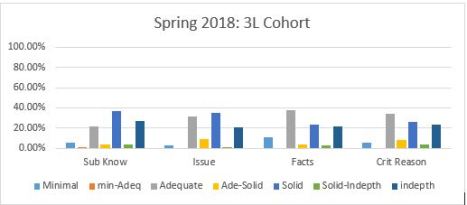
All data was entered from the completed rubrics into one master database and used to create a faculty report identifying student achievement, by cohort year (1L,2L 3L) for each rubric criterion [see sample below].

Lessons Learned:

1. Drafting Rubrics

We struggled to draft rubrics that could be easily adapted to a wide range of courses. If we were starting from scratch, it might have been easier if we used the rubrics drafted by the American Association of Colleges and Universities [AAC&U] as a starting point. Those rubrics have been developed and tested for reliability and validity. They also look at the big picture skills.

Because law faculty often think in context of how individual courses are taught it was sometimes challenging for faculty to start from scratch and draft rubrics that could be easily applied across the curriculum. Starting with the AAC&U rubrics allows faculty members to review examples of language and how larger/generalized program outcomes could be assessed through multiple different teaching methods and in a wide range of courses.

We also learned that it works best if we keep the rubrics to one page per learning outcome. Although outcomes could have a lot of criterion, it is important to identify 4-5 key criteria. Keeping the rubrics to one page forces us to hone in on the critical skills and helps ensure that the process is not overly burdensome for either faculty completing the rubric or staff entering the rubric data. It also makes reporting the data more manageable.

We also found it useful to remind faculty that the institutional rubrics are not meant to capture all skills taught in a given course and that we did not expect all faculty to assess every rubric criterion which is why we included a “N/A” [not applicable] choice for each criterion.

Finally, we found it helpful to emphasize that while we cannot change the rubrics mid-year, we welcome feedback and are open to changing future rubric iterations based upon faculty input. This keeps the faculty engaged and ensures the rubrics are as meaningful as possible.

2. Labeling Criterion Levels

Originally, we drafted rubrics and labeled each criterion level with word descriptors such as: needs significant help; developing; competent; and aspirational. Faculty found those labels more confusing than helpful. We thus changed the continuum labels to: level 1, level 2, etc. This change made it easier for faculty to focus on the descriptors along the continuum, rather than the achievement labels. It also eliminated any concerns about how the data collected could be used in the future, either internally or externally, to describe the quality of current and future graduates.

3. Data Compilation and Report Format

We chose a wide variety of 1L and upper level courses to get a robust data sample. In each course assessed, the professor completed a rubric for each student. Professors used anonymous exam numbers for the rubrics, just like for grading.

Initially, each rubric submitted was a data point. However, we realized that some students were taking multiple courses used in our data collection while others took only one course. To address the issue of “double counting” some of the same students, we changed our data entry system so that each student became a data point.

To the extent students took multiple courses where the outcome was measured, and they were rated differently by different professors, we averaged their score. Thus, if a student was at a Level 2 in issue spotting in Con Law II and a level 3 in issue spotting in Administrative Law, the student was entered into the program as a 2.5 for issue spotting. That also allowed us to have a more granular final report because instead of having four levels, we had seven.

The charts below illustrate what final data compilation might look like using that data entry system.

ACchart

ACC3

After experimenting with developing a software program to compile the data, we discovered it was cheaper, and significantly simpler, to use excel for data entry and basic data compilation. The excel option also allows for future entry into SPSS for additional correlations or data analysis.

As we move forward in assessing additional outcomes this year, we are experimenting with moving from hard copy to electronic rubrics to ease the administrative burden of data entry of hard copy rubrics.

There are multiple software options, such as Qualtrics, that allow for the same questions included in hard copy rubrics to be organized electronically for reports to be run quickly and efficiently.

4. Using the Report Data to Improve Learning

After compiling the data, the assessment committee reported out the analysis in a short, factual report to the faculty using the chart format above and some additional explanatory narrative.

Throughout the reporting process and ensuing discussions about how to use the data, we reminded faculty that the point of outcome measures is to improve student learning [something we all care about].

We also were very upfront about issues with methodology that produced imperfect results, and we reminded faculty that our goal was an overview, not a publishable paper. Reminders about why we are engaging in the process and transparency about imperfections in the process went a long way toward moving the discussion forward.

We used the report as a starting point for a big picture discussion. After briefly reviewing the report with the faculty, we asked the faculty to break out into small groups and answer questions such as: given the data on 1Ls, are we satisfied with where our 1Ls are at the end of the first year? If not, what changes should we consider to help improve their learning?

By engaging the faculty in answering specific questions, we got great feedback that we turned into recommendations/action steps that led to further discussions. Eventually we adopted action steps that we have begun implementing in the hope that we can improve student learning. For example, based upon the data and the experience using the rubrics, faculty agreed to develop criterion-referenced rubrics for their own courses so that students had more information than simply a curved grade by which to assess their progress.

Conclusion

Institutional outcomes assessment is a new process for most law schools. It is also an iterative one. We learn as we go along and make changes as necessary. At GSU, we changed our data compilation methods and tweaked the rubrics. We expect to continue rubric revision as we become more familiar with the process.

What we have learned is that the rubric assessment process is fairly easy to implement, cost-effective, and can provide us useful information as we continually strive to improve our students’ learning.

What’s in a Name? Teaching Implicit Bias

Every semester I weave into my classrooms several opportunities to teach about implicit bias. I have shown videos like this and led discussions on articles like this.

Last week in my Family Law Clinic seminar, we discussed Peggy McIntosh’s Unpacking the Invisible Knapsack, which describes the author’s quest to overcome her biases stemming from white privilege. A student shared their pain and frustration over college and law professors never using their full name, and often mispronouncing the parts of their name the professor is willing to speak out loud. “It’s dehumanizing,” my student said.

Those words have haunted me all week. Names are fundamental parts of human identity. Why can we, as educators–members of an elite profession–not get this right? Why is it not a norm in higher education for professors and teaching assistants to learn to pronounce every student’s name?

Also this week, I read in a memo from a colleague a to-do item along the lines of “practice pronouncing graduates’ names.” The colleague was sharing with me tips for the job I will soon begin: associate dean for academic affairs. One privilege of this job is reading the names of all Penn State Law graduates at the annual commencement ceremony. It was profoundly touching to learn that my colleague takes the time to practice every graduate’s name–and they felt it important enough to share with me as one of a handful of their significant monthly action items.

I give all my students the opportunity to share the pronunciation of their name with me on the first day of class, on note cards I keep with me at every class. An earlier post explained more about the note card system, which I learned from fellow blogger Paula Schaefer. Pronouncing each student’s name is challenging, and I sometimes falter. Last semester I began writing the pronunciations on my seating chart, to minimize my fumbling through the note cards. This is my seventeenth year of teaching. My only regret is not starting this earlier. It enriches my classroom, and it enriches me. It bakes into my pedagogy an indirect lesson about implicit bias, a lesson I re-learn every time I call on a student and say their name, whether it is Ainslie or Zhao-Ji.

Leadership Courses: Paving the Path for Future Attorneys

Written by: Dean Rosemary Queenan, Albany Law School; and Dean Mary Walsh Fitzpatrick, Esq.


There is a call to action to provide students with the opportunity to build leadership skills. This call originates, in part, from the changing legal services environment and the recognition that lawyers need to know more than the law: they need to master many disciplines that are commonly and collectively referred to as “leadership” skills. Broken down into its separate parts, leadership may include communication, teambuilding, organization, presentation, active listening skills, and a cadre of emotional intelligence competencies.

To answer the call, Albany Law School has developed and added to its course offerings a new Lawyers as Leaders course, which is being taught collaboratively by Mary Walsh Fitzpatrick, Assistant Dean for the Career and Professional Development Center and Rosemary Queenan, the Associate Dean for Student Affairs. The course will use skills-building exercises and constructive feedback to allow students to practice leadership skills. Students will create their own organizations and will be assigned to take on leadership roles in performing certain tasks including identifying a vision for their organization, managing and working with teams, making difficult decisions, navigating difficult conversations, presenting and communicating effectively and problem solving.

Our first class focused on a discussion of the work of Carol Dweck, Ph. D., Peter Senge, Ph. D., and Daniel Goleman, Ph. D., on mindset, emotional intelligence, and leadership styles, in the context of our broader discussion of what makes a great leader. With this introduction, students were asked to assess and identify their own leadership styles and emotional intelligence attributes. Each organization was also asked to research a leader in business or law and present on that leader’s failures and successes in leadership.

We are looking forward to this first-of-its-kind course to be offered at Albany Law School and are confident that every student will benefit in some way from the experience. Stay tuned, as we will provide updates on our progress and outcomes along the way!

Letters raise concerns about changes to the bar pass accreditation standard

Early next week, the ABA House of Delegates will again vote on whether to approve a revised bar passage accreditation standard [Standard 316]. The Society of American Law Teachers and the ABA Diversity Entities both have written to the ABA House of Delegates setting forth significant concerns about the proposed standard change.  Both letters are worth a full read.

Amongst the issues the letters raise about the proposed change are the following:

1.  There is incomplete data about how it will affect HBCU’s and other law schools with significant enrollment of people of color;

2.  It fails to account for state bar exam cut score differences and differences in state bar exam pass rates;

3.  It may result in even greater reliance on LSAT scores in the admissions process despite studies showing the scores’ limited predictive value for academic or bar exam success at many schools and despite warnings from the LSAC about how to use the scores properly in the admissions process;

4.  It may negatively impact schools willing to take a chance on students who are poor standardized test takers but who will be excellent lawyers and leaders if given the opportunity to attend law school and the coaching necessary to pass the bar exam;

5.  It does not consider the effect of transfer students on bar pass rates for schools that admit students who otherwise would not be admitted to law school, who perform well, and who then  transfer to other institutions;

6.  It eliminates some important aspects of the current Standard that take into account varying state pass rates, a school’s mission, the transfer issue, and the fact that improving bar passage is a complex and nuanced issue that requires study and experimentation [something currently underway at many schools];

7.  Now is not the right time for change given current studies about the validity of the bar exam as a licensing method and work being done to explore law licensing assessments that better measure who will be a competent attorney.

Proponents of the proposed change to Standard 316 believe it is necessary to protect consumers from law schools that admit students without devoting the necessary resources to ensure bar passage or that admit and retain students who have no chance of obtaining a law license.  The letters cited acknowledge the importance of the consumer protection issue but argue that issue can, and should, be addressed in other ways.

If you have concerns about the proposed change to Standard 316, contact your state ABA delegate.  The delegate information starts on page 13 of the ABA 2018-2019 Leadership Directory.

A Fresh Look at the Uniform Bar Examination

The bar exam is back in the news. Later this month the ABA House of Delegates will consider a proposal to raise the bar-passage standard. The proposal would require that 75% of an accredited law school’s graduates pass a bar exam within two years of graduation.

In most states, bar exam means the National Conference of Bar Examiners’ Uniform Bar Exam. The UBE has been adopted by 35 jurisdictions and is under consideration in others. It carries the endorsement of many ABA-related entities. They include the Conference of Chief Justices, the Law Student and Law Practice Divisions, the Section of Legal Education and Admissions to the Bar, and the House of Delegates.

As a reminder of the features of the UBE, and an update on the pace of its adoption, I have accepted Mary Lynch’s gracious invitation to reblog my recent post “Will the Uniform Bar Exam Come to Michigan?” from the Western Michigan University-Cooley Law School blog. (Spoiler alert: no time soon.)

Ode to Librarians

Librarians are the nicest, most helpful people I have ever met.  I don’t remember meeting any librarian who wasn’t.

They are particularly helpful for students, teachers, and scholars – like most of the readers of this blog.  Although librarians sometimes get acknowledgment, often they are unsung heros who bail us out when we have desperate last-minute requests to find hard-to-find stuff.  And somehow, they usually do find what we need.

I was prompted to think of them by a recent episode of This American Life devoted to librarians.  It features three stories of very unusual situations when librarians were especially helpful. Check it out.

Getting Students Out of Their Own Heads – Moving More Toward Justice Oriented Learning

As the New Year begins and I look back on last semester’s first-year student work, I am struck with how challenging it is to guide students into a shared understanding of law and toward an ability to think critically about and evaluate that understanding. I also find myself actively searching for how to reach students in ways that go beyond helping them pass the bar or find a job.  It’s hard enough to get first-year students to start with the same facts, let alone law.  This hurdle exists in part because we come from different life experiences such as racial, gender-based, religious, geographic, social, economic, historic, or cultural group-based memberships that help shape how we understand the world[1]. But, beyond viewing the world through different life experiences, sometimes known as bubbles, people now also have their own “personal facts” which are either chosen or assimilated from what they see on social media, television, or are simply made up. And, as our society becomes more rigidly partisan, personal facts become more fixed and more firmly held by our students. Whereas in the context of teaching persuasion in the past, I might have labeled these fixed positions simply as “contrary” or “argumentative” and pushed students to develop skills of logic – case analysis, statutory interpretation, synthesis, and advocacy, something more is needed now. This era of personal facts adds another layer of difficulty to legal education beyond the lack of academic preparedness students bring to law school.[2]

Teaching law and its value in the context of our rule of law society[3] is itself fundamentally challenging, but that function is complicated by personal facts and is made even more difficult in schools that shift their focus to “student-centeredness”[4] which winds up elevating students’ opinions and then further validating their personal facts.  The rise of student-centeredness goals in law schools reinforces a consumer-preference society and also enables students’ – later lawyers’ – ability to stray from the rule of law.[5] I take for granted for the moment here, that a rule of law society in which power is constrained by rules of law and where those rules have value beyond individual outcome preferences, is preferable to other paradigms[6]. To focus students on the law outside of themselves, professors in the past might have said “judges don’t care what ‘you’ think; they care about the law.” Today, though, if one of us tells a student that judges or we “don’t care” what they think, a student is all too likely to complain, choosing to ascribe some deep personal weight to a fictional lack of caring and then have their complaint heard and responded to, thus missing the lesson of law outside of themselves.[7]  And – yes, I can and do find nicer ways of encouraging students to put aside their own bias, but at some point I am the one spending energy on figuring out how to get across a point in a manner that doesn’t hurt, insult, or otherwise upset a student rather than the student spending time on shifting their perspective and learning.

Student personal perspective today is particularly strong, not always shared, intensely personal, supported by personal facts, and often indulged.  My self-aware upper-level students from the past would have recognized a distinction between personal facts and objective facts and easily distinguished the two.  Personal facts are facts as the student wants them to be or that the student can find – usually on the Internet – to support their idea of what “should” be.[8]  “Objective” facts for purposes of this contrast are facts that exist independently of whether a student is gathering them to make an argument and are usually found in clients’ words, documents, or in assignment or exam hypotheticals. Too much student-centeredness risks not disrupting a fixed mindset or the partisanship of personal facts.

So, as I prepare for next semester, I find myself wishing that, in addition to helping students learn rules of law, I could do more to get my students temporarily out of their own heads – individually and socially.  Each semester, I contemplate the delicate balance between having students learn the law and helping them develop tools to think about the law’s role and how to move it toward making a better society. Lately, that balance has been upset further with personal facts. By “get out of their own heads,” I don’t mean students should develop dissociative disorder; nor do I mean students should permanently ignore their own thoughts.  While I think that developing an adaptable mindset benefits students’ learning,[9] I am really concerned about the tendency students have to draw conclusions based on their own interpretation of a given scenario and their personal feeling about who should “win” and how inconsistent such a perspective is with a lawyer’s obligation to participate in and protect a system of justice for the public. I regularly now find myself trying to figure out how to encourage students to temporarily suspend personal facts and personal results[10] as their learning focus, to consider (not argue) what may make a better society, and to develop some empathy.

Since each student and student cohort comes from a different place – a different perspective – I am often off balance and searching for ideas to realign for educating future lawyers. Three strands have momentarily come together for me, though not exactly harmoniously – the allure of “expertise” as exemplified not only in some recent law school pedagogy[11] but generally in such well-received books as Anders Ericsson and Robert Pool’s Peak:  Secrets from the New Science of Expertise (2016); words given after the passing of a president, and the reminder by a colleague of James Baldwin’s “A Talk to Teachers.”  I think in re-assessing legal education, we might critically draw on what all of these have to offer us.

As I generally understand it, the idea of expert learning is that by developing “mental representations” of what is needed to think clearly about something, getting outside of one’s comfort zone, and by deliberately practicing (trying, receiving feedback, thinking about what one did, and trying again only differently) one can develop new and significantly better skills.[12]  Where there are well-defined standards of performance, expert learning of skills makes sense.  So, for example, extending the skill of memorization through expert learning makes sense in the context of law school – we want students to memorize the rules of law.  Deliberative practice in learning rules is also attractive because it can be taught by that which is arguably familiar to us: “breaking learning down into a series well-specified skills, designing exercises to teach each of these skills in the correct order, and using feedback to monitor progress.”[13]  A key component of expert learning, too, is its emphasis on adaptability[14]– the student requirements of willingness to try, make mistakes, get feedback, and try again differently.  But note – the skills developed through mental representations and deliberate practice work best when achievement can be measured by objective assessment.  Ericcson provides several examples of those situations amenable to this expert learning including chess masters who are able to develop mental representations of different chunks of a game, recall, and use those chunks; athletes; physicists; surgeons, and those who develop perfect pitch in music.[15]  In these examples, it is easy to see how memorizing rules, outlining, IRAC patterning, and trial skills are all amenable to expert learning.

In my attempt at balancing, though, I have found expert learning falls short of what is needed for legal education because of student perspective in two ways – first in students’ learning the law outside themselves at all and second in students’ learning to evaluate the law. Generally, deliberative learning requires an eagerness or at least a willingness to be wrong and receive feedback from an expert – something that Ruth Vance and others suggest may not be first on the list of today’s law students.[16]  Vance asserts today’s law students’ education has been compromised by a focus on testing. She also observes though, that despite arguably weaker academic preparation for law school, students nevertheless share the following traits:  high self-esteem, confidence, a belief that one is special, and a sense of entitlement[17] fully consistent with personal facts.   Thus, a first challenge to expert learning theory is the inability or unwillingness of students to “get out of their own heads” in the sense that they may be overconfident.[18]  This challenge is compounded when overconfidence occurs at the same time as when people are swayed by factors other than education, experience, or seniority, such as friendliness, and attractiveness, and conscious or unconscious bias.[19]  Such judging[20] of another’s competence or expertise allows students to reject expert feedback and preserve their own self-evaluation.[21]

Even where the skills to be learned are amenable to deliberative learning and students can get outside of their own heads and accept expert feedback, the evaluative or critical aspect of learning law on the other hand is not easily amenable to expert learning techniques.  Where skills are not yet well-articulated or where assessment is based on judgment rather than or in addition to some objective criteria, such deliberative learning is more difficult.

My colleague’s reminder of Mr. Baldwin’s “A Talk to Teachers” prompted me to consider how developing critical judgment, because it is derived from experience, specifically calls for something beyond deliberative learning.  Mr. Baldwin’s words, looking at unshared group history and the dissonance between experience and what is taught, point to how difficult it continues to be to help students develop that judgment. Baldwin states, “The paradox of education is precisely this – that as one begins to become conscious one begins to examine the society in which he is being educated. The purpose of education, finally, is to create in a person the ability to look at the world for himself, to make his own decisions. … But no society is really anxious to have that kind of person around. What societies really, ideally, want is a citizenry which will simply obey the rules of society.”[22] We are, no doubt in divisive times, but I think the growing tendency of people to be “judgy,[23]” where people believe only or primarily in their own personal reality, adds a third layer of separation of students from being full participants in our justice system even beyond the systemic concerns raised by Baldwin and others.  But, accepting Baldwin’s premise or even just accepting that our students need to get out of their own heads in order to fulfill their obligations as lawyers in our society, means we need to teach critical thinking in a way that prompts awareness of others, and that integrates critical inward evaluation with outward assessment. And, having personal facts, fake news, and confirmation bias become normalized in law school discourse makes glaringly obvious the existence of such entrenched positions, but may also provide an opportunity for change. This moment also affords a chance for us to check our own preconceptions.

As law faculty, of course we need to be teaching our students to think critically so they can participate in addressing social issues, but critical thinking in the sense of what officers of our legal system must do is not an easily objectifiable skill.[24]  Critical thinking is generally considered a compilation of the skills of conceptualizing, analyzing, synthesizing, applying, and evaluating information. As such, it does at first sound as though it is a skill learned by deliberative practice because those sub-skills are capable of assessment. Moreover, the aspect of deliberative learning that calls for students to go outside their comfort zone, if they will, is important and useful here to critical thinking.  However, what makes critical thinking ultimately so ill-suited yet for deliberative learning is that it inevitably requires one to consider ideas through experience, and we all come from different perspectives; we do not share fundamental experiences, and, our experiences may set us toward conflicting goals. Moreover, the present contracting of perspective to personal facts narrows thinking while widening our differences. Mr. Baldwin’s admonition to examine society should take on greater urgency today because not only are there bubble-differences between us, we have strengthening sub-bubbles of personal facts. Depending on the accuracy of Vance and others’ assessments of law students’ egocentrism, however, little is available to motivate those students[25] to put aside their reluctance to fail[26]or sense of entitlement in order to get outside of their own heads to truly examine society. That our students are adults further increases the challenge. Studies show that the human brain is much more flexible before the age of six than it is in an adult,[27]though the brain remains somewhat malleable. And, while many have suggested metacognition, self-monitoring of one’s own cognition, as a means of progressing toward both being able to accept feedback and to empathize,[28] day-to-day interactions may leave faculty resigned to a conclusion that students do not see the value in change or may even “double down” on their position.  This “double down” can easily mimic deliberative learning – practice until having ingrained some pattern or skill – especially where so many are already inclined toward personal facts and entitlement.

Given current public partisanship and the trend of law schools to be consumer driven, there is also a concern for a lack of will to really challenge student self-perception when to do so may not be considered student-centered and/or is inconsistent with the consumer-oriented positioning of one’s school[29].  It seems we now spend plenty of time and effort on “learning strategies” and “assessments” that are designed to help students “learn” the law and prepare students for that single assessment – the bar exam. I am, however, concerned we will have helped students deliberatively learn strategies and meet objectives that are capable of easy assessment, but will not have met the broader challenge of teaching critical thinking with the purpose of improving society, something beyond passing the bar or getting a job.

As I reflect in preparation for next semester, I have seen that in memorizing the rules and laying out IRAC or CREAC or whatever the requested formula, students have improved over the past several years.  I have found that when my students have practiced taking multiple choice questions over the semester, are given the answers with explanations, and repeat the process, they are more successful on multiple choice exam questions than in years past when I did not have them repeat practice as much.[30]  On the other hand, I have yet to see an equal growth in critical thinking.  In these times, true critical thinking seems much more important than ever.  Because of the extreme partisan positioning of the times, strong student egocentrism, and the consumer focus of law schools, we as faculty have to do more to cultivate empathy, a willingness to be wrong, a willingness to challenge what others say are “facts” and to pierce the bubbles with which people surround themselves, so they can see a much, much larger picture. Finding the will to participate in and teach critical thinking that is not necessarily designed to pass the bar exam seems challenging.

Which brings me to my third thread – the passing of a president and the words spoken to honor that service. These words referred to a leader who “believed in causes larger than” self; one who made “the lives of nations freer, better, warmer, and nobler,’ and who believed that “much is expected to whom much is given.”[31]  Words such as these are aspirational for how we may wish to be remembered and may help re-clarify goals.  As legal education over the past twenty years shifted its goals to be more consistent with a business model, it may have helped students to be more law-firm ready and useful to employers, but, to me, times seem to call for something greater than job preparation – more in line with our responsibility to the broader justice system. We need to not accept the status quo. We need to get out of our own heads and to help our students to get out of theirs and work for causes larger than themselves. And I’ll be honest – I welcome all comers with ideas for how we can do this.


[1] Some have labeled these perspectives as “bubbles.” Here, most of the discussion in this entry does not focus on the different life starting points that are racial, religious, geographic, social, economic, or gender based but is meant to focus instead on what I consider to be the self-constructed world of individuals that seems to be gaining a more prominent place in the “learning” students bring to law school.

[2] See e.g., Susan Stuart & Ruth Vance, Bringing A Knife to the Gunfight:  The Academically Underprepared Law Student & Legal Education Reform, 48 Val. U.L. Rev. 41, 57-59 (2013). The authors provide extensive citation to studies demonstrating the under-preparedness of students for law school.

[3] Defining “rule of law,” has been the subject of much literature over time – from the Roman era to today and by a range of authors from academicians to those in the military.  For a quick survey of that literature, see Arthur H. Garrison, The Traditions and History of the Meaning of the Rule of Law, 12 Geo. J. L. Pub. Pol’y 565 (2014).

[4] The rise of “student-centeredness” language appears to have begun somewhere in the early 2000’s.  Just some of the law schools that have declared a student-centered institution or atmosphere include Syracuse, Capital, Southern Illinois University School of Law, Gonzaga, Cleveland-Marshall, Albany Law School, Loyola Marymount, Richmond Law School, Southwestern, Rutgers, Lincoln Memorial, and Washington & Lee.  (google search “student-centeredness” and “law school” December 2018)

[5] As first articulated by such innovators as Tony Amsterdam and at our school in the creation of programs designed to contextualize law for students, and as built by learning theorists such as Gerald Hess and others from Gonzaga, student-centered learning had been meant to encourage law faculty to vary teaching style.  Where teaching style was primarily teacher-in-control, student-centered learning encouraged greater interaction with the material and with each other.  The value of interactive-learning is real; the way the term “student-centered” has been hijacked is likewise real.

[6] I recognize those rules are not inviolable; a discussion of whether and how to undergo a systemic change is well beyond the scope of this entry.

[7] There is a growing body of literature on how student evaluations tend to be biased toward what students like, biased against groups, and mainly a popularity contest – failure of which alone may result in loss of position or lack of an offer.

[8] Other synonymous terms include confirmation or opinion bias.  Having personal facts supports one’s ability to be “judgy.” See infra n.20.

[9] See e.g., Sue Schapcott, Sarah Davis, and Lane Hanson, “The Jury Is In:  Law Schools Foster Students’ Fixed Mindsets” 42 Law & Psychol. Rev. 1 (2018) addressing the connection between mindset toward intelligence and professional success.  There, the authors describe Carol Dweck’s “mindset” theory as “one’s perception of the ability to change a trait, characteristic, or skill.”  The authors also summarize research on how students’ mindsets – either growth or fixed – lead to the students’ approach to learning.  For example, students with fixed mindsets, the authors state “are motivated by a need to demonstrate their intelligence. … are more likely to engage in [easy] tasks, … attribute failure to the stupidity of others.” (internal citations omitted).

[10] See e.g., Ruth Vance and Susan Stuart, Of Moby Dick and Tartar Sauce: The Academically Underprepared Law Student and the Curse of Overconfidence,” 53 Duq. L. Rev. 133 (2014). This article focuses on addressing the changed preparedness of students arising from inadequacies in their education from being taught to pass standardized tests so that schools receive funding under the “No Child Left Behind Act” 20 U.S.C. 6301 (2006) to their habit of multi-tasking, and shortened attention spans. More importantly for my purposes here, the article discusses the student mind-set that has emphasized the student as consumer who is competent enough to determine whether the student has been taught well and the consequences thereof. Id. at 143 (citing Catherine J. Wasson & Barbara J. Tyler, How Metacognitive Deficiencies of Law Students Lead to Biased Ratings of Law Professors, 28 Touro L. Rev. 1305, 1316 (2012).

[11] For example, Michael Hunter Schwartz has done work on expert learning. Michael Hunter Schwartz, Expert Learning for Law School, (3d ed. 2018).

[12] Anders Ericcson and Robert Pool, Peal:  Secrets from the New Science of Expertise p. 253-254 (2016).  Expert learning theory is relatively new having been developed from the 1980-1990’s.

[13] Ericsson, supra n. 12 at p. 224.

[14] Adaptability seems to be synonymous with “growth mindset” as contrasted with “fixed mindset.”

[15] An interesting note is that musicians who have practiced since before they were six years old have more developed corpus callosum than those who haven’t practiced since that age.  That part of the brain is responsible for integrating language and for lateralizing language to the left side of the brain which correlates with higher IQ.

[16] See generally Vance, supra n. 10.

[17] Vance, supra n.10 at 134-135 (internal citations omitted).

[18] Of concern is an even more deeply held personal belief and reluctance to rely on experts that is appearing out concern for “fake news” which is that one can’t trust anything.  This range of skepticism or perspective narrowing is a whole other topic.

[19] Vance, supra n.10.

[20] The term “judgy” has its own Urban Dictionary meaning: “As adjective describing a person or their general attitude when they profoundly believe their own reality is the only one, or primary one, in existence, resulting in constant judgment of others (as opposed to ‘being judgmental’ where one consciously draws a judgment on a particular subject.” https://www.urbandictionary.com/define.php?term=Judgy .

[21] Much literature has been devoted to how student bias toward or against a professor interferes with their ability to learn from that professor.

[22] From James Baldwin “A Talk to Teachers” 1963. Unquestionably, many are deeply invested in the status quo.

[23] See n.22.

[24] It goes without saying, though it is said in the Model Rules Preamble, that lawyers have a special obligation to the legal system where they are officers and to society in general.

[25] Or for that matter, faculty and administrative colleagues.

[26] This has been the experience of those who grew up when everyone got a trophy for participating. This is not to say those children didn’t sense the flaws in that system, but is merely to note that this participation reward system has been prevalent for a couple of decades and many have written on its effect on motivation.  See, e.g., Vance, supra, n. 10.

[27] Ericsson, supra n. 12 at loc. 134.

[28] Barbara Kalinowski, “Logic Ab Initio:  A Functional Approach to Improve Law Students’ Critical Thinking Skills,” 221 Legal Writing:  J. Legal Writing Inst. 109 (2018); Patti Alleva, Jennifer A. Gundlach, “Learning Intentionally and the Metacognitive Task,” 65 J. Legal Educ. 710 (2016).

[29] And, of course, when to do so would call for drastic structural change.  See e.g, Nicole Truesdell, “Front Line in the Fight Against White Supremacy,” Inside Higher Ed December 22, 2017. https://www.insidehighered.com/advice/2017/12/22/faculty-trained-speak-about-systems-oppression-should-not-be-required-be-neutral .

[30] I have used LawClass Feedback for three semesters now and have seen improvement, but correlation is not causation and I have far too small a sample or repetitions to draw conclusions.

[31] Jon Meacham’s eulogy of George H.W. Bush https://www.c-span.org/video/?c4764801/jon-meacham-delivers-eulogy-president-george-hw-bush-state-funeral .

If 6 Turned Out To Be 9, I Don’t Mind (But 3? or 2!): The Uneven Implementation of Mandatory Experiential Credits

Robert Kuehn, Washington University School of Law, blog post author 

Legal education took almost 100 years before requiring that all J.D. students receive instruction in professional skills and, even then in 2014, acted modestly.[1] In adopting a six-credit experiential coursework requirement beginning with students graduating in 2019, the ABA rejected calls for making one quarter of a graduate’s legal training in experiential courses and mandating a law clinic or externship experience.[2] The limited six-credit requirement contrasts sharply with the one-quarter to one-third skills training required by other professional schools.[3]

A new survey of graduation requirements and student handbooks posted by law schools shows that 90% of schools reacted to the new ABA requirement by simply increasing their experiential requirements from “a course” (the prior ABA requirement of as few as one professional skills credit) to the minimum six credits. But a number seized the opportunity to examine their curriculum and impose additional experiential requirements, while a few relabeled an existing spring first-year legal practice course as “experiential” to avoid requiring additional training for their students.

As the table indicates, 22 schools now require students to graduate with more than the minimum of six total experiential credits from a law clinic, externship, or simulation course(s). Some (Washington & Lee, UDC, & CUNY) had implemented significant additional experiential requirements before the ABA adopted six credits. But others (e.g., Baylor, Case Western Reserve, Penn State-Dickinson, Widener-Delaware & McGeorge) followed the ABA’s action by going well beyond the minimum. For these schools, the new requirement for 6 turned out to be 9 [4], or even as many as 17, experiential credits for all of their graduates.
 

Schools Requiring More than 6 Experiential Credits Number of Required Credits
Washington and Lee* 18
Baylor 17
California Western* 15
District of Columbia* 14
Case Western Reserve* 12
Pennsylvania State – Dickinson* 12
Widener – Delaware* 12
McGeorge* 11
City University of New York* 10
Dayton* 10
Arkansas, Little Rock* 9
Liberty 9
Loyola – New Orleans 9
University of Washington 9
Western Michigan* 9
Chicago† 8
Elon* 8
Stanford 8
Touro* 8
West Virginia 8
John Marshall* 7
Ohio Northern* 7
* requires or guarantees law clinic or externship
† counts first-year spring legal practice course

Most schools mandating more than the ABA experiential minimum also require or guarantee that each student graduate with a law clinic or externship experience, indicated by an asterisk in the table. Since adoption of the new experiential requirement, 30 schools have implemented a new clinical requirement or guarantee. In total, over one-third of schools now require or guarantee each graduating J.D. student enrollment in a law clinic or externship course — 43 schools require a clinic or externship of at least 2 credits and 32 schools guarantee that training.[5] Prior research shows that students at schools adopting a clinical requirement or guarantee do not pay more in tuition for this additional training, contrary to claims that universal clinical training is cost prohibitive.[6]

Schools requiring more experiential coursework than the ABA requires are to be applauded. But there is continued resistance to experiential training at many schools. One-fourth of schools (50) limit the number of law clinic or externship credits or courses a student can apply toward graduation requirements. The most  common restriction is on externship participation, with 39 schools limiting total externship credits or courses, while 8 schools cap law clinics. Sixteen schools limit combined law clinic or externship credits or courses, with one school even capping total experiential credits. These restrictions are in addition to the limit in ABA Accreditation Standard 311(a) on non-law classroom credit hours. Standard 311 applies to externships, but not law clinics or simulations, and prevents some students from enrolling in externships or other useful practice-oriented experiences like moot court and interschool skills competitions.

A few schools have even chosen to simply recast long-standing first-year course credits as experiential as a way to meet the new 6-credit requirement. When the proposed amendment to increase experiential credits came before the Council of the ABA Section of Legal Education and Admissions to the Bar for approval it excluded credits obtained in the first year. One member argued, without support, that not all schools would be able to get to six credits, something clearly proven untrue. Others argued that accreditation standards should not be prescriptive and moved to strike “after the first year” from the proposal, claiming that permitting first-year courses to count would spur “innovation” in the curriculum. Persuaded, the Council removed the requirement that the minimum of six credits must be obtained after the first year.

There is scant evidence this change in the proposed requirement has spurred innovation in the first-year curriculum, with Boston College an exception by now requiring all first-year students to choose among experiential-based electives in the spring semester. There is evidence, unfortunately, that a few schools have taken their required first-year spring semester legal practice course (a persuasive legal writing course at 95% of schools)[7] and simply recharacterized it as a three- or four-credit “experiential course.” At those schools, the anticipated new six-credit experiential training mandate became a two- or three-credit upper-level course requirement, mirroring the old “a course” requirement the ABA had sought to abandon.

Schools that restrict experiential training for their students or engineer around ABA requirements reflect a resistance to professional skills training that was the hallmark of most schools in the 20th century. They prove, once again, that even when the ABA modestly attempts to make legal education more connected to the actual practice of law, many schools will resist. While this is a pity, the greater pity is the ABA Council’s condoning this race to the bottom.

 
——————–

[1] RPeter A. Joy, The Uneasy History of Experiential Education in U.S. Law Schools, 122 DICK. L. REV. 551 (2018), available at https://papers.ssrn.com/sol3/papers.cfm?abstract_id=3129111.

[2] Clinical Legal Educ. Assn. (CLEA), Comment on Draft Standard 303(a)(3) & Proposal for Amendment to Existing Standard 302(a)(4) to Require 15 Credits in Experiential Courses (July 1, 2013), at http://cleaweb.org/Resources/Documents/2013-01-07%20CLEA%2015%20credits.pdf ).

[3]Robert R. Kuehn, Pricing Clinical Legal Education, 92 DENVER L. REV. 1, App. A (2014), available at https://papers.ssrn.com/sol3/papers.cfm?abstract_id=2318042.

[4] Jimi Hendrix, If 6 Was 9, at https://vimeo.com/231127630.

[5] Required or Guaranteed Clinical Experience (CSALE Oct. 2018), at https://perma.cc/3CCA-53UQ.

[6] Robert R. Kuehn, Universal Clinical Legal Education: Necessary and Feasible, 53 WASH. U. J.L. & POL’Y 89 (2017), available at https://papers.ssrn.com/sol3/papers.cfm?abstract_id=2942888.

[7] ALWD/LWI ANNUAL LEGAL WRITING SURVEY, REPORT OF THE 2016-2017 SURVEY 25 (2018), available at https://www.lwionline.org/resources/surveys.