
A 21st Century “generalist legal education”? Skills & professional identity focused.

More musings on generalist v. specialist education, and how much doctrine law schools need to teach.

A conversation with one of our University of Washington alums — Leo Flor, Westpoint grad, Gates Public Service Law Scholar, Equal Justice Works Fellow at Northwest Justice Project, and spark plug for the new resource Representing Washington Veterans  — has me chewing on whether we need a new understanding of what a “generalist legal education” means.

Leo noted that the JD is often viewed as a relevant generalist credential, even though most law school grads move into traditional bar-passage-required “law practice” jobs.  And he observed that many job postings for alternative positions list an MBA or MPA as a relevant qualification, but not the JD.

The traditional generalist education of my era, and to a significant extent still, was intended to teach a set of analytical skills and and expose students to a broad range of legal doctrine potentially relevant to a general practitioner and to passing the bar exam. Though passing the bar remains important and is a significant factor in designing the educational program for lower tier schools, few 21st century lawyers are truly general practitioners.

Perhaps the generalist foundation needed in this era is built on skills, more than doctrinal knowledge.  And for Leo’s purpose not only skills in a technician sense.  Skills also in a “professional identity” sense.  Self-awareness & understanding of ones’ own gifts.  Leadership and interpersonal skills. Such an understanding of generalist could make the JD an appropriate credential for the types of job Leo described.

In a previous post, I suggested that that, at least for those students who come to law school with significant self-knowledge and experience, a substantively specialized curriculum could make sense, if combined with the general analytical and research skills to learn new areas.  This is not a new  idea.  Back in 2002 then-law-student Kevin E. Houchen self-published a detailed review of the trend toward certificate programs and concentrations, arguing that for a subset of students such specialization makes sense.

A decade later in 2012 the New York Times touted  NYU’s  limited moves toward greater specialization not just once, but again in an article  promoting specialization for law schools focused on Biglaw.

And in early May of this year 2015 at the National Summit on Innovation in Legal Services sponsored by the ABA and Stanford Law School, speakers reiterated these themes.   Richard Susskind (13:08) argued that legal education needs to train graduates for 21sth century jobs like legal project managers, legal process analysts, legal knowledge engineers, and legal risk management.  Prof. Deborah Rhode(13.29) observed that it “makes no sense to train Wall Street M &A lawyers the same way we train someone who’s going to be doing routine real estate and divorce work in a small town.”

It is not so very difficult to understand what acting on Prof. Rhode’s observation might mean.  As a practical matter, some curricular differentiation based on where graduates will practice already takes place, linked primarily to  different levels in the law school hierarchy.  Beyond that, many schools offer an extensive enough curriculum – both in doctrine and skills — to permit considerable specialization aimed at traditional law practice niches, even beyond formal concentration tracks and certificate programs.

For more specialized training law schools that offer extensive LL.M. programs routinely allow students to complete an accelerated JD/LL.M in three calendar years.  In the tax field, where the LL.M. has long been de rigueur, many schools provide such opportunities, including NYU, the long-time leader in tax LL.M’s.  And increasingly, schools educate students not just in substantive tax specialties, but also — using my own school, the University of Washington as an example — with  tax-focused skills and clinical training for both JD. and LL.M. students.

My hunch is that increasing numbers of students already opt to specialize, sometimes with a substantive law focus, often combined with a skills focus, e.g.  corporate deals with drafting or criminal & tort law with trial advocacy.

Richard Susskind’s challenge is a bigger stretch for legal education, though, again, some initiatives are visible, such as Michigan State‘s Reinvent Law Laboratory.

A key challenge for law schools is to learn how to identify prospective students or develop admitted ones who understand their life goals and values, and their intellectual and personal gifts well enough to make intelligent decisions around specialization.  To meet that  challenge, a holistic approach to education is needed –whether understood in the MacCrate framework of knowledge,  skills and values, or the Carnegie framework of cognitive, professional skills and ethical professional identity apprenticeships.

Inner Development, Community, Social Justice (Concurrent Session, AALS Conference on Clinical Legal Education)

Last, but not least, in this series highlighting lessons from experts in other disciplines relevant to how to navigate the chaotic “new normal”  in legal education: Thursday’s concurrent session organized by Tennessee’s Paulette Williams:  “A Commitment to Inner Development: Connecting the “New Normal” with Clinics’ Social Justice Mission”.

The session brought  Edward Groody and Timothy Dempsey from the Community Building Institute in Tennessee.  The Institute helps social service and criminal justice organizations become more effective by training participants in community building practices.  Taking an evidence-based approach built on motivational interviewing, trauma-informed care, and pro-social supports, community building is a “highly experiential process that helps participants remove barriers to communication and unlearn unproductive attitudes and behaviors.”

Groody began the session with a detailed overview of a four-stage process for building community:

  • Pseudo-community
  • Chaos
  • Emptying/Letting Go
  • Community

That process adds an important step — emptying/letting go — to Bruce Tuckman’s familiar “forming, storming, norming, performing” model of group formation.  My own interpretation of this additional,  third step is that it provides space for  participants to recognize,  and learn skills to address, the emotional issues that so often get in the way of honest connection with others.

Dempsey then shared powerful stories of how that process helps ex-offenders with post-prison re-entry,  allowing them to move past behavioral responses that may have seemed — and perhaps were — functional in their previous lives, but would block their efforts to move forward.   Or, to put it another way, this step acknowledges that in order to take advantage of education or employment opportunities, people need to let go of fears, resentments or trauma.  This is challenging work that is the foundation of many spiritual traditions, but can help build strong connections with others.

Time constraints prevented Paulette Williams from speaking in detail about how she makes use of this process in her clinical teaching work.  I hope she finds other forums for sharing those experiences and insights.

The insights of this community building process struck me as relevant not only to social justice and clinical legal education work, but also to faculty interactions within our law schools.  From another time and place, I well remember a year when every faculty meeting resulted in controversy, usually about something relatively minor that seemed to be a proxy for other, larger, but unacknowledged issues festering beneath the surface.    I suspect that many faculties are experiencing something similar as they operate  in the  current climate of uncertainty and change, too often getting stuck in the fear those conditions foster.  It’s  difficult for me to imagine applying this model in the typical law school environment.  But successfully moving through the “emptying/letting go” phase, as individuals and a group,  could be oh, so helpful!

Lessons from “Counseling Our Students” (Mini-Plenary at AALS Conference on Clinical Education)

At the recent AALS Conference on Clinical Education two additional sessions provided important insights from experts iin other disciplines on how to operate effectively in the midst of the current period of change in legal education.

Wednesday;s Mini-Plenary on Counseling Our Students In the New Normal included an inspiring guest speaker who was even more impressive as a listener.

Moderated by Mercer’s Tim Floyd, the session began with a helpful overview of the current state of the job market (bottom line:  recovering, slowly) by Abraham Pollack, GW’s  Professional Development dean. But the centerpiece of the session was Carolyn McKanders, Co-Director and Director or Organizational Culture, Thinking Collaborative and, not incidentally, mother of Tennessee’s Karla McKanders,

Carolyn brilliantly demonstrated “cognitive coaching” (check out the app!) in an unscripted coaching session that allowed Mary Lynch (yes, that Mary Lynch,  Editor of this blog) to expand  her acting career into improv. The session was designed to help Mary think through her goals and approaches in counseling students on career development in an environment where predictable and linear career tracks are no longer the norm.

After the role play Carolyn summarized three keys to cognitive coaching:  pausing, paraphrasing and posing questions (with a rising inflection that communicates curiosity and openness, not control or credibility).  The beauty of this approach is that it helps the individual “self-monitor, self-analyze, and self-evaluate“.

The session certainly reinforced three lessons that clinicians should know; after all, a foundational goal of clinical legal education is fostering reflection, and most of us teach interviewing and counseling, at least to some extent.

  • First, the power of listening.  In a world of fast talking, sometimes monologue-happy, often living-in-our-heads law professors, so easy for this lesson to “go missing”  if we ruminate worriedly, trying to cope with the new normal in faculty and committee meetings and informal conversations.
  • Second, the value of paraphrasing for understanding to ensure accurate communication.
  • And finally, the importance of  founding our questions on authentic curiosity — listening in order to understand, not to counter an argument.

In a constantly changing world, where so many verities are in play, it’s too easy for us to get stuck in fear and suspicion.  Though the stated rationale for the mini-plenary was to help us counsel students, for me it spoke at least as powerfully to how we can most effectively interact  with our colleagues.  And, perhaps, “counsel” ourselves.

In the next, and final post of this series, I’ll discuss a Thursday concurrent that linked “inner development” with community building and social justice.

Building on Best Practices for Legal Education Manuscript Submitted to Publisher

Four editors,  59 authors, 92 readers, three copy editors, librarians from two schools, a secretary, miscellaneous consultants, three student assistants for bluebooking, and one for setting up perrmacc links.*

Many people, occasionally in multiple roles, were needed to produce the manuscript sent to Lexis last Monday for the forthcoming book Deborah Maranville, Lisa Radtke Bliss, Carolyn Wilkes Kaas, and Antoinette Sedillo López (eds.),  Building on Best Practices:  Transforming Legal Education in a Changing World. (Lexis 2015).  A monster project — but, as I assured a friend, no, not a manuscript about monsters and not monstrously unpleasant to produce – just big, ambitious, and sometimes exhausting for the editors and authors.  A big thank you to all who participated!

The book is a follow up to CLEA’s Best Practices for Legal Education, the 2007 volume by Roy Stuckey and others that inspired this blog.  Like Best Practices, this book will be distributed for free to legal educators.  Lexis has promised to make it available in electronic format through their e-book library and to provide print copies on request.  Look for it in four to six months — if all goes smoothly perhaps in time for the AALS Clinical Legal Education Conference in early May.

The coverage of Building on Best Practices is wide-ranging.  To quote from the Introduction, “[t]his volume builds on the call to link mission and outcomes; emphasizing the themes of integrating theory, doctrine and practice, developing the broader spectrum of skills needed by lawyers in the twenty-first century, and taking up the question how best to shift law school cultures to facilitate change.”

Advance praise for the book has included:

  • “[M]ilestone in legal education . . . that legal educators will rely on as much as . . . on the first Best Practices book.”  (Patty Roberts, William & Mary)
  • “Educational for folks who don’t know much about experiential education and insightful for those who do. . . .Really something to be proud of . . . an invaluable resource to schools as they go to work on implementing the ABA’s new requirements for learning outcomes and assessment. . .The perfect product coming out at the perfect time.” (Kate Kruse, Hamline)

Once again, CLEA deserves kudos for its support of an important scholarly project on legal education.  And the Georgia State University, University of New Mexico, Quinnipiac University, and University of Washington Law Schools deserve a big round of thanks for supporting the co-editors in this project.

https://perma.cc/ provides an archive for those annoying website links that quickly become outdated.

Five Problems to Avoid in Writing Student Learning Outcomes

As law faculty across the country strive to improve student learning and meet ABA standards of accreditation through the assessment process, it is perhaps appropriate to stop and assess our efforts in that regard.  Here are five common problems that occur when first writing learning outcomes for a course:

1. Don’t focus on you – focus on the students
Student learning outcomes are designed to give students an idea of what they will be learning.  Avoid learning outcomes that describe what or how your will teach and instead focus on what the students will be able to know, do, or believe.

NOT: UMKC457  Trees as Thought
Student learning outcome:  In this course, I will be exploring the philosophical thought experiment “If a tree falls in a forest and no one is around to hear it, does it make a sound?”  I will explain my book “Trees as Focal Points for Reality” and refute critics of the proposals presented therein.

BETTER: UMKC457  Thought Experiments
Student learning outcome:  At the end of this course, students will be able to think critically and communicate effectively the metaphysical theories regarding the existence of that which cannot be perceived. Students will be able to describe how the theory of subjective idealism has impacted religious and scientific philosophy.  Through discussion and written reflection, students will demonstrate clarification of their individual values.

2. Avoid Vague Verbs
Probably one of the most common verbs found in student learning outcomes is “understand,” as in “students will understand [course content].” The problem with this as a learning outcome is that it is difficult to know what evidence would demonstrate that understanding.  A student learning outcome that uses more active and concrete verbs can unpack the type and degree of “understanding” that a professor expects.

NOT:   LAW8000  Family Law
Student learning outcome:  Students will understand the law regarding marriage regulation and the constitutional constraints on that regulation and the law of divorce, including child custody.

BETTER:  LAW 8000 Family Law
Student learning outcome: At the end of this course, students will be able to:
• identify the legal issues raised by a fact pattern involving a marriage regulation, make critical and effective arguments regarding the meaning of that regulation and its constitutional validity, and confidently predict the outcome of a challenge to that regulation
• identify relevant facts necessary to gather from a client seeking a divorce and child custody with property including real estate and pensions; draft a complete and legally effective petition for that divorce and custody action, including a parenting plan; and identify legal issues and make critical and effective arguments, applying the statutory and case law, to determine the divorce, property division, child custody and economic support in the case.
To read more about it, see Chapter Two. Understanding Understanding, of GRANT WIGGINS & JAY MCTIGHE, UNDERSTANDING BY DESIGN (2nd Ed. 2005).

3. Avoid “elementitis”
A student learning outcome should not merely summarize the syllabus or be a list of topics the course will cover.  Rather, the student learning outcomes should focus on thematic elements that tie these topics together or ways in which the students will be able to use this knowledge.  As David Perkins of the Harvard Graduate School of Education notes:
We educators always face the challenge of helping our students approach complex skills and ideas. So what to do? The two most familiar strategies are learning by elements and learning about. In the elements approach, we break down the topic or skill into elements and teach them separately, putting off the whole game until later — often much later….to have a little fun I call it ‘elementitis.’
DAVID PERKINS, MAKING LEARNING WHOLE: HOW SEVEN PRINCIPLES OF TEACHING CAN TRANSFORM EDUCATION (2010).  Avoid student learning outcomes that are plagues by “elementitis” and describe instead what it is students will be able to do with course coverage.

4. Don’t Always Expect Mastery
Student learning outcomes should indicate not only the content the students will learn but how well they will learn it.  We cannot aim for mastery of all aspects of the course.  Rather, learning outcomes in some courses are necessarily going to be at an introductory level (students will “recognize” or “describe” or “identify”) while other outcomes may be aimed at higher levels of mastery.  An effective tool to determine the proficiency level of your learning outcomes is Bloom’s Taxonomy of Educational Objectives, which provides a hierarchy of increasingly sophisticated learning outcomes.  To read more about it and see a list of verbs associated with differing levels of learning, see Rex Heer, A Model of Learning Objectives from Iowa State University Center for Excellence in Learning & Teaching (2012). To read an application of this model to law school, see Paul Callister, Time to Blossom: An Inquiry into Bloom’s Taxonomy as a Hierarchy and Means for Teaching Legal Research Skills 202:2 LAW LIBRARY JOURNAL 191 (2010-12).

5. Don’t Avoid Outcomes that May be Difficult to Measure
Student learning outcomes for a classroom rarely will focus entirely on the acquisition of knowledge.  At a minimum, most classes expect students to develop their cognitive and communication skills in using the knowledge base of the course.  Courses may also help students to clarify values, reconsider beliefs, appreciate new perspectives, or develop greater self-awareness.  Some faculty recognize that these skills and values are some of the most important benefits that students take away from the courses, but are reluctant to state these as learning outcomes because they are unable to “test” these outcomes.  However, any important skill or value can be assessed – even if there is a good deal of subjectivity involved in that assessment.  By stating these objectives as learning outcomes, faculty members can challenge themselves and their students to more clearly describe the dimensions of this learning.  Measurements of this learning may be through written reflections, observations of performance, or surveys of opinions.  These are perfectly valid assessment tools.

Unlearning as Learning Outcome

As the newly revised ABA accreditation standards 301 and 302 now require law schools to clearly articulate and publish their learning outcomes for their students, so individual faculty members must do likewise. Yet it is not uncommon to see these learning outcomes statements that read like the table of contents of the textbook used to teach the course. To truly be effective in driving learning and teaching, learning outcomes must be targeted, concrete, measurable and active (not “learning about” but “learning how to”).

How do we most effectively choose and articulate these learning outcomes? In MAKING LEARNING WHOLE: HOW SEVEN PRINCIPLES OF TEACHING CAN TRANSFORM EDUCATION 83-89 (2010)., educational specialist David Perkins emphasizes that learning is most effective if learners “work on the hard parts.” Similarly, the UNDERSTANDING BY DESIGN framework, originally developed by Grant Wiggins and Jay McTighe, emphasizes beginning the search for course goals by looking for the “Big Idea” in the course. These are the ideas or themes that can be used throughout a legal career and that require a lot of work to master.

One of the most effective ways to uncover these “big ideas’ or ‘hard parts” is to focus first on unlearning outcomes – that is, preventing and addressing predictable misunderstandings in the course. Thus, for example, much of the first year of law school is devoted to “unlearning” the positivist philosophy of students who believe the law is resolutely determinate. These fundamental misunderstandings are persistent, difficult to overcome and block learning of new ideas. Students construct knowledge by building on prior understandings. If those prior understandings are incomplete or incorrect, new learning will be flawed as well. As summarized by NATIONAL RESEARCH COUNCIL, COMMITTEE ON DEVELOPMENTS IN THE SCIENCE OF LEARNING, HOW PEOPLE LEARN: BRAIN, MIND, EXPERIENCE, AND SCHOOL: EXPANDED EDITION 11 (2000), “teachers need to pay attention to the incomplete understandings, the false beliefs, and the naive renditions of concepts that learners bring with them to a given subject.”

In her new book, Building a Better Teacher: How Teaching Works (and How to Teach It to Everyone) ( 2014), Elizabeth Green reviews the research concluding that effective teachers (as measured by student learning gains) are those who are able to identify the reasons that students misunderstand and help them to unlearn those misunderstandings.

Some of the most fundamental misconceptions that students bring to a subject from their own experience (or from bad course outlines passed around from prior semesters) must be discovered in the classroom. Brief classroom assessment devices such as “minute papers” or statements for the students to complete can easily generate a range of incorrect or incomplete understandings for any given topic.  The mission to discover student errors leads faculty to many of the best practices in teaching: regular interaction with students, frequent and meaningful feedback, and active learning strategies.

The power of an “unlearning” perspective on assessment improves student learning, but also quickly leads faculty to a deeper understanding of what assessment of student learning oucomes means.  Assessment is not an end-point, a box to be checked, reported and forgotten, but is an iterative process of discovery and experiment that drives students and faculty learning alike. Assessment tools (such as quizzes, socratic dialogue, essays, simulations, and reflections) might be used to unearth student misconceptions.  These misconceptions then become the basis for the learning outcomes around which one can build a course and assessments then can be used to determine the extent to which one is successfully dislodging misunderstanding and misconception and replace it with a solid framework mastery.

Shultz and Zedeck: Collaboration and Motivation in Orientation!

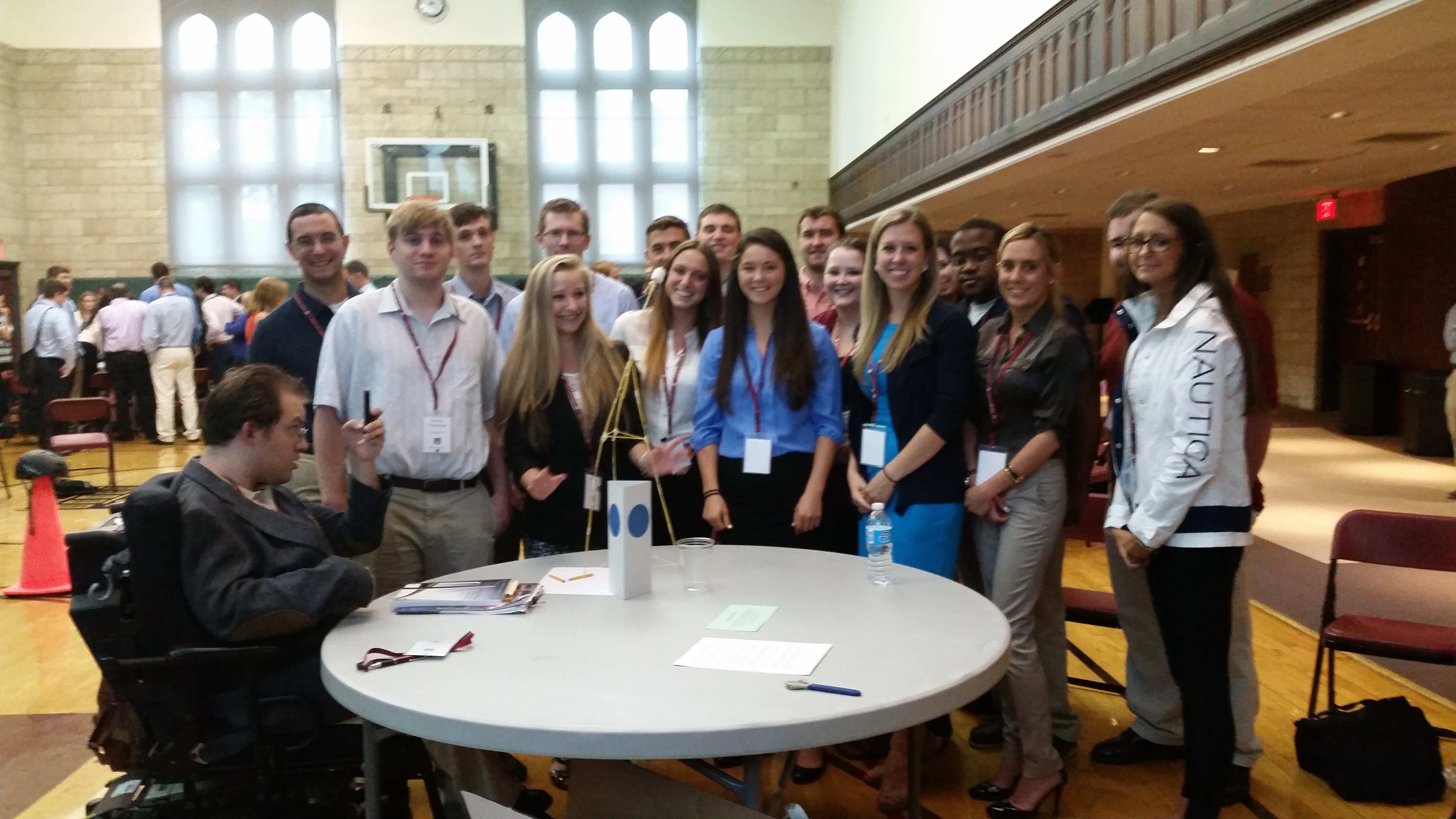
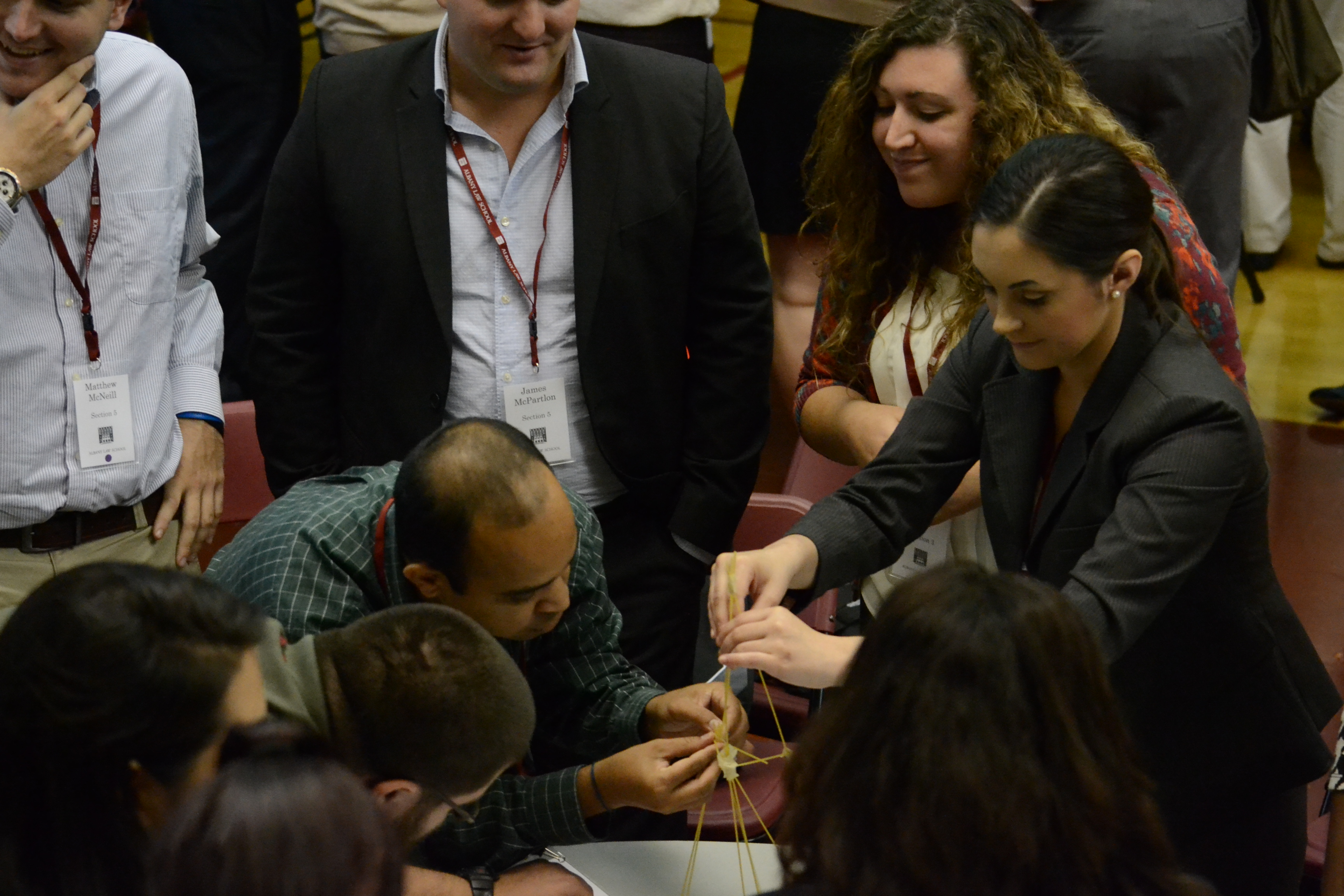
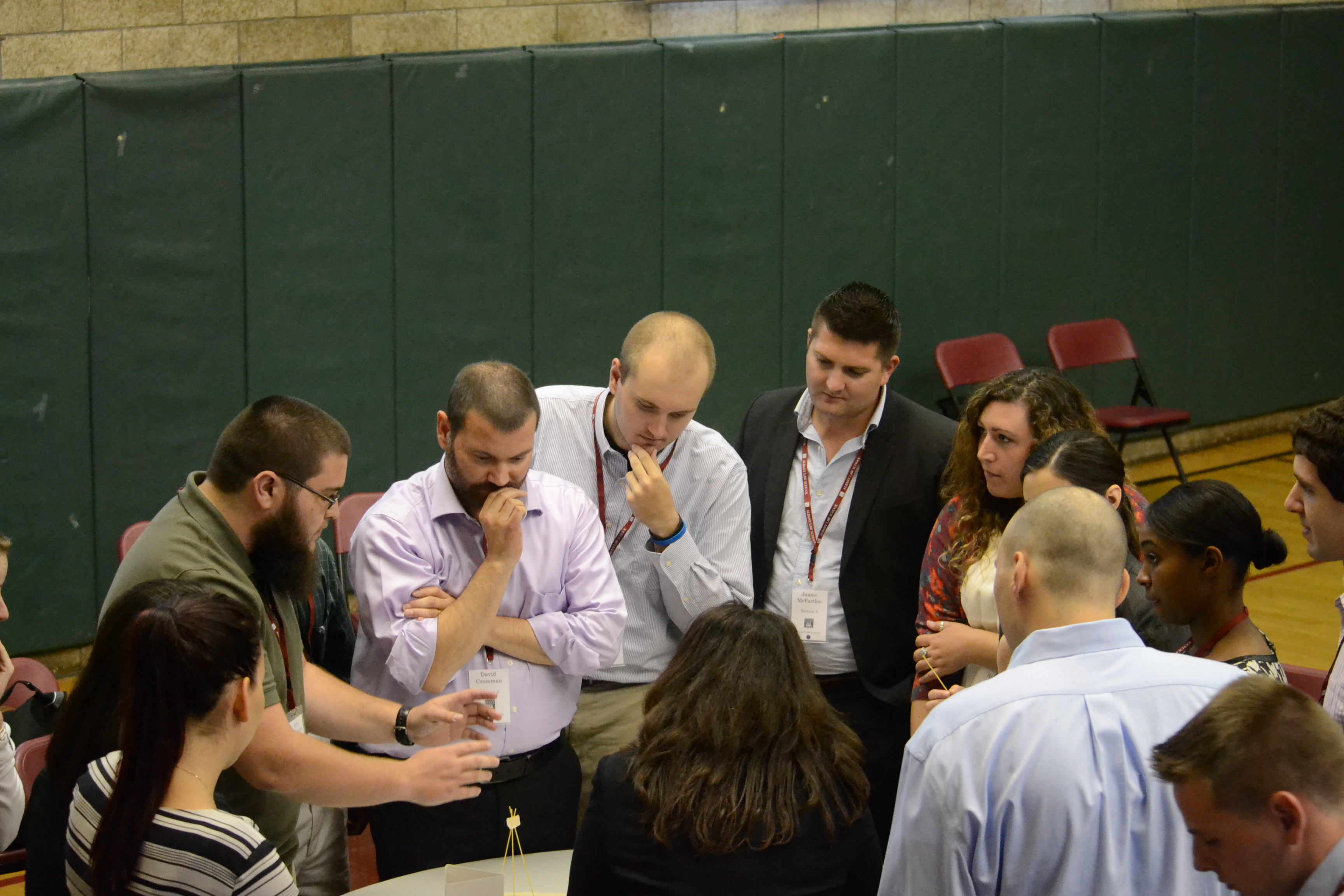
One-Ls at Albany Law, just like those at many other schools, are in the midst of Fall 2014 Orientation. Today, I participated as a  “faculty observer” in a collaborative skill building exercise organized by our Associate Dean Alicia Ouellette.  Imagine my delight to see copies of Schultz and Zedeck’s 26 lawyering effectiveness factors distributed at each table in the school gym!

Teams of 20-25 students, most of whom had either just met each other or not yet met, were tasked with:

  • Assembling a small children’s bike (to be donated to the Boys and Girls Club); the first team to both build the bike and have a team member ride the teeny-tiny bike around the orange cone course set in the gym would be declared winner. 🙂
  • Building the tallest pasta-marshmallow structure
  • Making sure every student on the team participated in the endeavor.

Faculty participants were assigned to observe what they saw happen during the group exercise, report their observations to their student team, and explore with the student teams questions such as:

  • what worked well?
  • what was challenging about  mandatory collaboration?
  • what might they have done differently to more effectively collaborate?
  • what might these exercises suggest about effective lawyering?

The students brought good humor to the task.  They brought a range of experiences, including a few with engineering backgrounds and/or “mom/dad” know-how, and a range of abilities. The fact that the bikes were to be REALLY used by local community members was a motivating factor.  In fact, students vocally expressed concern about the safety of the quickly assembled bikes noting,  “Remember, some kid is going to ride this!” and “It has to be safe.”

By the end of the assigned time period, everyone in my group had participated …. at least a bit. The debriefing was more effective than one might have predicted. One student on my team noted gender differences in approaches – a number of women were reading instructions for assembling the bike while a few of the males started to immediately put pieces of the bike together. This led to a discussion of THE CONFIDENCE GAP.  Another student noted the difference between working on a task when you know what the outcome should look like (the bike) and working on a concept without a uniform or agreed upon vision of what the outcome looks like (the highest pasta structure). Many students reflected on the significant importance of communication skills, particularly listening.

Other teams reflected on the challenge of being asked to accomplish a collective task when most members of the team felt inadequately prepared. With faculty guidance, that team explored when that might happen in law school or in practice.  Issues such as time management, resource management – one team ran out of tape – and problem solving techniques were also discussed. Students, encouraged by faculty suggestions, also pondered what kind of teams they might participate in their post-graduation future .

As I looked around the tables, I could not help but think of Richard Susskind’s book,  Tomorrows Lawyers.  These one-Ls will be entering a profession and a world in which working with others, problem solving, creative thinking, and clear communication will be even more critical for those in our profession than in times past.   As graduates, these students will be participating in teams and in collaborative enterprises that we faculty probably cannot now envision.  However, it is our job to facilitate their acquisition of the kinds of skills and capacities and attitudes that will best serve them in the uncertain but potentially exciting future.   Happy New Semester all! Happy Facilitating!

Orientation 20140813_142119


Orientation Pic 2 Orientation Pic 7 Orientation Pic 6 Orientation Pic 5 Orientation Pic 4 Orientation Pic 3 Orientation Pic 1

The Baby Has Finally Been Birthed!

Comprehensive revisions passed

The ABA House of Delegates passed the comprehensve revisions with “minimal  fuss” according to the ABA Journal linked  above.  One area, however, garnered  significant attention and also resulted in  an odd, though perhaps meaningless ,  procedural move.  The House voted  to send back to the Section on Legal Education for further consideration the comment to standard 305 which prohibits payment to students for credit-based courses.

What does this mean? Law schools which have not already done so must start identifying, articulating publicly and assessing student learning out outcomes, providing every student six  credits of clinic or clinic-like experiential courses and requiring students to take two credit hours worth of professional responsibility coursework.

Well, it’s a start……

Transferring Best Practices to a Domestic Violence Agency–i.e. the real world

On February 1, 2014 I left the ivory tower of a law school I had loved for 27 years to become the executive director of Enlace Comunitario, a non-profit agency focused on eliminating domestic violence in Latino immigrant communities through intervention services such as case management, counseling and legal services and prevention activities such as leadership development, education and outreach.   This was a big transition for me, but I am loving it!  And, my long time involvement with Best Practices for Legal Education has paid off in this context.  How, you might ask, are the skills transferable?  Well I will give some examples in my next few posts…but I will share immediately that I am working to create a teaching and learning culture at my agency.   Specifically, my goal is to build the capacity of folks in the agency so that when I step down one or several of the staff members will feel ready to take on the helm. And, of course, I will want staff members to step up to take their place. Already, we are training a counselor to become a counselor supervisor and we are training a former receptionist to become a case manager. I love seeing my staff take on the teaching role! And, they are good at it.

So…one of the foundational principles of best practices is to work to develop learning objectives for your students.  Well, it is not a stretch to work with staff members and develop learning objectives with them!  And, creating evaluations that fit the job duties and the learning objectives was fun:  Each job criteria or learning objective is evaluated as follows:  “in training”, “needs improvement” “good work” or “awesome, can teach this knowledge, skill or value”.   So far the staff has responded positively to the new evaluation process.  We will finish up this month!  I will let you know how it goes!

Five Tool Lawyers

Leading Northwest legal practitioner and technology entrepreneur Marty Smith has an interesting post on the Five Tool Lawyer over at Legal Refresh. Using the metaphor of the Five Tool Lawyer, Marty breaks apart the stages of problem solving, incorporating risk analysis in a way I found helpful. In my response Five Tool Lawyers and Legal Education, I critique aspects of the Five Tool Lawyer metaphor for compressing too much into the 1st [Use interviewing skills to gather client facts, goals and needs] and 5th tools[Counsel, document, negotiate and advocate on behalf of client]. But here’s why I thought the metaphor was compelling:

"Compelling, because [it] moves beyond issue spotting v. problem solving to articulate the stages of problem solving, targeting a spotlight on often overlooked aspects. . . . By focusing on risk, the metaphor highlights two often neglected stages of the lawyer’s work – “use judgment to assess actual risks” and “problem solve for best way to meet client’s needs with minimal risk.” At the same time, it implicitly places the legal problem in the larger context of the individual’s life, or the business’s health. And it underscores the fact that lawyers need to know how to assess the significance of legal risks within that larger context."

The definitive statement of a law professor’s REAL mission, or once again Harvard Law retires the chutzpah title

I cannot improve upon Scott Fruehwald’s presentation of this happy news in a recent email:

“Harvard is offering this course in the spring:

BECOMING A LAW PROFESSOR

“There are many elements that go into becoming a law professor, but at the core of the process of moving from law student to law professor is scholarship.  How do you choose your topic?  How do you write an article?  What will become your area of expertise?  What have others written about this subject area, and how do you break new ground?  How do you engage with fellow scholars in the midst of the writing process?

This reading group will focus on the generative scholarly process that is at the center of the life of the law professor.  [Emphasis added.]  Each week, a member of the faculty will present a working draft of her or his scholarship, and that piece will be discussed by the group.  Discussions will focus in part on the genesis of the research project being presented, in order to demonstrate how articles develop from the first spark of an idea to final publication.  Students will also explore substantive issues raised in the pieces, the better to become familiar with the latest work being done across a variety of subject areas.  Students will also develop their own research and scholarly agendas as the semester progresses.

Admission is by application via email to Susannah Barton Tobin at stobin@law.harvard.edu by November 8, 2013.  Please include a paragraph expressing your interest in the reading group and a CV and transcript.

As is the norm with reading groups, there will be no examination or paper requirement, and the class will be graded credit/fail.” (http://www.law.harvard.edu/academics/curriculum/catalog/index.html?term=Spring+2014&type=Clinic&type=Course&type=Reading+Group&type=Seminar&rows=10&year=2013-2014)

The course description says it all.

Happy New Year,  Scott Fruehwald  [If you are attending the AALS Conference, please come by the ABA Publishing table and look at my book, Think Like a Lawyer: Legal Reasoning for Law Students and Business Professionals (2013).]”

All right, I [VM] cannot resist adding one comment:  The best part of this deal is that the participating faculty actually get teaching credit for this!   Well, maybe no, teaching is probably not exactly a heavy load at HLS anyway; no, maybe the best part is that the selected students (or their parents/spouses, or the US government) are paying tuition for them to serve as extra unpaid research assistants.

Or perhaps the very best part of this course is the unabashed clarity of its focus exclusively on scholarship, without a shred of pretense, or allocation of even a single seminar to such irrelevancies  as teaching, advising, evaluating and assessing, mentoring, curriculum development, preparation for practice, or engaging (with and without students) in advocacy to improve and reform the law, our profession, or society — to mention only a few of the professorial roles one might name.   (Perhaps all these skills are innate for Harvard grads?)  This course was presumably approved by at least a bare majority of the Harvard faculty (assuming that they still bother to review course proposals) so I suppose it is an accurate  statement of that faculty’s priorities.

The truly sad part is that many of us, on Appointments Committees and as faculty members, will end up not merely voting to hire the graduates of this course, but trying everything in our power to lure them on to our faculties — including promises that as long as they churn out scholarship that is “cutting edge” (nothing as pedestrian as, say, realistic law reform proposals), no one will expect them to work as hard at learning how to teach effectively or fulfill any of the other aforementioned professorial functions.  And in the course of discussions about how to seduce these young superstars who wear the crimson “H” on to third-tier faculties (at least to start), no doubt someone will point out “Look, s/he took a course on law teaching at Harvard!  One with the evocative title of ‘Becoming A Law Professor’!  What could be a better indicator of serious commitment to teaching?”

Footnote:  Naturally, given the topic, I feel compelled to add at least one:  Of course, these remarks would be seriously misplaced if “Becoming A Professor” is one of several HLS courses or programs, some of which address the aspects of professorship that I am asserting Harvard neglects.  I can’t be sure — the hundreds of courses in the HLS catalog are just too daunting — but I did try searching the past three years for any course that included the terms “teach” “teaching” “education”  “educate” “professor” “school” and some others.  Only one item surfaced, a legal history course last spring entitled “American Legal Education,” taught by Visiting Professor Daniel Coquillette.  http://www.law.harvard.edu/academics/curriculum/catalog/index.html?type=Clinic&type=Course&type=Reading+Group&type=Seminar&rows=10&year=2012-2013  It does sound fascinating, a course that I would recommend to students and enjoy myself.  While certainly it would be of use to anyone who aspires to the law professoriate, given its scope and format it does not quite occupy a curricular niche comparable to the new scholar-centric offering.

Congratulations UNM and Editors of the proposed new Best Practices Book!

This weekend, the University of New Mexico hosted a workshop BEST PRACTICES IN LEGAL EDUCATION: The Walls Are Coming Down” in which draft chapters of a new “Best Practices” book were reviewed and discussed.  The proposal to create a second book focused on best practices in legal education is the brainchild of Professor Antoinette Sedillo Lopez, ably assisted by Professors Deborah Maranville, , Carolyn Kaas and Lisa Bliss. The symposium workshop brought together law professors from throughout the country interested in how legal education and the world of law schools has changed since the publication of the 2007 book Best Practices in Legal Education. Facilitated by Professors Beryl Blaustone and Alex Scherr, the conference explored how many law professors fluidly move from former silos of clinical, legal writing, lawyering, librarian, doctrinal, theory, or skills concentrations to pioneer a new kind of curriculum, better prepare students for the profession, explore the limits and usefulness of technology, and deepen the understanding and learning of law students through self-improving assessment processes.

Fully cognizant of the pressures on legal educators, the fact that not all in legal education welcome the need to change, and the moral imperative to address the concerns of debt-ridden unemployed law students, the authors, editors, advisory board members and readers reviewed challenges, cross-cutting themes and areas of promise. They engaged in innovative thinking about how to move legal education forward for the good of the profession, society and the students who desire to be lawyers of tomorrow. The keynote speaker for the Friday night dinner and author of the first book, Professor Roy Stuckey, directed the participants’ attention to what legal education should look like in 2027. At the same time, he reminded us that those seeking to improve legal education today stand on the shoulders of folks such as the honorable Rosalie Wahl and former ABA president Bob MacCrate who paved the way for the changes we have seen in the last 40 years. He recalled their joint mission to prepare “agents for justice in our communities.”

Every law graduate needs to understand fully that civic professional role of the lawyer. And every admittee to the bar has a sworn duty to improve our system of and access to justice. Returning to those principles can help prioritize our cost-cutting and can position us to move forward in the best interests of our students, our institutions and the society our profession is pledged to serve.

New Blog

Teaching & Learning in Higher Ed. (ISSN 2329-2504), a digital project that supports teachers and reformers in higher education through encouraging serious engagement with the scholarship on teaching and learning has recently announced its full launch.

You can visit at http://teachingandlearninginhighered.org/

The website features a manifesto, an infographic, a list of recommended readings and a blog.

Submissions to the blog are welcome on an ongoing basis.

Since its soft launch in March, visitors have viewed the site more than 4500 times. Some of the most viewed posts to date (with links shortened through goo.gl) include:

Those interested can sign up on the site to receive updates of new posts by email or follow the blog through:

Please consider visiting, reading, following, commenting, sharing, and/or submitting posts to the blog.

ABA COUNCIL ELIMINATES ANY MEANINGFUL SECURITY OF POSITION FOR FACULTY AND TURNS ITS BACK ON EXPERIENTIAL FACULTY

As reported last week here, the ABA Council on Legal Education met in San Francisco to review proposed revisions to law school accreditation standards.  The ABA reviewed four proposals sent to them by the Standards Review Committee (which I described in an earlier post here) and which were intended to address  faculty competence, academic freedom and governance rights.   The Council sent out for notice and comment two of the four proposals. Some commentators have suggested that one of the adopted proposals includes some security of position and the other does not. However, a closer look suggests that neither proposal affords any meaningful security of position.  see National Law Journal  

The alternative that mentions security of position states that:

(d) A law school shall afford all full-time faculty members a form of security of position sufficient to ensure academic freedom and attraction and retention of a competent full-time faculty (emphasis added).”

At first glance, I optimistically thought “Maybe ensuring a competent full-time faculty would require something beyond at-will employment?” However,  I was reminded by a professional colleague that this proposal is identical to the current provision for legal writing professors, which has been interpreted to permit at-will contracts as long as the teachers are “competent,”  Undeterred in my optimism, I thought “Well ensuring academic freedom certainly needs to ensure some job security especially for folks like clinicians who have been attacked repeatedly for representing the powerless against the moneyed members of our society, right?”  However,  the ABA interprets that same language  in the clinical context to permit one-year renewable contracts,  as long as the institution has a “policy” on academic freedom,

As Amy Poehler would say “Really!1?!  Really!?!”    Is that really the kind of job security that will fill you with confidence in advocating  on behalf of seemingly powerless clinic clients or articulating unpopular but important legal positions?   And what about all this talk from the ABA and the profession about how students need to be better prepared for practice and the profession.   “Really!1?!  Really!?!”  How is that going to happen when you de-value those in the academy who teach through supervised practice ?   CLEA President Kate Kruse got it spot on when she wrote on the clinic listserv,

“Because tenure is now and is likely to remain the norm only for doctrine professors, both of these provisions protect current faculty power relationships and threaten the presence in legal education of teachers specializing in experiential education.’

That is not good news for legal education, law students or future clients.  REALLY.

Revived CELT Website: Welcome to the Future!

Esteemed Bloggers and Blog Post Readers,

Albany Law School has redesigned the Center for Excellence in Law Teaching ( CELT) Website just in time to present you with videotaped presentations and materials from CELT’s Inaugural conference held last March 30, 2012  . If you are unfamiliar with the CELT website , I would like to introduce you to this clearinghouse of materials on teaching, , curriculum, and proposed revised  BA accreditation standards. If you  already are familiar with the website, I invite you to take some time to  re-acquaint yourself with the new organization and the wealth of information that is available for your perusal. (CELT)

Through this site, I hope you will be able to find learning resources, assessment materials and rubrics , syllabi from lawyering classes, PowerPoint presentations about different teaching techniques and links to other sources and resources.   In addition, you can access materials and presentations from the  CELT  March 2012 Conference, where innovative  thinkers attended and discussed current and proposed models for student-centered reform of legal education. (CELT CONFERENCE) This was in response to the changes students face in the profession and the new economy.  As a third year law student, I found this conference not only enlightening but reassuring. The materials that were provided to the attendees laid out ideas and suggestions to improve student  learning  and encouraged professors to take a more active role in design of the classroom experience and sequencing of the law school curriculum. .

As Special Assistant to CELT, I have attempted to organize materials on this website to make it simpler and more convenient for users to navigate.   I truly welcome your feedback. If there is something that you are looking for and cannot find, I ask that you let me know  and would be happy to direct you to the correct location of the information or figure out if there is additional material to be added to the cite.  In addition, if you have any questions about accessing the conference videotapes or materials, just send me an e-mail.

Finally, if you are interested in becoming a BLOG author or contributing a blog post to the Best Practices blog (which is housed within CELT), please let Professor Mary Lynch or myself know and we would be happy to assist!

Thank you for your readership and your loyalty!

-Stephanie Giancristofaro-Partyka