



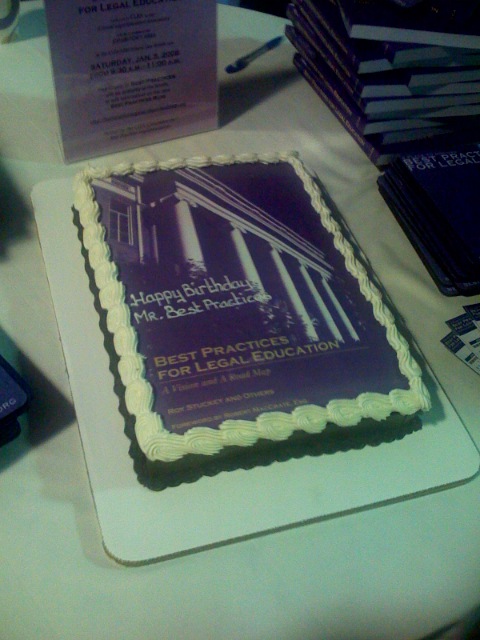
Happy Birthday Professor Roy Stuckey! Roy’s birthday was celebrated at the AALS Annual Conference.
Filed under: Uncategorized | 1 Comment »






Happy Birthday Professor Roy Stuckey! Roy’s birthday was celebrated at the AALS Annual Conference.
Filed under: Uncategorized | 1 Comment »
At this afternoon’s AALS plenary session on “Rethinking Legal Education For the 21st Century”, wonderful discussion occurred on legal education reform in a packed room of avid listeners. Two of the Carnegie Foundation Report’s authors, Judith Wegner and Bill Sullivan, discussed the findings of the report. Professor Martha Minow described curricular reform and process at Harvard. New Mexico Dean Sue-Ellen Scarnechia discussed the need for experiential and non-experiential teachers to build respect and collaboration capital and to break down biased perceptions of each other. Panelist Vicki Jackson of Georgetown reported on Georgetown’s first year course “FIRST WEEK. ” (Scheduled for the first week of the second semester, FIRST WEEK offers a brief and intensive integrated simulated experience in which students work with problem based materials in a global lawyering context based on legal concepts such as contracts or torts which were taught in the previous semester). Continue reading
Filed under: Best Practices & Curriculum | 1 Comment »
Many of the current posts on this Blog support the implementation of Best Practices recommendations as well as the recommendations made by the Carnegie Foundation in Educating Lawyers. Do not be dissuaded, however, from posting your concerns and critiques. Let us know if you disagree with the recommendations.
Nor should you hesitate to point out the obstacles or challenges to implementing Best Practices. Let us know what you think!
For example, a faculty member at my school during a curriculum committee meeting questioned the statement that current law graduates are not adequately prepared for practice. How would you respond?
Will implementing Best Practices result in a “checklist” approach to legal education instead of encouraging rich and varying experiences?
Currently, legal education has not created nuanced outcome measures for our teaching. Without such tools, how can we even begin to discuss implementing Best Practices?
What are other concerns you have? Please post a reply (below).
Mary Lynch, Albany Law School
Filed under: Catalysts For Change, Who is Using the Best Practices Book? | Comments Off on Concerns, Critiques and Challenges Welcome!
It ‘s a new year for Blogging and here we are in the Exhibit Hall at the AALS Conference. Come visit us on the 1st floor, make a left and go all the way to the end and you’ll find us against the wall! Interestingly, we are right next to Harvard University Press!
Conference attendees: please provide us with suggested blog topics. Let us know what to add to the Best Practices Blog resources. How can we improve on the Blog format? To provide input and ideas, please reply to this post (below). Thanks for participating in this collaborative, progressive endeavor!
Mary A. Lynch,Albany Law School
Blog Editor, Best Practices Implementation Committee
Filed under: Uncategorized | Comments Off on Input & Ideas from Jan 08 AALS Conference
I got this e-mail from from Victoria Pynchon:
“I know everyone is busy with shopping, family and wrapping up year-end. I’ve nevertheless taken the liberty of tagging each of you with the “Lawyer’s Appreciate” meme tag started by Stephanie West Allen of Idealawg and Julie Fleming Brown of Life at the Bar. Continue reading
Filed under: Who is Using the Best Practices Book? | Tagged: lawyers appreciate | 1 Comment »
If law schools are to assess outcomes, an early step is to answer the question, “What outcomes?” The prospect of articulating outcomes for a law school may seem overwhelming for many deans and faculty members. But existing resources give law schools a well developed starting point. In the 1990s, the MacCrate Report set out a list of professional skills and values. In Outcomes Assessment for Law Schools (Institute for Law School Teaching, 2000), Greg Munro gave detailed examples of outcomes appropriate for law schools and for Continue reading
Filed under: Best Practices, Outcomes & Assessment Techniques | Comments Off on Articulating Outcomes – Help for Law Schools
As I grade this semester’s torts exams I am again struck by how critical it is to give students practice in applying concepts. I am noticing that all students are more effective writing about an issue when they have had two or three chances to practice writing about it before the final exam. This semester students had an ungraded writing assignment which asked them to analyze 2 elements of a negligence claim – duty and breach of duty. Then they wrote a practice midterm and a midterm which asked them to analyze duty and Continue reading
Filed under: Best Practices, Outcomes & Assessment Techniques | 1 Comment »
The Carnegie Foundation for the Advancement of Teaching and Stanford Law School have recently joined together to sponsor “The Legal Education Study Project” as a follow-up to the Carnegie Report, Educating Lawyers. The Study Project has started with ten law schools that have made curriculum change a major focus in recent years, and the Study Project’s goals are to promote curriculum changes in law schools. A major focus is for law schools to do a better of job of addressing issues of professional identity lawyering skills, and to Continue reading
Filed under: Best Practices & Curriculum, Catalysts For Change, Teaching Methodology, Who is Using the Best Practices Book? | Comments Off on Carnegie Foundation and Law Schools Join to Promote “Legal Education Project”
When Best Practices for Legal Education was published in March, 2007, a box of 32 copies was shipped directly from the printing company to most law schools.
Subsequently, the following law schools requested enough copies for their entire faculties to have a copy: Continue reading
Filed under: Who is Using the Best Practices Book? | Comments Off on Who Has Been Using Best Practices?
On December 7th, Bill Henderson made the following comments on the Empirical Legal Studies blog site, http://elsblog.org, “[The Carnegie report] contains some great ideas, but as a group, law professors are not listening. More troubling, the book has no strategy for getting their attention.” Continue reading
Filed under: Catalysts For Change | 2 Comments »
The ABA Section of Legal Education and Admissions to the Bar has created a Special Committee on Outcome Measures. The charge to the Committee is:
“This Committee will determine whether and how we can use output measures, rather than bar passage and job placement, in the accreditation process.” Continue reading
Filed under: Best Practices, Outcomes & Assessment Techniques | Comments Off on ABA Seeks Input on Outcomes
In the spirit of Best Practices for Legal Education, a coalition of 10 law schools, including Harvard, Stanford, and Vanderbilt have agreed to work together to improve legal education. For more information on this project click here .
Filed under: Best Practices & Curriculum, Catalysts For Change | Comments Off on Law Schools Unite to Change Curriculum


 | Jim Wheaton on The Economic Value of Law Clin… |
| Could a purpose defi… on Implementation of the ABA’s Ne… | |
 | Kaci Bishop on Teaching Students the Art of G… |
 | Anne Gordon (Duke La… on Teaching Students the Art of G… |
| Defining lawyer comp… on Racial Inequity on the Bar… |
 Best Practices for Legal Education