
Reflections on New ABA Taskforce and Visit to WIlliam Mitchell

On July 31, 2012, outgoing ABA President Bill Robinson, in response to scrutiny by the media and concern expressed from inside and outside the profession, announced the formation of an 18 member taskforce to study the future of legal education.  http://www.abanow.org/2012/07/aba-president-names-task-force-on-the-future-of-legal-education/ Then, last week, many state and national journals reported on the proposed work of the taskforce and its two year charge while the Chair of the taskforce, Randall T. Shepard, former chief justice of the Indiana Supreme Court and current executive in residence at Indiana University’s Public Policy Institute, conversed with a Wall Street Journal (WSJ)  reporter on the  Journal’s law blog http://blogs.wsj.com/law/2012/08/10/law-blog-fireside-chairman-of-aba-task-force-on-legal-education .

Reading that blog interview, I was heartened to read comments by Chair Shepard which put the “business model” attacks which have dominated the public discourse for the past year or so in a broader context.  This broader context, I think, is more likely to result in lasting and less reactionary change.  For example, he emphasized that legal education reform efforts did not originate with the recent economic crisis and that ongoing change has occurred within law schools over the last 15 years.  At the same time, he forewarned that many within law schools believe there are “interesting opportunities for further change.” He also notes that

“the most dramatic change in the American legal education in the last 15 years has been expanding the opportunities students have for real life experiences in clinics and internships. Everyone I know thinks that’s a good thing and it has made a difference.”

I was also impressed by his thoughtful response to suggestions that the way to better prepare law students for practice is for most law schools to train their students on regional matters and local or state laws.   Shepard made clear that the current and future practice of law is not as parochial as such proposed solutions suggest.

According to Shepard, his taskforce will issue a report and recommendations to the ABA at the end of the two years. A few questions and reflections about the work of this taskforce spring to mind:

1) Do we need a new taskforce? Do we need a new report?

2) How will this taskforce coordinate with the ongoing work of the Standards Review Committee? Is its creation an admission that the work of that committee has failed? Or is it a suggestion that a different or supplemental approach is needed?

Reading this piece also reminded me that there are schools out there that have tackled the idea of better preparing students in a systematic manner.    We should recognize the hard work done by many unheralded schools to focus on students’ learning outcomes and their professional development. I would like to see more media and public focus on those schools, that hard work, and those results.

For example, this past April, I had the pleasure of presenting at a faculty workshop at William Mitchell College of Law coinciding with the publication of its Law Review’s edition of “Contemporary Issues in Outcomes- Based Legal Education.” (http://www.wmitchell.edu/lawreview/Volume38/)  My written contribution to the symposium edition, “An Evaluation of Ten Concerns About Using Outcomes in Legal Education” formed the basis of the workshop.    However, William Mitchell faculty are so immersed in outcomes evaluation and so savvy about good teaching techniques that the “presentation” turned into a collaborative discussion.   As a faculty and through a number of committees,  William Mitchell has focused on professional writing outcomes by  mapping the curriculum and developing a first year Proficiency test.   Last year, the law school ran a Pilot Program in one of their first year sections intended to , among other goals,  1) define outcomes for each first year course and the first year curriculum as a whole, 2) introduce students to a range of critical doctrinal foundations, 3) integrate skills, doctrine and professionalism in each first year course, and 4) coordinate a series of first year lawyering/legal writing assignments with the doctrinal courses.   At the time I visited, a report on the program was available.  Student feedback was positive and the committee with oversight for the program recommended its continuation and eventual expansion to the entire first year class.  In another example, William Mitchell faculty identified a list of skills and professional attributes recommended for professional practice and provided information for students on how competency is developed over time from introductory to intermediate to advanced development.

I know that the kind of progress I describe in this post is not the kind of dramatic assertion that will garner headlines or create an outpouring of blog comments beyond our circle of interested educators who want to do better and who “labor in the vineyard.” However, despite the lack of national headlines, I really believe that the thoughtful, painstaking, creative and labor intensive work with which William Mitchell faculty are engaged is where the real story lies. Can we ensure that those who pay for and attend law school are given value, learn professional development skills and gain an understanding of what they already can do well versus what they still need to learn? In other words, in the words of Carnegie, are we truly and effectively Educating Lawyers?

Best Practices in Teaching Legal Research (The Boulder Conference)

The American Association of Law Librarians is meeting this weekend in Boston Massachusetts and best practices in teaching legal research is a hot topic.

In the two days preceding the AALL meeting, an ad hoc working group of librarians (which I was privileged to join as an emissary) met at Harvard Law School for the Fourth Conference on Legal Information: Scholarship and Teaching (known as “The Boulder Conference”). The first Boulder Conference was held to respond to the Carnegie and Best Practices reports, neither of which addressed information literacy and legal research education with much depth at all. The group produced the Boulder Statement on Legal Research Education and the Signature Pedagogy Statement (which you can find at http://www.utexas.edu/law/faculty/pubs/bb26663_pub.pdf). In subsequent conferences, the group has gone on to encourage significant scholarship on the pedagogy of legal research education and will be producing a book on the subject, which will include a template for creating legal research classes based on the signature pedagogy. For more information, contact Susan Nevelow Mart at susan.mart@colorado.edu or talk to your local law librarian!

Legal Education, ADR, and Practical Problem-Solving (LEAPS) Project

For those of you who are familiar with this blog, you may notice a new link for the “Legal Education, ADR, and Practical Problem-Solving (LEAPS) Project.”

A brief description of LEAPS from Jim Hilbert at William Mitchell College of Law follows:

LEAPS is a project of the ABA Section of Dispute Resolution’s Law Schools Committee. We have recently launched the website and initiated what we call a “community organizing” effort to encourage faculty to talk with colleagues at their law schools, as described on the “engaging colleagues” page of our website. This project is devoted to increasing instruction in practical problem solving in legal education by integrating it into the curriculum in various ways.

If you have a chance, take a quick look and let the readers know what you think!

Existential Crisis and Bar Exams: what is really cruelest?

Perhaps it is because this blog has been discussing the need to change since 2009, so many of our contributors have been working to reform and improve legal education for decades and the Carnegie Report and Stuckey’s BEST PRACTICES FOR LEGAL EDUCATION both celebrated 5th birthdays earlier this year.   Maybe it is because our faculty and administration spent Friday evening gathering with our graduates at a Dean’s reception to provide support and succor to our July Bar Exam takers.   Whatever the reason, I can feel myself becoming very frustrated with the constant barrage of  johnny-come-lately and unproductive descriptions of the legal education crisis.

Being a strong  and longstanding advocate for reform of legal education, shouldn’t I be feeling  triumphant, or at the very least,  justified that what we warned about came to pass, that people are finally paying attention?  Instead what I feel is extremely protective of my current students, recent graduates and other poor souls who read each new assaultive journalistic “contribution” with fear, depression and hopelessness.  This morning , when many of us opened our NYT Sunday Review – in textured paper form or in handy  online edition – we were faced with Sunday Observer Lincoln Caplan’s piece “An Existential Crisis for Law Schools”  and his opening line “July is the cruelest month for recent law school graduates.”  

http://www.nytimes.com/2012/07/15/opinion/sunday/an-existential-crisis-for-law-schools.html?_r=1&ref=opinion Caplan notes that state bar exams scheduled next week are “make or break” affairs.   He then goes on for the next ten paragraphs repeating the oft-told story about how the economics of  legal education has changed for the worse and quoting Dean Frank Wu of Hastings Law:  “This is Detroit in the 1970’s : change or die.”

I think what is really cruel is publishing this piece right before anxious law graduates need to summon up all their positive energy to take an exam which in NY has 22 subjects and for which one must take an expensive bar course to learn the “gaming” of how to pass this test.   I think it is cruel to blithely assert that law schools fail to “train lawyers for public service or provide them with sufficient preparation for practical work” in that same article when this is the time to ask why doesn’t the bar exam have a clinical component or why don’t we have a public service or practical alternative to a largely multiple choice test?  If we really want to train civic professionals who deal with real people would we not make the examination of who becomes a lawyer more like the practice of law?  I am more interested in hearing about the practical opportunity this “crisis” gives us to change the outdated practice of written bar exams.  Maybe then, July would become a time of challenge – to demonstrate recent law graduates skills, values and knowledge -rather than cruel ritual.

Simplistic Media Reports

The website Law.com recently published an article entitled “ABA: Law schools getting the message on practical skills” The gist of the article is summarized in its opening sentence: “The dismal job market for newly minted lawyers has influenced how most law school administrators approach their course offerings, with 76 percent of the institutions surveyed by the American Bar Association reporting that they’ve modified their curricula to adapt.”

I will be interested in seeing the whole study. I’m not so sure of the causal link the article suggests, and certainly the Executive Summary of the ABA report makes no such connection. Most significantly, coming to the conclusion that the job market is the motivating factor in curricular reform based on a comparison between 1992-2002 and 2002-2012 seems tenuous. Comparing curriculum over 20 some years and concluding that the 2008 job market collapse is the cause of change seems a bit tenuous.

Skills training has been evolving in legal education since before 2008. While, as the article correctly points out, the Carnegie Report and Best Practices for Legal Education have influenced law schools since they were published in 2007, the McCrate Report (and the Crampton Report before it) arguably spurred greater and, at least at this point, more fundamental change. Indeed, the changes in legal writing cited in the article, including the proliferation of Lawyering Skills courses rather than legal research and writing courses, began in the 90’s. One thing that has made me proud of legal education over the decades is the increasing emphasis on skills – proud, because it has been done despite the fact that the reward structure to which law schools respond (e.g., U.S. News, large firm hiring, judicial clerkships) gives little reward to schools who do skills training well or students who take skills courses.

The article completely ignores what I think has been the biggest curricular reform in the past 20 years—the creation of academic support programs. My gut tells me that in the past 10 years law schools have invested at least as many, if not more, resources into programs to increase bar passage than teach skills.

My real concern with the article, however, and why I want to read the report, is that the article’s conclusion implies the conclusions are those of the ABA. In reality, the conclusions foster what I believe is the simplistic view expressed in the press and the biggest impediment to true reform of legal education in the area of skills training—the belief that reform is solely a law school problem. There is wide spread belief that if law schools just did the right thing, we would produce practice ready lawyers.

The fact is, skills education is a profession wide issue. I have already mentioned the fact that (despite criticism of legal education) the reward structure does not value skills training. You want to change legal education? Get federal court judges and hiring partners at large law firms to say they will not hire anyone who does not have 15 credit hours of clinic.

But the issue runs deeper. It requires all parts of the profession to look at what it does to inhibit the training of practice ready lawyers. Just take one example; bar admission. One of the biggest impediments to developing a program that truly prepares someone to practice law is the bar exam itself. When students need to take upwards of 22 subjects in some states to prepare for the bar exam, it leaves little time in the curriculum for innovative skills training. And, when a state (such as New York) decides to add a pro bono requirement for initial admission to the bar, rather than say reducing the number of subjects tested on the exam and requiring a truly meaningful clinical experience, it does not help matters

Scholarship, Teaching, & Service: An Academic Triangle

This next blog posting comes from Professor Nancy Cook:

The ABA’s Standards Review Committee is considering significant changes to the standards governing legal education relating to security of position. Tenure, even for those long protected in the legal academy, is on the line. CLEA and ALWD are on record as being in opposition to the abolition of tenure (or tenure equivalency) for not only the long-protected, but for all full-time teaching faculty. This is, in the eyes of many liberals, a question of fairness and equality.

Not all self-described lefties are quite so sure. Natural would-be allies hesitate about a system of job security that would open the doors to certain full-time faculty primarily on the basis of one factor: scholarship. Concerns center primarily around questions of the nature of the university. If, as many (if not most) people believe, the university is essentially a place where knowledge is developed and disseminated, then, the argument goes, employment protection (and certainly faculty governance) should be reserved for those who actually engage in the development and dissemination of knowledge. The means by which knowledge is developed and disseminated is scholarship, published in respected journals. A corollary to this argument is that tenure protects academic freedom by ensuring that those who publish unpopular views (historically, where truth lies) are not put at risk of losing their employment for expressing those views

I share with the many the belief that the university is a place where knowledge is to be grown, preserved, and shared, and that the development of knowledge should be nurtured and protected. But I take issue with the idea that knowledge is only evidenced by and disseminated via a particular brand of scholarship (see blog posting of October 10, 2010). It also seems ridiculous to assert that academic freedom only applies in controversies over what someone has written. Certainly, faculty who put themselves on the line by representing unpopular clients or pursuing truth through unconventional pedagogies are equally worthy of a shield against disgruntled employers, board members, and local citizens.

There is still more to this debate though. The university’s role as both guardian and generator of knowledge, concededly its primary function, is not accomplished only through the research and scholarship of its academic faculty. It is also accomplished through education and service. Typically, in law schools, these three functions – scholarship, teaching, and service – make up a triangle by which the university’s aims are meant to be achieved. Reliance on scholarship – and more particularly, on publication — as the top-heavy angle of the triangle has skewed this conversation about security of position. The privileging of scholarship is the elephant in the room whenever discussions about tenure, faculty governance, and appointments processes take place.

The role of teacher, vis a vis student, is to draw out knowledge. That is the etymological root of the word “education,” and it is at the heart of what we have come to call the “Socratic method.” However successful we may be in this role as teachers of students, we seem to lose sight of its value in our dealings with each other. We tend not to act as educators – drawing out knowledge and truth – in our peer group. It seems to me we have it backwards; we are using publication as the keystone, when we should be using education

The reliance on publication as evidence that knowledge is being created and disseminated needs re-examination. Clearly, this focus denigrates the other points of the triangle, teaching and service. As with our tripartite democratic government, the university academic triad is meant to provide balance that benefits the whole enterprise. The spirit of the university triangle is one of integration. Each part of the triangle supports the other two parts. It is true, as many have noted, that scholarship makes us better teachers; but it is also true that service makes us better scholars, that teaching improves our performance as public citizens, and so on. Too great an emphasis on any one part of the triangle carries risk.  With the over-weighting of scholarship, the risk is that our publications will be overly formulaic, exclusive, risk averse, and dishonest, thereby taking us away from our central mission of discovering knowledge and pursuing truth.

More significantly, in my view, this overemphasis on scholarship is not true to the spirit of education. Again I return to the idea that the method by which universities operate in pursuing truth and gaining knowledge is that of drawing out.  Certainly scholarship succeeds best when it does more than inform — when it, rather, draws a response from readers and provides the path by which readers possess their own understanding of ideas and principles and come to own knowledge for themselves. Teaching and service are also part of the educational process. Our colleagues, like our students, have been chosen for their commitment to learning and for their ability to contribute to the knowledge enterprise. Whatever policies we put in place to maximize the potential for sustaining this enterprise needs to honor the ability and commitment of each, and should provide the space and opportunity each needs to succeed.

Upcoming ABA Standards Review Committee (SRC) Meeting

The next meeting of the Standards Review Committee  will be on Friday, July 13, 2012 and Saturday, July 14, 2012 in Chicago at the American Bar Association.   The Schedule for the Committee Meeting indicates that the following topics will be discussed and reviewed for consideration:

  • Chapter 2 (Except 206 (c) & 211-213): Organization and Administration-Second Consideration
  • Chapter 3: Program and Legal Education-Second Consideration
    Proposed Standard 303 (Current 301-6): Regarding Bar Passage Rates
  • Chapter 5: Admissions and Student Services-Second Consideration
  • Chapter 6 (Except 603 (d)): Library and Information Resources-Second Consideration
  • Chapter 7: Facilities-Second Consideration

The meetings will begin at 8:30 a.m. on Friday and end at 12 p.m. on Saturday.

A tentative schedule for the July meeting, as well as upcoming meetings can be found here.


The address of the American Bar Association in Chicago is:

American Bar Association
321 North Clark Street, 21st floor
Chicago, IL 60654-7598

If you need accommodations, please contact the Amalfi Chicago located at 20 W. Kinzie, Chicago, IL 60654. The rates for a single/double are $189, plus tax (15.4%).

A 3L’s Perspective on Technology and the Future of the Legal Profession

It is no surprise that with growing advances in technology the context of the legal profession has begun to change and evolve. For a student entering her third year of law school, I find this trend both intimidating and exciting. Not a day goes by without me digging through my purse every five minutes for my Iphone or frantically pulling up a school email on an Ipad. Students today, including myself, are attached to this technology, and because of this reliance, the future of the legal profession is drastically changing. In Jon Garon’s article, Legal Education in Disruption: The Headwinds and Tailwinds of Technology, he addresses these changes and technological attachment and how they will forever affect the practice of law. Lawyers today, Garon explains, rely heavily on technology: submitting court documents digitally, responding to client emails from their iPhones, and locating clients on social media networks. Just yesterday, a close friend was recounting her day in a city court where an attorney conducted his entire caseload from his Ipad. In addition to that, not only can the state penal code, criminal procedure law, and vehicle and traffic law be found via an App from Itunes ($5.99 each), but entire case files can now be converted to be available on a tablet and subsequently, emailed to the court clerk.  It seems that this will lead to a balancing act where the technically savvy lawyer will prosper by harnessing this technology and mirroring that with the ability to provide adequate services to their clients. While I somehow find this “balance” calming, I can understand why those practicing law for several years can see this change looming on the horizon with both anxiety and nervousness.

Garon also explains that in today’s world there are plenty of “self help” remedies that can be found online, giving consumers legal products which require no actual contact with a lawyer. Out of curiosity, I googled “legal documents” and over 34 million results popped up, with the first page consisting of free downloadable forms (with suggestions for leases, promissory notes, and living wills). Garon states that the legal education must respond to the changing times, and must follow closely with the development of technology. It is particularly scary to a third year law student that the skills I am being taught in class and in my internships can simply be replaced by typing into a search engine. Professors and faculty must find a way to teach both the traits that can be found in successful lawyers, while balancing with business practices and technological advances in “forward looking practices.” The classes that seem to prepare law students the best are the ones that see these challenges and obstacles that face students, like myself, and grasp at the chance to show us how we can navigate through these changing times.

Garon ends his article with the question, ‘If not now, when?” While I understand that this question is directed towards faculty and staff at law schools, it is my belief that law students need to answer this question as well, for one day (very soon) we will also be practicing attorneys. Through embracing these constant changes in technology and combating these changes with teaching “intentionally rather than inductively,” law schools will be able to provide the best legal education possible and begin to transform the profession into a modern and technologically sound resource.

Here is the abstract:

“By harnessing improvements on communications and computational systems, law firms are producing a revolution in the practice of law. Self-help legal manuals have transformed into sophisticated interactive software; predictive coding can empower clients to receive sophisticated legal advice from a machine; socially mediated portals select among potential lawyers and assess the quality of the advice given; and virtual law firms threaten to distintermediate the grand edifices of twentieth century Big Law. These changes may profoundly restructure the legal practice, undermining the business model for many solo and small firm practices.

This paper focuses on the implications of these profound disruptive changes. It looks at the expectations the market may place on future lawyers and by extension the training necessary for lawyers entering the practice of law. The final section reflects a suggested curriculum and programmatic redesign, highlighting one possible future legal educational model, complete with acquiescence to existing constraints found in American Bar Association and other accreditation regimes.”

A working draft of the article can be found here.

Choosing Between Longterm Comprehensive Overhaul and Immediate but Small Steps?

A primary challenge in implementing legal education reform is asking institutions and their stakeholders to trust and have patience. Real reform, as described in Educating Lawyers and in Best Practices for Legal Education requires, in my humble opinion, prioritizing the long-lasting rewards that come with inclusive process, comprehensive analysis, thoughtful deliberation and time-intensive collaboration. I see these as the necessary ingredients for real reform. It also involves dealing with what Judith Wegner calls legal education’s “Wicked Problem.” (see previous blog post here)

However, sustaining the energy and commitment to create real reform, or even believing that such energy and commitment can be sustained, seems an impossible hurdle in some settings.

Professor and Dean Michael Cassidy offers in the September 2012 edition of the Boston College Law Review “an interim approach,”:

My goal in this essay is to offer a “self-help” remedy for faculty members and administrators interested in responding to the Carnegie Report’s call for greater emphasis on experiential education, but uninterested in waiting for the committee deliberations, reports, faculty votes, and tough resource trade-offs that lie ahead. We drag our heels at our own perils, and to the serious disadvantage of our current students. What follows is a description of nine changes that individual faculty members and deans can make now to improve the professional education of law students. While each initiative when viewed in isolation may seem modest, collectively they could have a huge impact on our programs.

The steps outlined in the article which can be found on SSRN here include exposure to foreign law, additional career path courses, as well as law practice management courses, and holding professional formation retreats for students, faculty and alums to discuss the values of the legal profession. These “retreats” would allow students to explore what it means to morally and ethically be a lawyer. Cassidy explains that the first five recommendations, which are pedagogical in nature, require changes by the individual faculty member, and can be found in some of the best law classrooms and employed by the best law professors in the field. The remaining recommendations require work from both students and Academic Deans to improve and expand on current practices in law schools. He concedes that his most “controversial” step is the ninth: that when looking to hire new professors, special attention should be paid to the amount of practical experience these new hires have in the field.

Creating Conditions of “Cognitive Disfluency”

A recent article in The Chronicle of Higher Education discusses research that shows our efforts to make it easier for students to process course materials may be less effective in promoting learning. This article is worth a read and connects research about learning with some of the teaching methods many of us already use. I could see using some of this information to explain to students why course materials are NOT being made as though to spoon feed them what they need to know. (The first study referenced in the article seems to equate learning with memorization, but law students also must spend significant effort memorizing, whether to excel on traditional exams or, ultimately, to pass the bar.) Also, those of us who struggle with less-than-perfect classroom slide presentations may take some comfort – wacky fonts may be a better tool than we thought!

I DON’T AGREE WITH TODAY’S NYT OP-ED: “How to Make Law Schools Affordable?”

Well, at least not fully! In today’s New York Times Op-Ed page,  Professor  Brian Z. Tamanaha asserts that “[t]wo factors have combined to produce” the student debt situation: “the federal loan system and the American Bar Association-imposed accreditation standards for law schools.” He then goes on to make reform suggestions. You can read the Op-Ed piece here

Although this two-prong format works to make a punchy Op-Ed, I worry that its reductive nature will lead us astray. This assertion does not consider external influences such as US NEWS, the global recession and higher service expectations by consumers. I do agree with Professor Tamanaha, however, that both the federal loan system and the ABA standards need to be “reformed.” (And, as I am not an expert on loan reform, I hope others add comments to this post!) As to ABA standards reform, the Op-Ed is almost misleading by failing to acknowledge that since 2007 and 2008 many, many people have worked on reforming the ABA accreditation standards.

The most powerful, disturbing and accurate part of the Op-Ed is the conclusion:

“If we don’t change the economics of legal education, not only will law schools continue to graduate streams of economic casualties each year, but we will also be erecting an enormous barrier to access to the legal profession: the next generation of American lawyers will consist of the offspring of wealthy families who have the freedom to pursue a variety of legal careers, while everyone else is forced to try to get a corporate law job — and those who fail will struggle under the burden of huge law school debt for decades.”

With that, I fully agree and applaud Professor Tamanaha for reminding us of what’s at stake if we don’t ACT NOW!

DO I HAVE QUESTIONS FOR YOU!

For this entry, I’ve got just questions for you, hoping they prompt a conversation among us about one, several, or ALL of them. The questions concern your experiences incorporating the principles of Best Practices in your non-clinical classes.

At the beginning of the course, did you explain to your students what you were going to do and why?  If so, what did you say?  Did you also offer a written explanation?  Does your experience indicate that your explanations were effective?

Have you noticed differences in your students’ ease in learning the curriculum?  If so, can you attribute it to these methods?  Can you tell us about it?

Are there certain types of class activities preferred by students more than others?  What are they?

What about your students’ responses to these changes in the classroom – have they been receptive (or not)?  In any event, how have you learned of their reactions?  Verbally? In writing?

Have you formulated a specific evaluation form to gather feedback?  If so, could you share it?

Have you’ve used these methods in multiple law schools, so that you’re able to compare responses when you’ve been relatively singular in doing it, compared with when you’ve been one among many?  Can you tell us about these experiences?

Let’s hear from you out there!

[For those interested in reading more about the process of transforming the law school classroom, take a look at Introduction:  Teaching in a Transformative Age:  The Law School of the Future (Seattle Journal for Social Justice, Vol. 10, p. 1, 2011), an introduction to the papers published from the 2010 Conference of the Society of American Law Teachers, Teaching in a Transformative Age:  The Law School of the Future.]

The Mirror Excercise

The Spring 2012 issue of the Law Teachercame out and features an article from Professor Laurie Shanks, Albany Law School.  The article is “The Mirror Mirror Exercise: A Quick and Easy Method to Begin Discussing Race, Gender, Ethnicity, Age and Other Differences with Your Students” (page 25).

The article is also available on SSRN here.

Here is the abstract:

Becoming a competent attorney is a journey that requires law students to face numerous challenges. For a legal skills professor, a major step in the process is helping students become conscious of who they are and how others perceive them. There is a widespread tendency in law schools around the country to avoid frank discussions about race, gender, age, class and ethnicity, even though in reality people habitually use those characteristics to make judgments about others. The fear of being considered racist or classist forces educators into a “conspiracy of silence” about these topics. It is imperative that students in skills courses learn to acknowledge and discuss issues of diversity openly and honestly in order to be prepared to deal with juries, clients, judges, witnesses and adversaries once they are in practice.

This article is provides an exercise, called the Mirror Exercise, which can be used by clinical and legal skills professors to penetrate the silence and help their students acknowledge and discuss their differences and similarities and how they will affect their practice of law.

Engaged Learning and Collaborative Teaching

This topic comes to us from Keith Hirokawa, Professor at Albany Law School.  In a post on the Environmental Law Prof Blog, he discusses his experience of teaching a class via webstream for Professor Jonathon Rosenbloom at Drake Law School.

The post discusses the importance of comfort with technology both for students and faculty, and the classroom dynamics at play where the professor is not physically present.  Here is a short bit:

 I recognize that I may be a newcomer to this type of distanced participation, but I think I can still say that I found the technology surprisingly effective.  Innovative teachers have already developed uses and opportunities for video chatting in the classroom, including: experimenting with collaborative project-based learning between students at other schools; enabling access to guest speakers; conducting interviews with authors, activists, or other subjects of study; engaging students in lessons on cultural difference; allowing students to share experiences or performances; and a host of others.  Students are, or need to be, comfortable with today’s communication technologies and the accompanying opportunities, and we should be willing to bring technology into the classroom.

Click here for the full article.

Before You Ban: Empirical Data on Student Laptop Use

The following comes to us from Professor Kim Novak Morse. Professor Morse is the Associate Director of Writing Support at Saint Louis University School of Law as well as adjunct assistant professor in Pre-Law Studies at Saint Louis University, undergraduate school. This study is a component of her Ph.D. Dissertation. Please direct questions or comments to morseka@slu.edu.

Laptops and law students go hand in hand in the classroom nowadays. I would not be alone when I say, I find myself having a pang of annoyance toward laptop users since their laptop commitment strikes me as disrespectful. Pedagogically speaking, teaching to heavy laptop users frustrates the typical visual cues faculty rely on that demonstrate students grasp of the information being taught. In effect, teaching to classroom laptop users eerily comes close to teaching to an empty classroom (or so it seems).

Beyond frustration, however, more and more faculty are turning toward banning laptops in the classroom citing, at minimum, that classroom discussion is completely stymied, or worse, students are failing to learn.

The outright banning of laptops seemed hasty to me since most of the reasons for doing so were anecdotal, or based on student-self reporting of misuse.  In order to get an objective picture of off-task laptop behavior, I initiated an empirical study. For the entire Fall 2010 semester, in an IRB-approved observational-study, six of my research assistants and I observed five different law classes where students used laptops (total population size of 95).

In the study, we observed two first-year courses, one second-year course, and two third-year courses at one law school. The research assistants sat throughout the classroom and manually timed, with special software, how often students went on or off-task.

Four research questions drove the study:

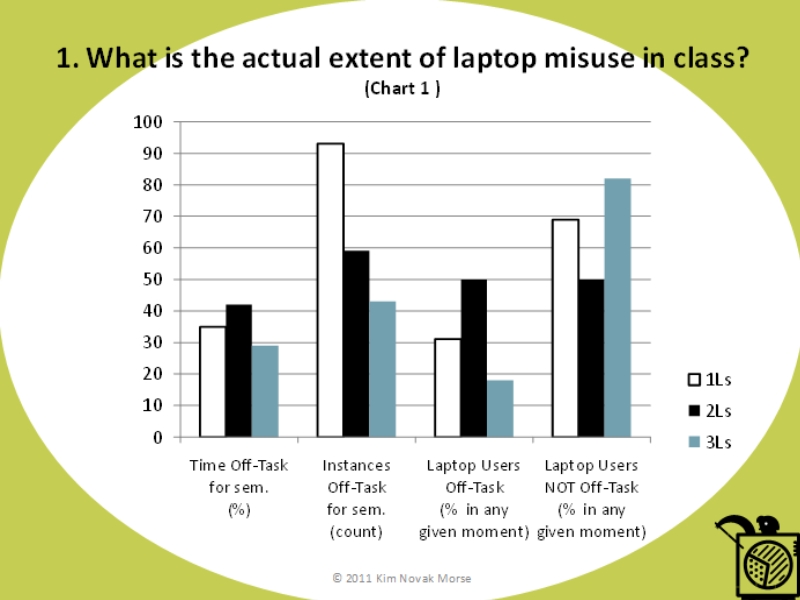
1. What is the actual extent of laptop misuse in class?

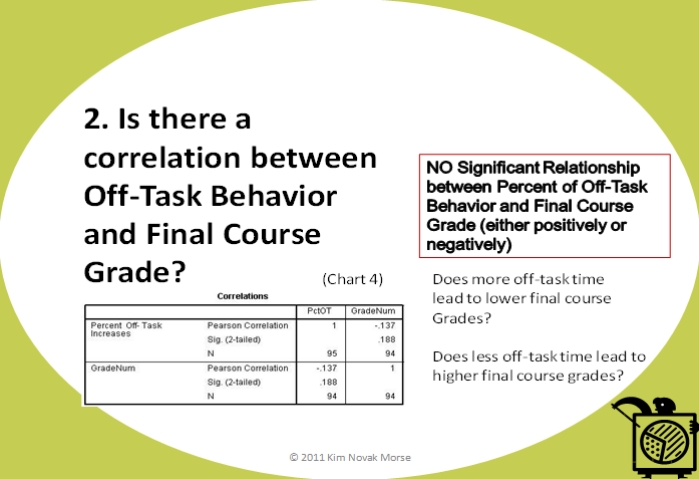
2. Does off-task behavior correlate to final course grade?

3. What classroom conditions promote off-task behavior?

4. What classroom conditions redirect laptop users’ attention away from off-task behavior?

The results from the study reveal that indeed students are off task in class; however, it is not as extensive as we thought, nor is it the population of students we thought it was (of course, this depends on whether you are an optimist or pessimist). Second-year students were off task the most time, at 42% of the entire semester. First-years were off task approximately 35% of the time for the semester while third-years spent approximately 28% of their class time off task. Regarding how many individual students were ON-task at a given instant, roughly 82% of third-years, 69% of first years, and 50% of second-years were NOT misusing their laptops (chart 1).

Interestingly, students who had higher LSATs were off-task more than students with lower LSATs (chart 2 & 3). In fact, higher LSAT students reported that they often are off-task in classrooms and only redirect their attention back to the lecture when they need clarification on topics.

While the numbers indicate that students are off-task, my second research question sought to answer whether more off-task behavior might correlate to lower final course grade. Through statistical analysis, the results indicate that there is no correlation between high off-task behavior and lower final course grade (chart 4). Nor is there a correlation between low off-task behavior and higher final course grade. Such results support the idea that students learn outside of class as well as in class and, though they may miss ideas in class due to off-task behavior, they often learn or supplement it through readings, study groups, clinics, etc.

The study is further instructive to legal educators since it also identifies some of the conditions that promote off-task behavior:

1)    Student laptop users tend to go off-task when X-(anything) occurs for 4 minutes or more…

2)    When professor is engaged in Socratic method with one student, there is an increase in off-task behavior by other students.

3)    When a classmate engages with professor, there is an increase in off-task behavior by other students.

4)    When professor is monotone, or, overly uses one linguistic intonation style, students tend to increase off-task behavior.

5)    Approximately 40 minutes into class, off-task behavior increases.

6)    When professor calls on students in expected order, off-task behavior increases.

Just as students went off-task when certain conditions existed in the classrooms, my study also captured when students re-directed their attention away from off-task behavior. Faculty can employ the following strategies:

1)    “Announcing-the-Good-Stuff” Strategy: Students redirect attention

away from off-task behavior when professor provides big-point-summaries,

rule formations, definitions, and conclusions.

“Ultimately, courts look at X…”;  “The upshot is…”           

2)    Using the “Rupture Strategy”: Students decrease off-task behavior when directed to an item in a book, chalkboard, digital presentation, in-class task, etc.

“Look at page X…”;   “On the chalkboard you see…”; 

“On the screen, notice X…”, “Write a brief X…”

3)    “Changing-up-the-Voice” Strategy: Students redirect attention away from off-task behavior when the professor prefaces content with signal phrases like:

“This would be a good exam question…”

“ I want to flag for you…” , “The critical idea here is…”

Or, by using linguistic mannerisms like intonation, especially rising intonation found in questions:

“And, how would you know   X     ?”;  “Because……..?”

4)    “Problem-Posing” Strategy: Students redirect attention when the professor asks a problem-solving question to the class (less so than targeting one student).

“How might we determine X…?”

“If we alter X, what might Y?”

5)“Keep-the-Show-Moving” Strategy: Students redirect attention away from off-task behavior when the professor manages “the duration of any X” so it doesn’t exceed 4-5 minutes. For example, the professor

1) may present info (5 min or less)

switch 2) ask a question to the class (5 min or less)

switch 3) direct students to book (5 min or less)

switch 4) ask an individual a question and have student respond (5 min or less).

switch, etc.

6)“Moving-into-student’s-space” Strategy: Students redirect attention when professor moves toward off-task individuals (but surprisingly only for a short time).

Some faculty may feel it is just simpler to ban laptops than employ some of the “workaround strategies” offered above. Before doing so, however, I would urge faculty to recall that the study indicates that the majority (82%, 69% & 50%) of the students are not misusing their laptops. In fact, students are listening– counter to the common assumption that everyone is monkeying around.