
Albany Law’s New Two-Year JD

In recent years, the late Antonin Scalia questioned whether the traditional law school education has to take three years, with the justice griping that too many upper-level classes explore fluff and are not focused on educating students in the law.  Similarly, law school critic Brian Tamanaha has also said there should be a two-tiered system of law schools: one elite track that promotes legal scholarship, and another, non-elite track, that has a program of study that transfers basic legal skills to its students and takes just two years to complete.

President Obama, highlighting ways to make law school more affordable and lower student debt burdens, joined in the chorus, opining that perhaps law school could be completed in two years.  Obama’s concerns are shared by Tamanaha: i.e., that law school is too pricey at current tuition rates and one way to provide value to students while keeping costs down is to eliminate one year of training.

At the same time that these critics from without and within the academy have argued that law schools spend too much time with their students, the practicing bar has long lamented that when law students graduate, they are not “practice ready”: their law school training was not sufficient for them to engage fully in the practice of law when they leave law school.  Moreover, going back at least over twenty years, to the American Bar Association’s MacCrate Report, law schools have been told they are not instilling in law students the skills and values essential to the practice of law.  Echoing such concerns, and weighing in on the law-school-in-two-years debate, Justice Ruth Bader Ginsburg said that two years would be fine for a law degree, but it would not teach students the craft of lawyering nor would it instill in them the values of the profession.  Similarly, I have argued elsewhere that so-called “Law and…” courses, which Scalia decried, help round out the law school education and expose students to new ways of looking at the law and their place within the legal profession.

Indeed, it is hard to square the “law schools are doing too much” argument with the “law schools are doing too little” one.  Responding to the latter argument, schools have expanded their offerings to include more experiential components and more values-based training in an effort to prepare students to serve clients and participate fully in the profession immediately  upon graduation.

In an effort to respond to the first argument, though, a number of law schools have begun to offer two-year juris doctor degrees, including all of the credits one would earn in three years into a two-year course of study.  One would think that this would mean schools are offering students a bargain, lopping off one year of tuition for the ability to graduate a year early.  Surprisingly, most schools offering a two-year JD are not reducing tuition; they are charging students three years of tuition for a two-year course of study.

Recently, however, my institution, Albany Law School, responding to the critics, like the President, who argue that law school is too expensive, has announced it will offer a two-year JD, at the cost of two years of tuition.  Like other two-year JD programs, the academic program of study is the same in terms of how many credits students must complete to earn their degree, whether they do it in two or three years, but the cost of the program is one-third less than the traditional JD.

We believe the program will appeal to prospective students who are interested in pursuing a degree on an accelerated track so that they can get back to work sooner after starting their studies and save some money while they are doing it.  We anticipate that this will attract students who are already in the working world, who are cost conscious, sensitive to losing the three years in their professional development that a traditional three-year program would cost, and hope to enhance their credentials and earning potential in as short a time as possible.

The program is being launched with a January 2017 start date.  Time will tell whether such an approach will attract students and offer them real value, both in the short and long run.

Let Me Introduce Myself

My name is John Lande and I just became a blogger with BPLE.  I want to tell you about my background and interests and the kinds of things I expect to write about in this blog.  This post also includes links to some resources you might be interested in.

I taught at the University of Missouri starting in 2000 and I retired a year ago, beginning what I call “unbundled retirement.”  I don’t teach or attend faculty meetings anymore, but I still want to stay involved in things that I care about.

Two years ago, I started blogging on Indisputably, a blog of law professors who focus on dispute resolution.  I love blogging, which I will continue in retirement.

Here’s a link to my website, which includes more information about me and links to my publications, some of which are not on ssrn.

Focus on Dispute Resolution

My career has focused on dispute resolution.  I graduated from law school in 1980 and practiced law for a while.  I felt uncomfortable with the adversarial dynamics of legal practice and I took my first mediation training in 1982 and then practiced law and mediation for several years.

In 1989, I went to grad school in sociology at the University of Wisconsin, studying sociology of law and dispute resolution.  For my masters thesis, I interviewed people who handled employment discrimination disputes within their organizations.  For my doctoral dissertation, I interviewed business lawyers and executives about their attitudes about litigation and ADR.

Most people in the “ADR” field, including me, think that it is misleading to refer to it as “alternative dispute resolution,” but the label has stuck.  I don’t think that there’s an ideal alternative and many of us simply use the term “dispute resolution” or “DR,” even though that’s problematic too.

Many people in the DR world think of “ADR” as involving neutrals (other than judges).  But focusing only on neutrals doesn’t fit because unmediated negotiation is recognized as a major sub-field.  Indeed, much of what we teach and do is advocacy in processes like mediation and arbitration.  Here’s one post I wrote musing about what ADR is and isn’t and here’s another one.  They reflect my view that lawyers and judges are dispute resolution professionals, not just mediators and arbitrators.

In the last decade, I wrote a series of articles about collaborative law and cooperative law, which are processes in which lawyers and clients start by trying to negotiate instead of starting in litigation and negotiating at the end of a case, after most discovery has been completed.

I think that these processes have real value though they are used almost exclusively in family law cases and only by agreement of both sides.  Collaborative law involves a “disqualification agreement,” which precludes the collaborative lawyers from representing the clients in litigation if needed.  This makes the process a non-starter for many lawyers and parties, especially in cases other than family law.

I wrote a book, Lawyering with Planned Early Negotiation: How You Can Get Good Results for Clients and Make Money, in which I applied some concepts from collaborative and cooperative law to describe an approach that lawyers can use unilaterally in any type of case.  This book was based, in part, on interviews with lawyers who actually use this general approach as opposed to lawyering with unplanned late negotiation.  I later did another study along the same lines based on more interviews with lawyers, Good Pretrial Lawyering: Planning to Get to Yes Sooner, Cheaper, and Better.

Focus on Legal Education

I developed and maintain a website, Dispute Resolution Resources for Legal Education (DRLE), which includes syllabi, teaching materials, and a list of DR programs and links.  It also includes instructions for subscribing to a listserv promoting discussion of issues relevant to DR in legal education.

In 2010, I wrote my first article on legal education, co-authored with Jean Sternlight, The Potential Contribution of ADR to an Integrated Curriculum: Preparing Law Students for Real World Lawyering.  This piece describes how ADR concepts and skills are integrated into other courses and suggests ways that this could be done more.

This article inspired the development of the Legal Education, ADR, and Problem-Solving (LEAPS) Project of the ABA Section of Dispute Resolution.  LEAPS developed a great website with lots of resources about how to increasingly incorporate “practical problem solving” into law school curricula.  Perhaps of particular interest to BPLE readers, this website has a list of textbooks in a wide variety of subjects which include a problem-solving approach as well as a list of colleagues who would be happy to help you incorporate problem-solving techniques in your courses in particular subjects (e.g., civ pro, contracts, etc.).

In 2012, I organized a symposium at Missouri entitled, “Overcoming Barriers in Preparing Law Students for Real-World Practice.”   For the symposium, I wrote an article, Reforming Legal Education to Prepare Law Students Optimally for Real-World Practice, which incorporated major themes in the symposium and included my ideas about legal education reform.

That year I also started teaching negotiation and I experimented with lots of techniques in that course.  In Teaching Students to Negotiate Like a Lawyer, which I wrote as I embarked on this experiment, I described these techniques.  In Lessons from Teaching Students to Negotiate Like a Lawyer, I described what worked and what didn’t work so well the first time I taught it.

One of my major insights from this experience was the great value of using multi-stage simulations in addition to one-stage simulations.  Most DR courses rely primarily or exclusively on one-stage simulations in which students are given fact patterns to enact for perhaps 10-60 minutes.  While these simulations are useful in prompting students to get into roles of lawyers, clients, and others, students don’t get into their roles in single-stage simulations as much as multi-stage simulations.

I described my use of multi-stage simulations in the two articles I just mentioned about teaching negotiation.  I prepared an eight-page document with suggestions for instructors who want to use multi-stage simulations in their courses.  And I solicited descriptions from colleagues about how they use multi-stage simulations in a wide range of courses, which are posted on the DRLE website.

I recently wrote my “Last Lecture” article, summarizing advice for law students based on my teaching and scholarship.

Blogging for BPLE

As a blogger on Indisputably, I have written various posts about legal education, generally tagged “for teachers and students.”  I have written some on particular topics that BPLE readers might be interested, including simulations, legal skills and techniques, and student assessment and grading.

I have occasionally passed along some posts to Mary Lynch that I thought BPLE readers would be interested in.  After I wrote one recently, I thought it would make sense for me to post some myself from time to time.

For example, you might be interested in my posts Non-Apology Apologies, Ethics, and Lawyers and Training Law Students to be Leaders.

By joining BPLE, I hope that I can serve as a bridge between faculty particularly interested in dispute resolution and those particularly interested in legal education issues.  If you have some interest in DR, you might check out or subscribe to Indisputably.  Conversely, I am encouraging my friends on Indisputably to check out or subscribe to BPLE.

I hope that you enjoy my posts.  I welcome your comments online or off.


Looking Beyond the Trends: Who’s Our Curriculum Really For?

Just catching up on my summer reading and I came across a short piece titled, “My Best Marketing Advice for Lawyers,” by John H. Fisher, Esq.  In the article, Attorney Fisher responds to an inquiry for his best marketing advice by saying: “Identify your ‘Ideal Client’ and nurture and cultivate the relationship with your Ideal Client through a series of educational and informative newsletters, speaking events, books, and social events.” 1  This three-step plan: paint a picture of your ideal client, attract your ideal client, and nurture the relationship with your ideal client was clear, linear, and supported with some truly clever and constructive examples of providing best tips and advice – for your referral partners. The article concludes that this plan has the power to change law practices, create goodwill, and perhaps make the actor a “mini-celebrity among peers.”  Apropos of the previous blog, such advice seems consistent.  And, to be fair to Mr. Fisher given what follows, he was posed the question, and we are still in the post “failing” law school phase.


Two of several things that give me pause here, are in who is assumed to be the “ideal” client and how we are affecting our students’ priorities when we offer and even encourage them to take “law” school courses in economic trends in the legal profession and personal finance.  The apparent underlying assumption of both articles is that the “ideal” client is someone who will financially advantage the lawyer, and/or that the wealth of our profession and ourselves is worthy of credit in a school devoted to the study of law. Understanding that making a living is important, I’d note that there are no major stories about whether lawyers make a “living wage” either here2 or in other nations, or of lawyers who cobble together several jobs over the long-term to support themselves or a family.  But I did, however, recently listen at a ceremony where the head of a non-law institute spoke eloquently about the goal of that educational institution as doing justice and having their faculty involved in field-work toward helping others establish workable justice systems.  Non-lawyers.


Whenever students struggle with understanding a statute or regulation and where I sense a disconnect, I encourage asking who benefits from a policy or something being advocated.  Then, recognizing how easy it is to go along with an idea that is being advocated when it is self-benefitting, I encourage students to ask who is left out and, if appropriate, why we continue to allow others’ priorities to be that determinative.

Expanding the Curriculum to Build Better Lawyers

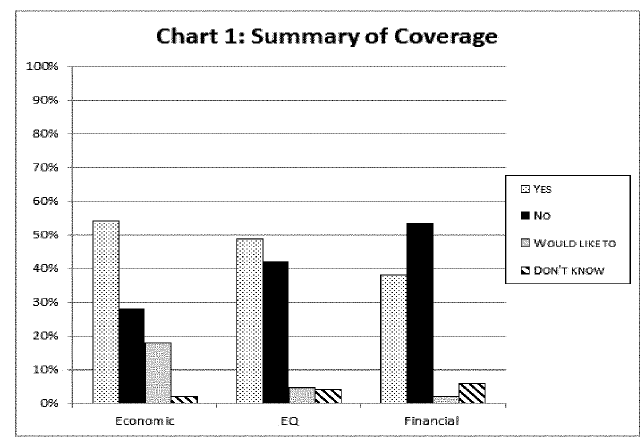
Just finished reading a fascinating piece in the Journal of Legal Education by Pamela Bucy Pierson, Bainbridge Mims Professor of Law at the University of Alabama School of Law.  Her article, Economics, EQ, and Finance: The Next Frontier in Legal Education,  describes the results of her survey of how law schools are covering the topics of: (1) economic trends in the legal profession; (2) emotional intelligence in issues such as managing stress, building resilience in the practice of law; and (3) personal financial planning for tomorrow’s lawyers.  The article outlines why each of these topics is essential to preparation of tomorrow’s lawyers.  Ninety-one law schools responded to the author’s survey on this topic, and the results are encouraging. piersonchart  The descriptions of courses and ancillary programs addressing these topics provides a rich source of ideas for approaches to building these topics into the curriculum. So grab that copy of the Journal that is likely piled in your mailroom or read the article on SSRN

The Cost of Traditional Legal Textbooks . . . and Alternatives

As the semester starts, 1Ls face a shock as their basic required textbooks cost over $200 apiece. Publishers have realized how the used textbook market cuts into profits and have decreased the number of years between editions.

These prices are not sustainable, especially for those law students who are already squeezed to the limit.  As a librarian, I have seen more and more students relying on the textbooks on Course Reserve, even going so far as to using them in open book exams.  We fear the day when we have 5 students who want the text for their open book exam and we only have 3 copies.

At the same time, as a library, becoming a textbook supplier helps our students, but it also means there are other materials that we cannot acquire or license.  With this bundle of challenges, there should be an easy solution, but most faculty who assign textbooks are removed from the cost of the assigned text.

Intellectual property textbook authors are at the forefront of this wave of change with several free and low cost alternatives. For examples, see Semaphore Press and Clause 8 Publishing, but there is also quite a bit going on beyond IP, notably e-Langdell (CALI). At that site, you can find texts on torts, sales, contracts, etc. It is no longer an excuse that there are no alternatives to traditional legal textbooks.

Some faculty have started creating their own textbooks, and many of those have matured and are now distributed, but some live primarily on Canvas or TWEN pages.  For those of you who have done this, why not make your materials more widely available?  Yes, they might not be as perfect as you would like, but what is?  Help students around the country by freeing your course materials.  If you are not sure how to do it, contact your AALS section or contribute to H2O, a legal crowdsourcing site associated with top names in the field.  If you are looking for edited cases and course structures, it should be a first stop if you would rather not edit a new case when someone else already has.

In short, the time to embrace alternatives to traditional textbooks, even for traditional subjects has arrived.  Imagine if you could give each of your students $200 . . . well, you can.

For more on this topic, see James Grimmelman, Alternative Publishing Models for Cost-Conscious Professors, and Ben Trachtenberg,  Choosing a Criminal Procedure Casebook: On Lesser Evils and Free Books

Fall and Spring Reading Group Suggestions


As we ready ourselves to begin a new academic year, I wanted to offer some suggestions for inspiring reading.  Perhaps you will even consider, as I am, starting a faculty reading group to grapple with related issues.


Implicit Bias and its Consequences.    I suspect that many of you have continued to reflect about how “black lives matter” and how we might encourage our law students to grapple with related issues.  I strongly recommend a new book, out in paperback just last week, from one of the principal researchers on implicit bias.  The authors are Mahzarin R. Banaji and Anthony G. Greenwald, and the title is Blind Spot:  Hidden Biases of Good People (Bantam Books, 2016, $17.00, available from Amazon.com and elsewhere).  The authors are experts on the ”implicit association test”  (available at https://implicit.harvard.edu/implicit/takeatest.html ), a tool used to explore the relationship between visual stimuli and perceptions.  For more background, see https://www.projectimplicit.net/index.html .  The test involves responding to various sets of paired visual stimuli, such as black and white or Asian and non-Asian faces.  https://www.projectimplicit.net/stimuli.html This highly accessible book explores the sources and nature of hidden biases, the dynamics of stereotyping, and the social implications of widespread implicit bias.  The book is highly accessible, and its research is also well-documented in footnotes.  I’m working with a former student to develop a continuing legal education program on cultural competence and implicit bias, which we hope to roll out in February.  I’m also thinking of inviting faculty and staff colleagues (and perhaps some students) to come together for lunch time reading group using this text.  I’ll keep you posted on how these efforts proceed.  I’d also encourage others to post about ways that they may be working to engage similar issues.


A Culture of Assessment.  Culture plays an important but potentially negative role in shaping implicit biases and stereotypes.  Culture can also be shaped in positive ways to improve institutions.  I recently read Professor Andrea Funk’s manuscript for “The Art of Assessment,”  forthcoming in January 2017 from Carolina Academic Press (http://www.cap-press.com/books/isbn/9781611637359/The-Art-of-Assessment).  This book, too, would be a wonderful choice for a faculty/staff reading group.  As most readers know, the American Bar Association now requires law schools to set “learning outcomes” for students, adopt more comprehensive forms of assessment and develop plans for “ongoing evaluation” of their “program[s] of legal education, learning outcomes, and assessment methods.”  Many in legal education fear that these new standards will result in intensified bureaucratic burdens.  Professor Funk, on the other hand, sees them as offering a new arena of creative activity, a space for engaged inquiry, a means of helping students learn more effectively, and a framework for building institutional pride.


Professor Funk’s book focuses on how individual faculty members and their schools can create a culture of assessment, perhaps the most crucial but often invisible element in achieving an energizing and constructive assessment process.  She is very effective in deconstructing opaque language and concepts, suggesting methods for getting started, and creating a sustainable assessment cycle.  She offers important tips on building on existing practices, gathering and using information, grappling with doubts about why and how assessment can work, and building institution-wide interest and commitment.  This is a book that gives readers important tools, but goes further, by illuminating the real potential of assessment for teachers, learners, and educational institutions.  It puts me in mind of Parker Palmer’s wonderful The Courage to Teach, with its uplifting willingness to confront fears but build on hopes that are dear to the hearts of the best law teachers:  helping students learn, working with colleagues, and “teaching from the heart of hope.”


I hope your coming year will be a fruitful one.  Important conversations with colleagues, spurred by books like these, can help make it so.  Please share your own suggests with others on the Best Practices Blog!

Experiential Learning Resources

Looking to add experiential learning to your law school course but not sure where to start or what to add? There’s a list for that!

As we start another school year, let me take this chance to mention the list of experiential learning resources that I maintain and update on an ongoing basis. You can access it here:

goo.gl/59KlUP

In the list, you’ll find experiential learning resources sorted by topic, including books, articles, simulation ideas and examples, and links to numerous databases that host even more materials.

Don’t see a resources that you are familiar with? Or have an idea that isn’t on the list? Send it to me! I update the list regularly, and I’d love to add your materials so the international community benefits from your ingenuity.

I should highlight especially that the list includes the ABA Guidance Memo on experiential learning. As we enter a year of site visits that will address, among other topics, the revised 303(a)(3) and 304 standards on experiential learning requirements and simulation courses, you’ll want to be familiar with that memo’s recommendations.

Hope to receive your list suggestions soon!

Learning and Teaching – the Progression

I have become interested in progression and ordering lately.  Not so much with chickens and eggs, but more with respect to progressions used in the classroom.  Traditionally, I would start a class with a case and deploy it to open up an area of substantive law, utilizing questions, problems, canons of interpretation, and other cases to explore the meaning of concepts presented in the initial case or topic. The substantive areas depended on the course and ran from appurtenant easements (Property Law), to impeachment by prior untruthful acts (Evidence), to searches incident to lawful arrests (Criminal Procedure). My interest in ordering made me aware of the fact that I approached each class with a duality of teaching and learning.  Teaching usually was first in my progression.  The spotlight was on me as the teacher; I opened and conducted the class and then ended it when time ran out. I had many assumptions.  I assumed student motivation existed; that students started, followed, and ended the class with me; that students had effective practices of adding information to their understanding; and that students readily retrieved the information when needed.

But I wondered what would happen if I reversed the norm of ordering?  What if I placed learning first in the progression, especially in reference to motivation?  Motivation in law school is a lot like a roller coaster (at least it was for me) – it ebbs and flows quite a bit, sometimes within the same day. Motivation is often invisible to the classroom, but weighs heavily on learning.  Early in the first year there is a surfeit of it, and by the third year, well, lets just say there is not as much of it.

This reversal of progression, with learning first, changed a lot for me in the classroom.  In the past year or two, it has allowed for more variation, for greater focus on student improvement, for more experiential “doing” as part of basic courses, and for more direct consideration of student motivation.  For example, in this new progression, students fill out cards explaining what motivates them to learn the most and the least. Students also start each class by indicating where we are in the tapestry of subject matter – something they were used to me doing.  Since experiences often are helpful motivators, many more experiences are blended into the course — students now interview real world participants in law (e.g., police officers in a Criminal Procedure course) or Evidence (trial lawyers) and create short but deep PowerPoint presentations or videos in all courses about a point in the course that was worth further exploration.  These presentations served to recap what people had learned and to offer a combined “outline” of sorts for exam preparation.  Further, classes now end (at the students’ request) with a brief synopsis of what we did, to see if everyone finished around the same place.

In all, I found that focusing on learning generally, and motivation in particular, were very worthwhile.  I enjoyed the new way of guiding the course even more than I did the old.   There were different assumptions made, but I think they were more accurate.  Priorities can inform progression.

Life balance: Our students recognize false promises and are demanding real changes based on a value set.

The millennial worker is an educated consumer armed with details about the global economy. They acquire knowledge that provides factual comparisons of how similar professionals work-life is balanced in other countries versus the many demands of the American lawyer.

In externship classes, students hear about the work life of attorneys in various office settings and explore how their values may merge in the professional world. Even more interesting, the students who gain an international perspective and further enlighten the class. For example, I recently had a student return from an internship in a Sweden.

The student shared:

“I have a desk that can be raised and lowered so I can stand and work. My work phone is an iPhone and there is free lunch here every day! We only work until 4 pm and the attorneys are only required to do 1000 billable hours per year!!! It is all about streamlining and efficiency here.” The student further remarked about the clear message that is sent when a society endorses such a model: We want you to be happy and produce quality work.

As a legal educator, how do you defend the 2100 billable hour or the underfunding and understaffing of government offices? How do we arm our students with grit and resilience for more than the first few years, but a lifetime of sacrifice?

Students interning or externing at law firms or other placements quickly notice the deficient message our American profession endorses. Over and over again, I hear in my classroom students remark about the inadequate time lawyers have to invest in family or pursue individual interests.

So, why are less people deciding to become lawyers? Because, the millennial worker is focused on community values, family, and life balance and our profession continues to pay lip service to such values. The time for reform is now. Reform not just focused on legal education, but the profession as a whole. If we do not readily restructure our value set, work habits, hiring practices, funding sources and curricula, we will lose the next generation of brilliant change makers. Both our profession and society crave such reform, specifically to foster leaders who will pursue justice, uphold government, adhere to the rule of law and build community.

Even Law Professors Need to Laugh

For a break from polishing your article or prepping for fall classes (assuming you’re through watching political convention coverage), try viewing the original Australian version of Rake. This series features Richard Roxburgh as a deeply flawed but appealing barrister. Get through the first two episodes (I did not like the first one) and you might be hooked. The show is biting, bawdy, and profane, but well-written. It could help you laugh your way through the last part of summer. Also, for the technologically skilled, you may find useful clips for teaching purposes – many along the lines of “what not to do.” Students can develop momentum in learning to critique lawyering performances by starting with on-screen characters. This quirky and comedic drama provides vivid scenarios for stimulating discussion. Or just enjoy the show!cleaver_rake_e345_Master

Finding Meaning

As national and international events continue to develop in uncertain and unsettling ways, educating the next generation of lawyers continues to be obviously and critically important. What should our laws be, how are they interpreted and enforced, how are our leaders elected, and what can be done to move toward justice? Legal education prepares leaders to contribute (wisely, we hope) to all aspects of civic governance – and yet – the institutions that provide legal education are still finding their way.

Word got out that most graduates do not become rich law firm partners within 7 years, or ever, and this is among the reasons why far fewer people want to attend law school. The boom and eventual bloat in legal education shouldn’t have been about the money, but, for many, it was. Now some large firm salaries have recently increased, in perhaps a hopeful sign of a rebound. But Professor Frank H. Wu’s comments resonate:

I have nothing against a young person declaring that they wish to make money — of course they do. My point is if that is the primary consideration in your career choice, there are better methods for doing so. Joining a profession in which you represent someone else entails making a sacrifice in the name of principle.

Society needs members of the legal profession who embrace the significance of their noble, helping role, apart from whether it brings wealth (and even though in many cases it won’t). Likewise, legal education needs students who seek potential meaning in their work, and also faculty, staff, and administrators who recognize that educating new lawyers might be more of a helping profession than a ramp toward remuneration. The disruption of the past several years has taught us that lesson, but without this underlying nugget of optimism:  As described by Will Storr in his recent New Yorker article, maybe Aristotle’s prescription for the good life was on target. Preliminary findings show that being engaged in meaningful work improves health and lifespan. Guiding our institutions and untangling the current state of affairs provide serious opportunities for lawyers to take on and benefit from this vital, meaningful work.

The Campaign for Full Citizenship for All Full-Time Law Faculty

I’ve just returned from the Legal Writing Institute’s Biennial Conference held in Portland, Oregon.  With hundreds of attendees presenting on a variety of topics in workshops, panel discussions, coffee sessions, and a plenary, I am more inspired than ever to incorporate new and innovative teaching ideas into my course, produce scholarship that contributes to our field, and continue to serve my law school as we navigate implementation of the ABA’s new standards.  I want to thank all who contributed to the event for sharing their knowledge.

There was, however, one overriding issue which tempers this enthusiasm and inspiration:  the continued battle legal writing faculty face in striving for equal status within their law schools.  While it is true that many have made positive strides, the empirical and anecdotal information shared over the course of the conference shows that there is still far to go.   The Legal Writing Institute (“LWI”) the Association of Legal Writing Directors (“ALWD”), and the Society of American Law Teachers (“SALT”) have formally adopted a policy statement on full citizenship for all faculty.  Here is the text of the statement:

The Legal Writing Institute is committed to a policy of full citizenship for all law faculty. No justification exists for subordinating one group of law faculty to another based on the nature of the course, the subject matter, or the teaching method. All full-time law faculty should have the opportunity to achieve full citizenship at their institutions, including academic freedom, security of position, and governance rights. Those rights are necessary to ensure that law students and the legal profession benefit from the myriad perspectives and expertise that all faculty bring to the mission of legal education.

LWI launched a campaign for individual signatures which began at the conference and will continue.

A recent article also discusses the impact of the lack of full citizenship for a group of faculty who are largely female: Stars Upon Thars: Law Schools Use ABA Standard 405(c)’s Tenure Like Security of Position to Discriminate Against Female Legal Writing Faculty, 34 Law. & Ineq. 137 (2016) by Melissa Weresh from Drake Law School.  This article addresses the potential for exploitation of law faculty members who hold ABA Accreditation Standard 405(c) status (“reasonably similar to tenure”) and the likelihood that such exploitation will have a disparate and discriminatory impact on a predominantly female cohort of law faculty.

After attending multiple sessions which discussed the push for full citizenship, as well as the possible discriminatory impact of the lack of this citizenship, I’m left wondering: what message are we sending to female law students about the role of women in law school and the  practice of law?


Seeing Black: Unconscious Bias and Pro Bono Lawyers

centerforprobono's avatarABA Center for Pro Bono Exchange

Lillian Moy Lillian Moy

The events of the last year in Ferguson, Staten Island and Baltimore have focused the public and the legal community on racism and unconscious bias in the criminal justice system, particularly in policing. Seeing Black, an article by Jennifer Eberhardt and three other psychologists, discusses their research and findings that many law enforcement officers “see black” resulting in their unconsciously seeing criminal activity and criminal defendants. It’s not much of a leap to conclude that others in the justice system, including lawyers, also unconsciously and automatically “see black.” and may make negative judgments about key aspects of our work, e.g., the credibility of your client or a key witness.

I cannot explain unconscious or implicit bias in this blog. I commend to you this video which talks about one community’s study of implicit bias and their attempts to mitigate bias in their juvenile justice system. In the…

View original post 436 more words

Teaching Reading and Access to the Profession

A couple of weeks ago, I had the good fortune to listen to Doug Lemov speak about his new book on the WAMC radio show “To The Best of Our Knowledge.”  The book, co-authored with Colleen Driggs and Erica Woolway, is entitled Reading Reconsidered:  A Practical Guide to Rigorous Instruction.  Doug is an expert on teaching and education (focusing on the K-12 space).  He happens to live in my town, and our daughters have crossed paths on the soccer field, so I’ve had the opportunity to chat with Doug from time to time about his work.

In the interview, Doug speaks about the latest research in reading instruction.  He makes a number of points that resonated with me as a practicing lawyer and law school teacher.  Any errors in summarizing Doug’s remarks are, of course, my own:

  • Interacting with difficult texts:  Doug explains how important it is for students to learn how to read difficult tests – particularly dense, non-fiction, and often highly specialized texts.  These are, of course, exactly the kind of texts one is likely to encounter in law school and law practice.
  • Developing close reading skills:  Doug offers a definition of close reading, and then explains why close reading is so important for developing readers.  He talks about the importance of moving beyond “gist” conversations (i.e., conversations where students recount and respond to the main idea, or gist, of a text) to conversations involving a more in-depth and nuanced consideration of language, themes, choices, etc.  Again, from my perspective, these are exactly the sort of skills one needs to develop to succeed in law school and law practice.
  •  Working with archaic textsDoug makes the point that archaic texts can be challenging for readers.  He argues that students who do not have the opportunity to interact with archaic texts during middle school and high school may find it difficult to make the jump to this sort of material  in college – where they will regularly encounter older texts such as the Declaration of Independence, The Canterbury Tales, Darwin’s Origin of Species, etc.  As someone who teaches contracts, this is (ancient?) music to my ears.  Try teaching cases like Hadley v. Baxendale to readers who have never encountered older British texts, for example!
  • Developing autonomy as a reader:  Finally, Doug talks about what it means to be an autonomous reader – i.e., a reader who can engage deeply with written material; a reader who asks his or her own questions and does not simply respond to the teacher’s prompts; a reader who examines author perspective, bias, etc.  This, too, seems relevant to my experience as a teacher and practicing lawyer.

For all of these reasons, my first thought was that Doug’s book might have useful teaching tips for me.  I am reading — and highlighting — the book for this purpose now!  In chatting with Doug over email, however, we identified another issue associated with reading skills and reading instruction – namely, justice and access to the profession.  If a student does not develop strong reading skills by the time he graduates from high school, that student may struggle in college.  If a student struggles in college, she may not be in a position to apply to law school.  And, if a student is not in a position to apply to law school . . .  well, it’s hard to become a lawyer if you don’t have the degree.  Reading and writing – along with legal reasoning – are at the core of the work of a lawyer.  The idea that talented students may not be in a position to apply to law school — or may struggle in law school —  due to gaps in reading instruction or experience pains me.

Here in New York, Doug’s points likely will get linked to debates about the common core.  The common core is, of course, a highly controversial issue in education.  Teachers, students, and parents have raised questions about the rollout of the common core (and common core testing) here in New York.  There have been discussions about the quality of the tests and curricular materials; debates about whether to let your child take the tests, or whether to opt out, etc.  As the mother of two children in the thick of standardized testing, I feel the pain on these issues on a personal level.  And, because I have to deal with the reality of the bar exam in my teaching, I think about strengths and weaknesses of standardized testing on a professional level, as well.

I am not writing today to comment on the common core or standardized tests, though I am an enthusiastic participant in debates about these issues.  Instead, I simply wanted to react to Doug’s thoughtful work as a fellow teacher.   As a teacher, I cannot assume that my students have had exposure to difficult or ancient texts prior to law school, nor can I assume that my students are trained in close reading.  I also cannot assume that my students are autonomous readers.   For all of these reasons, I need to commit — every single day – to helping my students master the reading skills that are necessary to thrive in law school and in the practice of law.    I also need to do more to ensure that students who want to be lawyers get to my classroom in the first place.

. . . because there is no social justice

Yesterday, I reviewed a student reflection that broke my heart a little bit. The student responded to my prompt, which asked her to comment on her summer work experience in the context of advancing social justice, by describing an intractable problem with her indigent client. She described hours upon days of work attempting to resolve an unjustified power shutoff for the client, and she ended her piece by explaining that she would continue to work with this case, this issue, and this client “because there is no social justice.”

My response to the student in part, was as follows:

As I sit here preparing to write a piece about the disintegration of our criminal “justice” system, prompted by yet another set of police homicides of men of color this week, your comment that “there is no social justice” certainly resonates with me. The need for us as lawyers, mentors and teachers to reflect with our students about that harsh reality, and to get up and do our jobs as public interest lawyers again the next day, is sometimes overwhelming. I share your frustration, which is not even the right term. I often feel in working with domestic violence victims in my clinic as if we are just rearranging deck chairs on the Titanic. The fact that we do not stop, though, is what keeps the ship of justice afloat. Battered, barely making it, but afloat. I fear it is at greater risk now than ever in this nation, though, and advocates like you will be critical to affect change from inside. Please keep doing what you are doing.

I like the sound of that metaphor about a ship of justice. But I’m frankly not sure if it is even apt.  What ship? What justice? As my colleague Leigh Goodmark noted yesterday, “As soon as I saw the news about Dallas this morning, I thought, I can’t. I just can’t face another day of violence and death and destruction.

That’s privilege. I don’t have to face the reality that when my son leaves the house, he might not come back. That my husband–or I– could be pulled over for a broken taillight and shot as we reached for identification. I don’t have to go into the streets to protest and die trying to protect my children from sniper’s bullets. Because I don’t live in black or brown skin, with a threat hanging over me every minute of every day.

That’s why we have to keep looking. Keep talking. Keep posting. Keep letting our friends of color know that we hear them, we see them, we value their lives, and we love them. Keep demanding better from our police, our government, ourselves. Our friends don’t ever get to say, I can’t. We shouldn’t either.”

Our privilege as law professors goes beyond skin color, but make no mistake, it is seeped in elitism.  Today I am using that privilege on this blog to say these words. That is all. It is not enough. It will never be enough. But I won’t stop. I don’t know if there is social justice. But I know there is a movement towards it, and I want to be a part of it.