
MAKING IT PERSONAL

I’ve been a devotee of Parker Palmer ever since I read The Courage to Teach.[1]  I often think of his statement: “We Teach Who We Are.”[2]   In January, David Brooks, Op-Ed columnist for the New York Times, echoed a similar sentiment.  Brooks’ piece, entitled Students Learn from People They Love,[3] told of how a class he taught at Yale softened around him after he had to cancel office hours a few years ago, having shared with his students that he “was dealing with some personal issues and a friend was coming up to help me sort through them.”  Recognizing something that many of us have long known, Brooks drew the connection between emotional relationships and learning.  Thus his Palmer-like statement: “[W]hat teachers really teach is themselves—their contagious passion for their subjects and students.”[4]

But we teachers are much more than our passion for our subjects and our students. We are human beings who bring into our teaching the accumulation of all the innate and environmental influences and experiences of our entire lives.  While these influences implicitly affect how we teach, each of us strikes a balance of how much of the personal we explicitly bring into our interactions with students, both in the classroom and outside.  My tendency is to share a great deal about myself, to share my personal stories.

I am an advocate of holistic lawyering, of the essentiality of understanding that a client comes into a lawyer’s office with a host of needs, only some of which are legal.  The lawyers I regard as most effective, the ones I most admire, are those who recognize their clients’ multiplicity of extra-legal challenges and, where appropriate, address them, if only by suggesting or referring to other professionals.

In writing this blog entry, I came to realize that I might appropriately call myself a holistic teacher. I’m not only committed to teaching my students the knowledge, skills, and values of the profession they are studying to enter.  I care about how they will bring their entire beings into their careers.  All of their signature strengths as well as their challenges.  If they are struggling in any part of their lives, it will likely bleed into their performance as students and, ultimately, left unaddressed, into their careers as lawyers.

I teach a general civil externship seminar.  I have the luxury of inviting my students to focus on key aspects of successful lawyering generally taught, if at all, only in clinics and externships.  These include, above all, the people skills so essential to effective lawyering:  communication; cultural competence; emotional intelligence; self-care; and finding realistic and healthy balance among work, family, friends, and self.

A joke I tell about myself and often share with students in distress is if a student comes into my office complaining of a hangnail, I recommend talk therapy, because it has been so helpful in my own life.  I have long been open about my history of episodic clinical depression, and have shared it with students and others struggling with their own mental demons.[5]   Sometimes, however, I wonder if I risk crossing the line between teacher and therapist.

Here’s a recent example.  I have been working on a pro bono case with a student now in her last semester.  We’ll call her Susan; not her real name.  Several times Susan had promised to get me a draft of a letter to a Congressperson for my review by a certain date and had not done so.  I had told her that I understood she had a lot else on her plate, and just to send me an email if she wasn’t able to get it to me by the date she had promised.  A week or so ago, she assured me that wouldn’t be necessary; she would absolutely get it to me by the end of the following weekend.  That didn’t happen.  Last week Susan and I were talking after a lunch hour program about her upcoming interview for post-bar exam employment at a firm with which she was currently externing.  It was an encouraging and upbeat conversation.  At the end, I gently mentioned that I had neither received the draft letter or an email explaining she was unable to get to it.   She confessed that she had begun to draft the email, but was just too anxious to finish it.  Apparently, this was not an isolated instance; she has long been plagued by anxiety.  A deeper conversation ensued about the importance of being in communication for the career she was entering.  I mentioned something I often said to students, that they wouldn’t have gotten as far as they had if they didn’t have an awful lot going for them.  But if something wasn’t working and they were unable to fix it on their own, there was no shame in seeking professional help.  Susan shared that she knew this, and also that she had stopped going to therapy several years ago when her therapist had suggested she might benefit from anti-anxiety medication.  Susan was and is adamantly opposed to psychiatric medication.  I stressed the importance of not burying her head in the sand, that the choice of whether to take medication would be her own but that not doing anything to solve a seemingly intractable problem was not a rational choice.  I reminded her of my own mental health history.  She later wrote, thanking me for the advice.

I write all of this with admitted ambivalence.  I even question whether it belongs in the “Best Practices” Blog.  For I struggle with my tendency to so readily recommend therapy to my students.

There are times when crafting my journal prompts, I have to remind myself to relate them to my students’ lives as externs and the lawyers they are becoming.  An example, from our exploration of Emotional Intelligence:

  1. Reflect on how well you think you know yourself, your MO (modus operandi). For example, are you aware of what your immediate response is to an upsetting or difficult situation?  Are there automatic responses you have that you would like to change?  Specifically, do any of these responses tend to create problems for you professionally, to keep you from being the law student or lawyer you most want to be? If so, what steps can you take to change them?

and another based on the chapter I contributed to Learning from Practice,[6] on Work and Well-being:

  1. Considering chapter 25 and our class discussion on Monday, reflect on what, if any, habits or practices you have developed in law school that detract from your sense of well-being. What, if any, habits or practices contribute positively to your sense of well-being?  What if anything might you change to improve your well-being, now and going forward?

Is it good practice to probe so personally into my students’ inner lives?  Is it sufficient that I offer them the option of writing about something less personal?  Although I may have doubts, I find that these prompts often elicit some of the most thoughtful reflections of any my students write.  Self-awareness, like awareness of others’ emotional contexts, is so critically important to being an effective lawyer.  Where in the curriculum can we explore this if not in experiential courses and, specifically, in journals?  Here’s a recent example from one of my student’s journal responding to this prompt:

One habit developed during law school that detracts from my well-being is that I have stopped going to the gym and eating healthy. I was always very into fitness and living a healthy lifestyle….  The time constraints of law school and working fulltime have forced me to essentially eliminate this from my life. . . .  My physical health and body image definitely play an important role in my mental health.  In the future, I think it will be important for me to carve out time to keep this part of my life….

I value the importance of introducing my students to positive psychology[7] and mindfulness practices, both empirically demonstrated to provide a plethora of benefits.[8]  For more than ten years, I have had a regular morning meditation practice which has been hugely beneficial in my own life and work.  For many years I have introduced my students to mindfulness meditation in the first class of the semester.  I usually show a wonderfully accessible twelve-minute video of Anderson Cooper’s introduction to meditation at a weekend silent retreat with Jon Kabat Zinn.  For even longer than that, I have begun each of my classes with two minutes of what I have come to call “settling in,” accompanied by an introduction, and invitation, to mindful breathing.  Some students find it to be an invaluable tool for settling their minds and reducing their anxiety, in and out of class.  Many others are agreeable to practicing it in class, but not inspired to try it elsewhere.  Still others find it to be a hippy-dippy waste of time.  I know it alienates some students, but that’s a cost I deem worth it for the possibly life-long benefits it provides for others.

I consciously model vulnerability, fallibility, and taking responsibility for messing up.  I admit my MO—being a scold.  I am naturally impatient with students who haven’t lived up to their responsibilities, who haven’t exhibited the professionalism becoming a lawyer requires.  I work hard at not acting out of my “default position.”  Too often, I fail.  Even if I say nothing, it shows on my non-poker face.  To put it mildly, this does not improve the climate in the classroom.   Here’s an example from this semester of failing and recovering:

I have the smallest seminar I have ever had: only five students.  We meet on Mondays, late afternoon.  On a Tuesday that was a “legislative” Monday[10] following Presidents’ Day weekend, only three students showed up.  The absent students hadn’t notified me. The following Monday, three students showed up.  One of the absent students had let me know that she had a stomach flu; I heard nothing from the other.

The assignment for that particular class was to prepare for partnered simulations based on the ethical dilemma hypotheticals in chapters 10 and 11 of Learning from Practice.[11]  The instructions I sent with the assignment right after the prior class, in bolded text, instructed the students to do two things:  1) coordinate with their simulation partner in advance and 2) notify me if they weren’t going to be in class so that I could make alternative assignments.  Of the three students who showed up, only one had read all of the assigned pages, and none had communicated with their partners about the simulations.

I did my best not to blow up but I was practically ready to end class then and there.  Instead, I took a deep breath, gave them a few minutes to read the hypotheticals, and left the classroom for a few minutes to cool down.  When I returned, we discussed the scenarios, rather than acting them out.  It was the best I could think to do at the time, and the discussion was sufficient to get us through the remainder of class.  It probably goes without saying that it was not a great class.

My true recovery actually occurred the following day when, having sufficient distance in time and place, I drafted, edited and emailed the class a missive I titled “IMPORTANT.”  After reciting the concerning events of the previous two classes, I added:

I appreciate that you are all juggling multiple responsibilities and substantial workloads.  This is training for careers as lawyers.  You are in the process of developing your professional identities.  I am committed to supporting you in that process.

Your professional training to become lawyers requires you to be accountable and in communication.  If you need to miss a class for which you have been assigned a particular role or task, you should inform your professor and any affected classmates in advance, or, if not possible, as soon as you can.

Law school generally, and the externship and clinical programs in particular, serve as a laboratory for developing the professionalism habits you will need for your future careers.  Towards that end, I … have attached … a Professionalism rubric[12]… .  I ask all of you, as you prepare your mid-semester self-evaluation to rate yourself on this rubric and see where you need and want to improve.  I will ask you to do the same at the end of the semester.  It’s up to you whether you want to share your rubric with me.

We are a very small group.  That has advantages and disadvantages, the latter having been evident for the past two classes.  We all need to work hard to live up to our obligations in order to maximize this learning experience for you.

I am posting the above on the Discussion forum and invite replies.  Or contact me privately and/or anonymously.

I’m committed to your success and know that you are, too.

No one took me up on the offer to post on the Discussion forum, nor to contact me otherwise.  Nonetheless, at the following class, all five students were present, thoroughly prepared for the simulations, and completely engaged.  It was a terrific class thanks to the work they put into it.

* * *

I have never been a trial lawyer or practiced law in a private firm.  I don’t have much in the way of war stories relevant to my externs’ placement experiences.  But I do have stories gleaned from seven decades of lived experience.  I have wisdom gained from pursuing my three major life passions:  One, to write and speak about more healing, relational and non-adversarial methods of achieving justice, resolving conflict, and ordering legal affairs.  Two, to decrease the shame and stigma around mental illness, having suffered six episodes of major clinical depression over the past forty-four years.  And three, to help my students envision and strive for careers that will make them excited and happy to get out of bed every morning.  I have been blessed with a career that has enabled me to pursue all three.

When I look back on my more than 36 years of teaching, I see that I have lived them holistically.  My work has been almost seamlessly integrated into the rest of my life, not separate and apart.  In both I have experienced the full gamut of emotions: joy, sadness, frustration, contentment—but never boredom.

We teach who we are.


[1] Parker Palmer, The Courage to Teach: Exploring the Inner Landscape of a Teacher’s Life (1st ed., 1998).

[2] Id. at 1.

[3] David Brooks, Students Learn from People They Love, New York Times, Op Ed 1/17/19.

[4] Id.

[5] See, e.g., Marjorie A. Silver, Healing Classrooms, in Transforming Justice, Lawyers, and the Practice of Law 264-65 (Marjorie A. Silver, ed., 2017);  Marjorie A. Silver, A Transformational Melancholy: One Law Professor’s Journey Through Depression, https://ssrn.com/abstract=1908992 (2011).

[6] Marjorie A. Silver, Chap. 25: Work and Well-Being 699-724 in Learning from Practice (Wortham, et al. eds., 3rd ed. 2016).

[7] Id.at 700-05.

[8] See, e.g., Shailini Jandial George, The Cure for the Distracted Mind: Why Law Schools Should Teach Mindfulness, 53 Duq. L. Rev. 215 (2015).

[9] omitted.

[10] This is Touro’s term for following a particular day’s schedule on a different day of the week.

[11] Lisa G. Lerman & Lisa V. Martin, Ch.10: Ethical Issues in Externships: An Introduction 261-78; Alexis Anderson, Ch. 11: Ethical Issues in Confidentiality  279-93 in Learning from Practice (Wortham, et al. eds., 3rd ed. 2016).

[12] See https://www.stthomas.edu/media/hollorancenter/pdf/FINALProfessionalismRubricMarch2019.pdf.

A Pedagogical Twist for the 1L Appellate Brief and Oral Argument

For those who teach legal writing to first-year law students, it is the season for appellate oral argument. Yes, the long-standing tradition of requiring first-year students to complete an appellate oral argument in the legal writing course continues today at the large majority of American law schools–at just under 75% of them, according to recent data. At those schools, the oral argument, which is commonly the capstone exercise near the end of the spring semester, has become something of a rite of passage for the students.

In a 2011 article, Legal Research and Writing as Proxy, I argued that assigning an appellate brief and appellate oral argument in the 1L legal writing course remains a pedagogically sound practice, even though a large majority of practicing attorneys will never engage in appellate practice, let alone complete an appellate oral argument. I still retain that view but won’t rehash my arguments here. Rather, I will focus on a pedagogical opportunity afforded by the brief/oral argument sequence of assignments that I discovered more recently.

In the last few iterations of my legal writing course, the appellate brief and oral argument assignments have proven an excellent vehicle for a bit of a pedagogical twist: A few weeks before the brief is due, not after, I teach lessons on oral argument and require the students to complete a practice oral argument round in front of my 2L teaching assistants. (The formal rounds of oral argument in front of a trio of local attorneys still occur after the briefs are submitted.) For many years, I kept brief writing and oral argument entirely separate—only after the briefs were completed and submitted would I shift the students’ attention to oral argument. (After all, that mimics the realities of the “real world“ of appellate practice.) But as a pedagogical matter, just like writing the brief helps in preparing an oral argument, working on an oral argument–and thereby having to talk out and defend one’s positions–can help in preparing a brief.

A few weeks before the brief is due, most students will have a scattered and underdeveloped array of arguments. Completing a practice oral argument can help them–or, in the case of those students who are spinning their wheels, force them–to organize and further develop those arguments for the purposes of the brief. In pursuit of this goal, I ask my TAs to give extensive feedback to both students after each practice round. Moreover, I require every student to attend two additional practice rounds as observers. At each round, the student representing Petitioner, the student representing Respondent, and the students attending as observers also begin to appreciate the formalities and peculiarities of oral argument, thus helping them to prepare for the formal rounds that will occur after submission of their briefs.

This semester, shortly after the practice rounds (just over a week before the briefs were due), my students graciously agreed to provide me some feedback on the experience. One of my students volunteered to solicit comments from all of her classmates, anonymize those comments and her own, and then send them to me. Twelve out of fourteen students in my small section gave a positive review. I include two of the more thoughtful evaluations here:

  1. I found doing the practice oral arguments before my brief was fully written to be helpful. Arguing my side in the courtroom and fielding questions from the TAs helped me more precisely narrow the theme of my arguments and determine how I wanted to frame my position in the brief itself. After receiving pushback from the TAs on certain points, I was able to refine my responses to common criticisms that would come from the other side. Additionally, I now feel more comfortable going into the “official” oral arguments having completed a practice round. However, I would have liked to participate in another mandatory practice round with the TAs after my brief is written; the substance of my oral argument has substantially changed since my first practice round.
  2. Practice oral arguments were a large motivator to get my arguments organized. I found it really helpful to speak out loud about the arguments. Doing so really helped me understand what my points were and whether or not they held up against scrutiny. Speaking about the arguments also helped me understand how they related to each other. The TA’s did a good job of making us feel comfortable throughout the process. I think overall the exercise is going to be beneficial as long as the practice round is kept informal. We were all stressed about how to perform the oral arguments, so maybe there could be a concession in the formality/process of the oral argument that could make us more comfortable.

Good food for thought, as I continue the tradition of appellate oral argument again next spring.

Are the Students Failing the Bar Exam Today Canaries in the Coal Mine warning us of a More General Need to Change Legal Education?

Thank you so much to Best Practices for Legal Education for inviting me to blog again and to Elizabeth Murad for her remarkable work in keeping contributors in touch and on track.  So much is written about the very real decline in bar passage that it is easy for schools with high pass rates–or at least high in relation to other schools in their state– to ignore the need to change what goes on in the classroom and dismiss the excellent work being done in effective law teaching as a problem for “lesser schools” in “lower tiers.”

We know, as legal educators , members of the bar and even members of the public, that bar passage rates have been falling.  And we also know that many, if not most, law schools are admitting students today with LSAT scores lower than those that they  admitted ten years ago. So it’s easy to see a correlation between lower scores and falling rates.  After all, the bar exam is a test much like the LSAT–why wouldn’t there be a relationship?   But even if students are failing the bar exam for the same reasons they are getting low LSAT Scores,  we still have the opportunity to intervene in ways that we know raise pass rates.  This blog contains so many resources for those who want to teach more effectively.   Why wouldn’t we want this for all our students?

Everyone at a school with a “bar passage problem” is well aware that we cannot continue to do the same things we always have when they are no longer working the way they used to.  But we hear this less at schools satisfied with their bar passage  Perhaps the students who are failing are really canaries in the coal mine and a warning to all of legal education that all of today’s law students find it more difficult translating their legal education into the very peculiar format required for bar passage-regardless of LSAT score? Everyone who has ever studied for the bar exam remembers it as a grueling, unpleasant, and highly intensive process–but until very recently that process started after graduation and barring personal disaster almost always resulted in passage.  Even when it didn’t, the consequences of were lower.  Today, students safely employed in September find themselves fired if October brings news of failure.  We need to consider bar passage as an issue both for students who fail and for those who pass–after all, both groups spend the same three years in law school.

Anecdotal evidence (which we could easily substitute for actual data by doing some surveys) suggests that bar passage anxiety spreads well beyond those students most at risk.  All students know that the stakes are high and many believe that their chances of passing are lower than students in the past.  Does that affect their choices while in law school?  Could they be doing more to prepare for their future careers if we could provide them more effective instruction?

Medical students and educators are expressing the same kinds of concerns about their curriculum being shaped by a test as we should be about ours.   We can’t easily change the bar exam–but we can adopt more direct methods of instruction that support not just bar passage but create time for the more complex and less exam focused thinking that we want to be going on in class.

I hope over the week to share resources that would encourage everyone to consider how studying for a very old fashioned test is negatively shaping the education of all of today’s law students. (and because it always warrants reposting-here is a recently revised article by, Louis Schulze of what they have done at FIU to apply the “science of learning” across the curriculum in support of higher bar passage.


New Rubrics Available to Help Law Schools that Have Adopted Learning Outcomes Related to Professional Identity Formation

By: Professor Benjamin V. Madison, III


A recent blog by Andi Curcio and Dean Alexis Martinez addressed the manner in which well-developed rubrics help law schools in program assessment. As newcomers to assessment of program learning outcomes, see Article, law schools need guidance on best practices for program assessment.

Rubrics are clearly a key part of assessing whether law students, by the time they leave law school, have attained skills, competencies, and traits embodied in a given school’s program learning outcomes. The Holloran Center for Ethical Leadership in the Professions created a database of program learning outcomes adopted by law schools. See Database. The program learning outcomes that many of us find most intriguing are those under ABA Standard 302(c) (exercise of professional and ethical responsibilities to clients and the legal system) and Standard 302(d) (professional skills needed for competent and ethical participation as a member of the legal profession). The competencies and skills in learning outcomes adopted by law schools under these categories include: Cultural Competency (46 schools), Integrity (27 schools), Professionalism (31 schools), Self-Directedness (41 schools), and Teamwork/Collaboration (52).

Associated with St. Thomas School of Law, the Holloran Center brought together two leaders in the professional formation movement, Professor Neil Hamilton and Professor Jerry Organ of St. Thomas Law, with faculty and staff from other law schools that have committed to pursuing professional identity formation as part of their law schools’ effort to produce complete lawyers. Like Professor Hamilton and Professor Organ and St. Thomas, these faculty, administrators, and staff–and their law schools–have demonstrated a commitment to the professional identity formation movement—a movement inspired by the 2007 publication of the Carnegie Report and of Best Practices in Legal Education. Recently, rubrics developed over the past year by working groups assigned to specific competencies were added to the Holloran Center web site, see Holloran Competency Milestones.

The Holloran Competency Milestones offer any law school that has published a program learning outcome in the competencies listed above—competencies that some educators may consider too challenging to assess. If anyone believes these competencies are impossible to assess, however, the Holloran Competency Milestone rubrics show otherwise. A law school must decide in what courses, or in what contexts (possibly clinical settings), the school uses the rubrics to assess attainment of a given competency. However, the Milestones are a valuable tool for assessing these competencies.

The work of the Holloran Center, and of those of us on the working groups that developed these first rubrics will continue. (The persons and schools who have participated in this project to date are identified on the site with the Milestones.) Law schools that have not previously been involved in development of rubrics have recently committed to developing further rubrics. Continuing the progress that has begun will provide rubrics for program assessment of competencies for which assessment tools have not been developed. For instance, these schools are likely to address competencies such as Reflection/Self-Evaluation (36 schools include in published learning outcomes), Active Listening (31 schools include in published learning outcomes), and Judgment (18 schools include in published learning outcomes).

Anyone who considers the competencies discussed here to be too abstract to include in a law school’s program of instruction ought to review the impressive survey by Educating Tomorrows Lawyers (ETL), called the Foundations of Practice Survey. There, ETL’s survey of more than 24,000 lawyers nationwide demonstrated that the very competencies discussed above (1) were among the most important factors in employers’ decisions whether to hire law students, and (2) determined whether the student is likely to succeed in law practice. See Foundations of Practice Report (The Whole Lawyer and the Character Quotient).

In short, the law schools that adopted learning outcomes designed to produce lawyers who are not only legal technicians but whole persons are on the right track. The law schools that adopted competencies that go beyond traditional competencies (analytical skill, writing, etc.) showed they believed a complete lawyer needed other competencies to be complete. The efforts described here validate the decision of such schools to adopt learning outcomes that go beyond the traditional ones. The hope, of course, is that law schools now use these rubrics to do program assessment of competencies such as cultural competency, integrity, professionalism, self-directedness, and teamwork/collaboration.

May these efforts ultimately produce more lawyers that embody these competencies.

The Feedback Sandwich: A Bad Recipe for Motivating Students’ Learning

This past year, I’ve been participating in the hiring process for clinical professor positions at our law school. I’ve observed job talks and engaged with candidates about how they provide supervision. Because I believe that giving students feedback is, perhaps, the hardest part of being a clinical professor, I tend to ask lots of questions about how candidates would, ideally, provide feedback in an academic or practice setting.

I’ve been surprised by how many candidates still ascribe to the “feedback sandwich” as a model for delivering feedback and by how many clinical professors claim they use the model in their teaching. The feedback sandwich is a feedback delivery method that uses a compliment, criticism, compliment format. It’s meant to soften the blow of critical feedback and increase the likelihood that the recipient will actually listen to the “meat” of the sandwich – the corrective measures. But the feedback sandwich has been widely criticized.

Feedback is the backbone of clinical education. One of the greatest benefits of experiential learning is the opportunity to give and receive constant feedback. Feedback helps students develop their skills and their professional identities. Well-designed feedback can lead to increased motivation and learning. But ill-designed feedback can lead to decreased motivation, low performance and disengagement.

No doubt, most feedback is well-intentioned whatever form it takes. The feedback sandwich certainly seems well-intentioned too. Professors often use it to remind students that they can and have done some things well. But danger lurks in the good intentions of comforting feedback.

Researchers have demonstrated that giving students comforting feedback significantly decreases their motivation to learn.  Comforting feedback communicates low expectations. For example, telling a student that plenty of people have difficulty with this skill but may be good at others doesn’t empower students to improve. In fact, it may even suggest that the professor doesn’t think the student can improve.

On the other hand, controllable feedback increases students’ motivation and effort to learn. Controllable feedback gives students the specific strategies they need to improve. For example, suggesting a student talk through strategies used to complete a task, and together develop specific ways that the approach can be improved offers students a pathway to increase their learning.

Don’t let your feedback get hijacked by the sandwich myth. Research shows that when we hide feedback that is critical for learning, students tend to remember the compliments and forget critical aspects that will lead to real struggle and learning. And, importantly, students interpret comforting feedback to mean that they may not be able to improve their performance in this particular skill. Compliments and comforting feedback may help students feel better in the short term, but it doesn’t help them address their deficits.

If you are uncomfortable giving critical feedback, consider the learning culture you foster. The type of feedback one gives reflects one’s mindset. Instructors with a growth mindset foster a belief that students’ intelligence or aptitude can grow with effort and good strategies. Those with a fixed mindset believe that one’s intelligence or ability is mostly fixed, and one can’t significantly change their natural abilities. Researchers have shown that instructors with a fixed mindset give significantly more comforting feedback than instructors with a growth mindset. This makes sense because if we believe a student may not be able to greatly improve their performance despite their best efforts, we seek ways to make them feel better about themselves.

A growth-minded culture allows for feedback to be taken in the spirit it was intended – to provide students with an honest assessment of their performance and concrete ways to improve it. It’s essential for clinical professors to provide growth-minded and controllable feedback. That’s because students can detect instructors’ mindsets. They see through the comforting feedback and come to believe they aren’t capable of significantly upping their game. Only controllable feedback provides a path for sustained improvement and growth. Law students will need to learn to receive and give this kind of feedback as they enter the legal profession, and law schools can play a role helping them manage this process.

CLEA, SALT and others urge Council on Legal Education to increase transparency and reject proposed changes to Standard 316 at their Friday 2.22.19 meeting

FROM CLEA website:

On February 20, 2019, CLEA submitted two joint advocacy memorandums, with the Society of American Law Teachers (SALT) and others, to the Council on the ABA Section of Legal Education and Admissions to the Bar. 

In the first joint memo, CLEA and SALT urge the Council to increase transparency in its processes and engage in meaningful dialogue with all interested constituencies before making decisions that affect law schools and the legal profession.

The second advocacy memo urges the Council to once again reject the proposed changes to Standard 316 relating to bar passage.  The second memo is co-signed by SALT, the ABA Coalition on Racial and Ethnic Justice, ABA Commission on Disability Rights, ABA Commission on Hispanic Legal Rights & Responsibilities, ABA Commission on Sexual Orientation & Gender Identity, ABA Commission on Women in the Profession, ABA Council for Diversity in the Educational Pipeline, ABA Law Student Division, ABA Young Lawyers Division, HBCU Law Deans Gary Bledsoe, John C. Brittain, Elaine O’Neal, John Pierre, & LeRoy Pernell,  and the Hispanic National Bar Association (HNBA).

Assessing Institutional Learning Outcomes Using Rubrics: Lessons Learned

By: Professor Andi Curcio & Dean Alexis Martinez

Experience confirms using rubrics to assess institutional learning outcomes is relatively easy and cost-effective. It is also an iterative process. Below we share some of the lessons we learned as we engaged in this rubric-based institutional assessment process. We also share examples of final report charts to illustrate how this process results in usable assessment report data.

A Review of the Basics

Georgia State University College of Law has institutional outcomes that encompass the ABA required legal knowledge, analysis, research and writing outcomes as well as outcomes covering self-reflection, professional development, ethical and professional obligations, teamwork, ability to work effectively with courts and clients, and awareness of pro bono responsibilities.

An earlier blog and article provide an in-depth discussion about the development and use of rubrics to assess these institutional outcomes.

To briefly review the main idea: we engaged faculty in designing rubrics with measurable criterion for each institutional outcome.

For example, for our legal knowledge and analysis outcomes, our criterion included: substantive legal knowledge; issue spotting; fact usage; critical analysis; and policy analysis. For each criterion, we identified a continuum of competence.

For example, for issue spotting, the rubric looked like this:

ACC1

As the excerpt above illustrates, we drafted rubrics so that faculty teaching a wide range of courses could use the rubric, regardless of course content or assessment methodology.

For each outcome, we identified multiple first year and upper level courses that would provide a solid student sample and used those courses to measure the outcome. In the designated courses, faculty graded as usual and then completed a rubric for each student.

Faculty did not have to change how they taught or assessed and the only extra work was completing a rubric – a process the faculty agreed took little additional time.

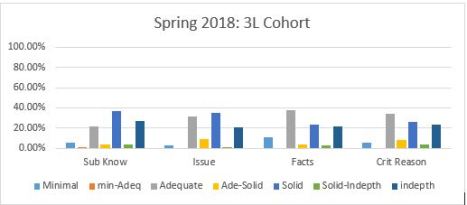
All data was entered from the completed rubrics into one master database and used to create a faculty report identifying student achievement, by cohort year (1L,2L 3L) for each rubric criterion [see sample below].

Lessons Learned:

1. Drafting Rubrics

We struggled to draft rubrics that could be easily adapted to a wide range of courses. If we were starting from scratch, it might have been easier if we used the rubrics drafted by the American Association of Colleges and Universities [AAC&U] as a starting point. Those rubrics have been developed and tested for reliability and validity. They also look at the big picture skills.

Because law faculty often think in context of how individual courses are taught it was sometimes challenging for faculty to start from scratch and draft rubrics that could be easily applied across the curriculum. Starting with the AAC&U rubrics allows faculty members to review examples of language and how larger/generalized program outcomes could be assessed through multiple different teaching methods and in a wide range of courses.

We also learned that it works best if we keep the rubrics to one page per learning outcome. Although outcomes could have a lot of criterion, it is important to identify 4-5 key criteria. Keeping the rubrics to one page forces us to hone in on the critical skills and helps ensure that the process is not overly burdensome for either faculty completing the rubric or staff entering the rubric data. It also makes reporting the data more manageable.

We also found it useful to remind faculty that the institutional rubrics are not meant to capture all skills taught in a given course and that we did not expect all faculty to assess every rubric criterion which is why we included a “N/A” [not applicable] choice for each criterion.

Finally, we found it helpful to emphasize that while we cannot change the rubrics mid-year, we welcome feedback and are open to changing future rubric iterations based upon faculty input. This keeps the faculty engaged and ensures the rubrics are as meaningful as possible.

2. Labeling Criterion Levels

Originally, we drafted rubrics and labeled each criterion level with word descriptors such as: needs significant help; developing; competent; and aspirational. Faculty found those labels more confusing than helpful. We thus changed the continuum labels to: level 1, level 2, etc. This change made it easier for faculty to focus on the descriptors along the continuum, rather than the achievement labels. It also eliminated any concerns about how the data collected could be used in the future, either internally or externally, to describe the quality of current and future graduates.

3. Data Compilation and Report Format

We chose a wide variety of 1L and upper level courses to get a robust data sample. In each course assessed, the professor completed a rubric for each student. Professors used anonymous exam numbers for the rubrics, just like for grading.

Initially, each rubric submitted was a data point. However, we realized that some students were taking multiple courses used in our data collection while others took only one course. To address the issue of “double counting” some of the same students, we changed our data entry system so that each student became a data point.

To the extent students took multiple courses where the outcome was measured, and they were rated differently by different professors, we averaged their score. Thus, if a student was at a Level 2 in issue spotting in Con Law II and a level 3 in issue spotting in Administrative Law, the student was entered into the program as a 2.5 for issue spotting. That also allowed us to have a more granular final report because instead of having four levels, we had seven.

The charts below illustrate what final data compilation might look like using that data entry system.

ACchart

ACC3

After experimenting with developing a software program to compile the data, we discovered it was cheaper, and significantly simpler, to use excel for data entry and basic data compilation. The excel option also allows for future entry into SPSS for additional correlations or data analysis.

As we move forward in assessing additional outcomes this year, we are experimenting with moving from hard copy to electronic rubrics to ease the administrative burden of data entry of hard copy rubrics.

There are multiple software options, such as Qualtrics, that allow for the same questions included in hard copy rubrics to be organized electronically for reports to be run quickly and efficiently.

4. Using the Report Data to Improve Learning

After compiling the data, the assessment committee reported out the analysis in a short, factual report to the faculty using the chart format above and some additional explanatory narrative.

Throughout the reporting process and ensuing discussions about how to use the data, we reminded faculty that the point of outcome measures is to improve student learning [something we all care about].

We also were very upfront about issues with methodology that produced imperfect results, and we reminded faculty that our goal was an overview, not a publishable paper. Reminders about why we are engaging in the process and transparency about imperfections in the process went a long way toward moving the discussion forward.

We used the report as a starting point for a big picture discussion. After briefly reviewing the report with the faculty, we asked the faculty to break out into small groups and answer questions such as: given the data on 1Ls, are we satisfied with where our 1Ls are at the end of the first year? If not, what changes should we consider to help improve their learning?

By engaging the faculty in answering specific questions, we got great feedback that we turned into recommendations/action steps that led to further discussions. Eventually we adopted action steps that we have begun implementing in the hope that we can improve student learning. For example, based upon the data and the experience using the rubrics, faculty agreed to develop criterion-referenced rubrics for their own courses so that students had more information than simply a curved grade by which to assess their progress.

Conclusion

Institutional outcomes assessment is a new process for most law schools. It is also an iterative one. We learn as we go along and make changes as necessary. At GSU, we changed our data compilation methods and tweaked the rubrics. We expect to continue rubric revision as we become more familiar with the process.

What we have learned is that the rubric assessment process is fairly easy to implement, cost-effective, and can provide us useful information as we continually strive to improve our students’ learning.

What’s in a Name? Teaching Implicit Bias

Every semester I weave into my classrooms several opportunities to teach about implicit bias. I have shown videos like this and led discussions on articles like this.

Last week in my Family Law Clinic seminar, we discussed Peggy McIntosh’s Unpacking the Invisible Knapsack, which describes the author’s quest to overcome her biases stemming from white privilege. A student shared their pain and frustration over college and law professors never using their full name, and often mispronouncing the parts of their name the professor is willing to speak out loud. “It’s dehumanizing,” my student said.

Those words have haunted me all week. Names are fundamental parts of human identity. Why can we, as educators–members of an elite profession–not get this right? Why is it not a norm in higher education for professors and teaching assistants to learn to pronounce every student’s name?

Also this week, I read in a memo from a colleague a to-do item along the lines of “practice pronouncing graduates’ names.” The colleague was sharing with me tips for the job I will soon begin: associate dean for academic affairs. One privilege of this job is reading the names of all Penn State Law graduates at the annual commencement ceremony. It was profoundly touching to learn that my colleague takes the time to practice every graduate’s name–and they felt it important enough to share with me as one of a handful of their significant monthly action items.

I give all my students the opportunity to share the pronunciation of their name with me on the first day of class, on note cards I keep with me at every class. An earlier post explained more about the note card system, which I learned from fellow blogger Paula Schaefer. Pronouncing each student’s name is challenging, and I sometimes falter. Last semester I began writing the pronunciations on my seating chart, to minimize my fumbling through the note cards. This is my seventeenth year of teaching. My only regret is not starting this earlier. It enriches my classroom, and it enriches me. It bakes into my pedagogy an indirect lesson about implicit bias, a lesson I re-learn every time I call on a student and say their name, whether it is Ainslie or Zhao-Ji.

New Blog on Teaching and Learning Features Contributions from Law Faculty

Touro College has launched a Teaching and Learning Exchange Blog that all are welcome to drop in on.  Some of the recent posts discuss topics this Best Practices blog has highlighted in the past. For example, recent postings from four law faculty include: Laura Dooley , Hypo Hell: Using Short Form Questions in Class to Engage Students with Important Texts; Jack Graves, Multiple Choice Questions as an Integral Part of an Effective Assessment Regime; Dean Harry Ballan (and Dylan Wiliam), In Defense of Multiple Choice; and Meredith Miller, Day One: You Never Get a Second Chance to Make a First Impression.  Other interesting posts from faculty across the College include: Attention, Memory, and  Learning: What Do We Know? So What?, “I’m Not an Actor?” and Curiosity Feeds the Cat. Please bookmark this blog, facilitated by Dr. Rima Aranha.

Leadership Courses: Paving the Path for Future Attorneys

Written by: Dean Rosemary Queenan, Albany Law School; and Dean Mary Walsh Fitzpatrick, Esq.


There is a call to action to provide students with the opportunity to build leadership skills. This call originates, in part, from the changing legal services environment and the recognition that lawyers need to know more than the law: they need to master many disciplines that are commonly and collectively referred to as “leadership” skills. Broken down into its separate parts, leadership may include communication, teambuilding, organization, presentation, active listening skills, and a cadre of emotional intelligence competencies.

To answer the call, Albany Law School has developed and added to its course offerings a new Lawyers as Leaders course, which is being taught collaboratively by Mary Walsh Fitzpatrick, Assistant Dean for the Career and Professional Development Center and Rosemary Queenan, the Associate Dean for Student Affairs. The course will use skills-building exercises and constructive feedback to allow students to practice leadership skills. Students will create their own organizations and will be assigned to take on leadership roles in performing certain tasks including identifying a vision for their organization, managing and working with teams, making difficult decisions, navigating difficult conversations, presenting and communicating effectively and problem solving.

Our first class focused on a discussion of the work of Carol Dweck, Ph. D., Peter Senge, Ph. D., and Daniel Goleman, Ph. D., on mindset, emotional intelligence, and leadership styles, in the context of our broader discussion of what makes a great leader. With this introduction, students were asked to assess and identify their own leadership styles and emotional intelligence attributes. Each organization was also asked to research a leader in business or law and present on that leader’s failures and successes in leadership.

We are looking forward to this first-of-its-kind course to be offered at Albany Law School and are confident that every student will benefit in some way from the experience. Stay tuned, as we will provide updates on our progress and outcomes along the way!

Letters raise concerns about changes to the bar pass accreditation standard

Early next week, the ABA House of Delegates will again vote on whether to approve a revised bar passage accreditation standard [Standard 316]. The Society of American Law Teachers and the ABA Diversity Entities both have written to the ABA House of Delegates setting forth significant concerns about the proposed standard change.  Both letters are worth a full read.

Amongst the issues the letters raise about the proposed change are the following:

1.  There is incomplete data about how it will affect HBCU’s and other law schools with significant enrollment of people of color;

2.  It fails to account for state bar exam cut score differences and differences in state bar exam pass rates;

3.  It may result in even greater reliance on LSAT scores in the admissions process despite studies showing the scores’ limited predictive value for academic or bar exam success at many schools and despite warnings from the LSAC about how to use the scores properly in the admissions process;

4.  It may negatively impact schools willing to take a chance on students who are poor standardized test takers but who will be excellent lawyers and leaders if given the opportunity to attend law school and the coaching necessary to pass the bar exam;

5.  It does not consider the effect of transfer students on bar pass rates for schools that admit students who otherwise would not be admitted to law school, who perform well, and who then  transfer to other institutions;

6.  It eliminates some important aspects of the current Standard that take into account varying state pass rates, a school’s mission, the transfer issue, and the fact that improving bar passage is a complex and nuanced issue that requires study and experimentation [something currently underway at many schools];

7.  Now is not the right time for change given current studies about the validity of the bar exam as a licensing method and work being done to explore law licensing assessments that better measure who will be a competent attorney.

Proponents of the proposed change to Standard 316 believe it is necessary to protect consumers from law schools that admit students without devoting the necessary resources to ensure bar passage or that admit and retain students who have no chance of obtaining a law license.  The letters cited acknowledge the importance of the consumer protection issue but argue that issue can, and should, be addressed in other ways.

If you have concerns about the proposed change to Standard 316, contact your state ABA delegate.  The delegate information starts on page 13 of the ABA 2018-2019 Leadership Directory.

A Fresh Look at the Uniform Bar Examination

The bar exam is back in the news. Later this month the ABA House of Delegates will consider a proposal to raise the bar-passage standard. The proposal would require that 75% of an accredited law school’s graduates pass a bar exam within two years of graduation.

In most states, bar exam means the National Conference of Bar Examiners’ Uniform Bar Exam. The UBE has been adopted by 35 jurisdictions and is under consideration in others. It carries the endorsement of many ABA-related entities. They include the Conference of Chief Justices, the Law Student and Law Practice Divisions, the Section of Legal Education and Admissions to the Bar, and the House of Delegates.

As a reminder of the features of the UBE, and an update on the pace of its adoption, I have accepted Mary Lynch’s gracious invitation to reblog my recent post “Will the Uniform Bar Exam Come to Michigan?” from the Western Michigan University-Cooley Law School blog. (Spoiler alert: no time soon.)

Leadership Education in Law School: You’re Already Providing It

Regardless of whether they think of themselves as leaders, our law students will play a leadership role for the rest of their lives. Certainly many will be leaders in their local legal community, in their law offices, and in various bar associations. But beyond that, all lawyers will be expected to lead outside of their law practices. As a lawyer (and sometimes the only lawyer) in their community group, family, or organization, they will be looked to for leadership.

Just as our students may not recognize themselves as leaders, we may not recognize ourselves as teachers of leadership. But we are. Most of our classes provide excellent opportunities to talk about leadership, even if “leadership” is not in the title. And we model leadership in how we treat our students and other members of the law school, how we contribute to and connect with our communities, and how we help move our law schools forward to address the changing profession.

Recognizing the growing interest in leadership education for lawyers, the AALS Section on Leadership was chartered in November 2017. The section describes its purpose as promoting “scholarship, teaching, and related activities that will help prepare lawyers and law students to serve in leadership roles.” This section is a great place to start for a law professor who wants to learn more about leadership education.

Law professors interested in getting some innovative ideas for integrating leadership-related topics into their classes should consider attending a workshop and roundtable at the University of Tennessee College of Law on April 4-5, 2019. The program is titled Leadership Development for Lawyers. The “workshop” day of the program will give attendees the chance to choose two of four interactive sessions: collaborating with career services; integrating well-being into leadership curricula; assessing leadership development efforts; and effective leadership skill development exercises. Then, the “roundtable” day of the program will provide an opportunity for conference attendees and panelists to share ideas and experiences in leadership education.

The goal of the Tennessee workshop and roundtable is to bring together a large group of legal educators who are working in the area of lawyer leadership education–including professors who don’t (currently) think of themselves as “leadership” teachers.


Disruptive Leadership in Legal Education

Nicholas A. Mirkay and Palma Joy Strand*

NOTE: This is an abridged version of the full essay available at: https://papers.ssrn.com/sol3/papers.cfm?abstract_id=3309981

“The act of leadership is not always comfortable.”[1]

Last spring, the Wall Street Journal unveiled “The Captain Class,” a new feature focusing on “the lessons and strategies of leadership.”  The inaugural column by reporter Sam Walker focused on leadership changes at Boeing over the last decade when its Board of Directors intentionally hired Jim McNerney, a “disruptive leader,” to redirect the company’s trajectory.[2]  “The company had been floundering, and the digital revolution was barging down the gangway.” The landscape for Boeing’s business had transformed, and Boeing needed to adapt.

Disruptive leaders who reorient institutional culture, Walker observed, necessarily “embrace conflict, are ruthlessly direct, and intellectually irreverent.”  Theoretically there is a “gradual way to renovate a proud old institution,” but change rarely unfolds that way.  Rather, “[h]istory shows that it usually comes down to one determined individual—someone who bursts through the door swinging a 7-iron.”[3]

While neither of us regularly swings a 7-iron, to our own surprise we recognized ourselves in the description of disruptive leaders prodding a proud old institution to evolve to meet a changing environment. Two years ago, both of us were full, tenured professors at the Creighton University School of Law.  We sought to position the law school as a leader in responding to the shifting and uncertain landscape that currently characterizes law, the legal profession, and legal education.  Because of institutional resistance to change, however, neither of us remains in our former positions.  One of us is now a tenured Professor of Law at the University of Hawaiʻi Richardson School of Law; the other is still at Creighton and still a tenured Professor of Law, but no longer in the School of Law. 

Legal Education is Ripe for Disruption

Legal education is ripe for disruption because the legal profession and law itself are ripe for disruption.  The crisis in legal education reflects an increasing mismatch between the limited services that law and lawyers provide and vast and acute societal needs for legal services. 

In addition, law has become increasingly attenuated from justice in the sense of contributing to the creation of “right relationships” between and among people.  Because law is inaccessible to most individuals, it is irrelevant to them except as they are subjected to bureaucratic regulation by the government.  Law has become a burden rather than a useful tool for people figuring out how to live together.  A significant proportion of students come into law school seeking to work for justice, yet law school and the legal profession too often send the message that justice is irrelevant.

Nontraditional processes that allow for coordination, collaboration, and conflict engagement and resolution have already overtaken courtroom and law office services.[4] Arbitration, mediation, restorative justice, collaborative governance, LegalZoom, negotiated settlements and regulation, and more were once secondary to litigation and other lawyer-dominated processes.  The balance has now tipped, yet the focus of legal education and the legal profession on lawyers obsessively grooms the traditional tail while ignoring the ever-evolving dog.

As a result, legal education is “at a crossroads…legal educators should be talking about an entirely new business model.”[5]  Law professor William Henderson, who analyzes the legal profession and legal education, concurs:  “Legal education and the legal professions are at an inflection point where traditional models of education and practice no longer fit the shifting needs of the market.”[6] In a recent speech on “The Future of Legal Education,” departing Brooklyn Law Dean Nick Allard described change in the profession as “inevitable” and warned that “clinging to the ‘business as usual’ status quo” is not a viable option.[7]  At the same time, Allard characterized the legal profession and legal academia as “always slow and even resistant to adaptation.”[8]

Lawyers need not be the only providers of legal services.  Doctors today work alongside not only nurses but other health care professionals with diverse training and diverse skills; these teams extend the reach of the health care system.  Similarly, with additional legal professionals, the work of lawyers could reach much further than it does at present.  There has been a recent uptick in the number of persons taking the LSAT[9] and applying to JD programs in law schools.[10] While this trend lulls law schools back into comfortable reliance on the JD, a few additional lawyers will not meet the pressing demand for legal services.

The Opportunities and Pitfalls of Disruptive Leadership

When we arrived at Creighton School of Law, one of us in 2007 and the other in 2011, each of us had been faculty members at other law schools.  We saw Creighton’s small scale and personal relationships in Nebraska as creating an ideal environment for innovation and for nimble responses to the documented lack of legal services in both urban and rural parts of the state.  We were energized by the opportunities presented at a small regional private law school with close ties to the local legal community and the state bar.  We were particularly excited by Creighton’s Jesuit mission of service to others and its expressed commitment to social justice endeavors to form graduates and benefit the community.  A new, yet already nationally-recognized program in Negotiation and Conflict Resolution provided in-house expertise in innovative approaches that complement and expand the effectiveness of traditional law.

Within two years, however, a cohort of fellow faculty members, drawn predominantly from the ranks of those with the most seniority, had negatively branded us “reformers” who were seeking to move students away from “real law.” Overall, our relatively mild exercise of disruptive leadership through leadership in strategic planning and assessment, which envisioned a robust Law School response to fundamental shifts in the legal landscape, was met with a level of blowback that neither of us could have imagined.

In the face of this resistance, which escalated into a personal attack and to which a fledgling University administration capitulated, both of us sought and secured other academic appointments.  The newly-hired dean was “invited” to move out of the administrative suite and into an office on faculty row after an unexpected sabbatical year.  The Negotiation and Conflict Resolution Program was transplanted to a Department of Interdisciplinary Studies in the Graduate School and its expertise and vision quarantined from the JD curriculum and students.

Academic Resistance to Change: Tenure, Academic Freedom, and Administrative Disinterest

Though legal education in the abstract may be ripe for disruption, disruptive leadership in a real-world law school setting is a tough and potentially perilous road.  Legal education is closely tied to the legal profession, and as long as lawyers have a monopoly on law, changes in legal education that respond to broader imperatives will face the challenge of not being “real law” because the entry to the legal profession lies exclusively through the straitjacket of the bar exam and admittance to a state bar.  Further, placement of legal education in universities subjects it to academic constraints that dampen potential change initiatives.

We see three characteristics of academia in general—characteristics that are not limited to legal academia—that contributed to resistance to our disruptive leadership and that are likely to ground resistance to disruptive changes in legal education generally.  The first characteristic is tenure.  Academic tenure, intended to protect and encourage open discourse, has the additional effect of protecting entrenched faculty and perpetuating institutional inertia.  The most seasoned and senior engineers at Boeing have less job security than the least productive tenured faculty member at an average college or university.  Tenure gives faculty members who resist change a powerful and easily wielded weapon:  They can choose to “not go gentle into that good night” but “[r]age, rage against the dying of the light.”[11] 

The second characteristic, related to the first, is academic freedom.  The lofty goal of academic freedom is to ensure the free and fair dissemination of views and ideas. But academic freedom can turn from shield to sword. The claim that academic freedom is being infringed can be used to challenge administrative efforts to monitor academic quality through program assessment.[12]   Even more troubling, “academic freedom has been claimed as an excuse for the most abusive and uncollegial behavior—shouting at colleagues, publicly berating students or staff members, defaming supervisors or other university administrators, shirking professional duties.”[13] 

Third, the imperatives of university administration and governing boards focus on raising funds and maintaining tradition rather than on responding innovatively to shifting economic and social dynamics.  University presidents spend a substantial portion if not a majority of their time fundraising,[14] often appealing to alumni,[15] whose views of the school necessarily look backward rather than forward.[16] University presidents and provosts may also lack essential knowledge regarding “research on innovation and their own role in the process”[17] as well as essential leadership skills, especially those related to change and conflict.  Nonprofit board members are accountable by law for fiduciary duties owed to the institution, but these duties are enforced only rarely by the Attorney General of the state in which the organization is chartered.

Law School Exceptionalism: Monopoly and Gender Dominance

The dynamic between university administrators and law schools is especially likely to be inhospitable to necessary changes.  For decades, law schools were cash cows for universities: Large class sizes and minimal hands-on clinical offerings led to law school revenues that supported other academic programs across campuses.[18]   Because of law school financial contributions, university oversight was relatively deferential, and both central office administrators and law faculty grew accustomed to laissez faire management.  Add in accreditation of law schools by the ABA, which until very recently did not even require meaningful assessment of JD programs, and you have a recipe for habits of non-accountability.  Moreover, university administrators may well be cautious about taking on entrenched and tenured law faculty who as lawyers might be expected to be relatively litigious, as we experienced. 

Two additional characteristics of legal education in particular contribute to militant resistance to disruption.  The first is the ABA’s monopoly on both the practice of law and the accreditation of law schools.  According to Professor Henderson, the legal profession is currently challenged by an environment in which “the cost of traditional legal services is going up, access to legal services is going down, the growth rate of law firms is flat, and lawyers serving ordinary people are struggling to earn a living.”[19]   Lawyers, who themselves are JDs and graduated from law schools configured to meet 20th-century needs, are in control of how legal practice is defined and regulated and of setting barriers to entry.  Lawyers wield “unauthorized practice of law” sanctions as a protection against competition despite the fact that much of the law that non-lawyers seek to practice is law that lawyers find tedious and unprofitable.[20]  

The effects of this monopoly are compounded by a second characteristic of law and legal education: a lack of diversity.  Law and legal education today remain highly gendered: Men and traditionally masculine norms permeate the profession and continue to dominate in law schools even as student enrollment approaches gender parity.[21] The two of us began collaborating as institutional leaders at Creighton as members of the School of Law’s Strategic Planning Committee.  Both of us had been elected by the faculty.  One of us (Nick) was Chair; the other (Palma) was a member who had served on the Committee for a number of years.  It was evident that we enjoyed working together and that we were a strong team.  After one contentious strategic planning meeting, a very senior (white male) member of the faculty made a point of warning Nick (via another colleague) that Palma was “emasculating” him.  A group that has been dominated by a single gender may resist a shift in gender dynamics as well as changes in practice initiated by more diverse decisionmakers.[22]

The Non-Ethics of Non-Disruption

Legal education is ripe for disruption, and disruptive leaders can challenge conceptual mindsets constructively, using technology and data analytics to map changing landscapes and reframe conversations about the future.[23]  In a changing world, adaptation allows organizations to not just hang on but to thrive. 

The casualties of law schools hanging on to the familiar are the students—the very people an educational institution exists to serve.  Is it ethical for law schools to mindlessly continue to train students for a profession that is shifting under everyone’s feet?  Is it ethical for the legal profession to wring its hands about “access to justice” while maintaining its protectionist posture?  Is it ethical for university administrators to pocket law student tuition dollars knowing that the debt those students incur is buying them an education that is unlikely to render them financially secure?  These are the unwelcome questions that disrupters in legal education should be raising – and that law and the legal profession should join in addressing.


* Director of Faculty Research and Professor of Law, University of Hawaiʻi Richardson School of Law, B.S.B.A. Saint Louis University (1989), J.D. University of Missouri (1992), LL.M. Georgetown University Law Center (1996); Professor of Law and Director, 2040 Initiative, Negotiation and Conflict Resolution Program, Department of Interdisciplinary Studies, Creighton University, B.S. Stanford University (1978); J.D. Stanford Law School (1984); LL.M. Georgetown University Law Center (2006).  We thank colleagues, past and present, who reviewed and commented on this essay.

[1] Sam Walker, One Leader Sent Boeing Into a Hurricane; Landing It Was the Next Guy’s Job,  The Wall St. J. (2018) https://www.wsj.com/articles/one-leader-sent-boeing-into-a-hurricane-landing-it-was-the-next-guys-job-1524821400.

[2] Id.

[3] Id.

[4] See, e.g., Oralandar Brand-Williams, More disputes in Mich. settled through mediation, The Detroit News (2018), https://www.detroitnews.com/story/news/local/wayne-county/2018/03/29/mediation/33406027/; and https://thelawdictionary.org/article/what-percentage-of-lawsuits-settle-before-trial-what-are-some-statistics-on-personal-injury-settlements/.

[5] Huffman, supra note 4.

[6] Bill Henderson, What signal are legal employers sending to legal education?, Legal Evolution (2018), https://www.legalevolution.org/category/legal-education/.

[7] Paul Caron, Allard: The Future of Legal Education, TaxProfBlog (June 20, 2018), http://taxprof.typepad.com/taxprof_blog/2018/06/allard-the-future-of-the-legal-profession.html.

[8] Id.

[9] Debra Cassens Weiss, Increase in LSAT test takers seen as evidence of ‘Trump bump,’ ABA Journal (2017),http://www.abajournal.com/news/article/increase_in_lsat_test_takers_is_seen_as_evidence_of_trump_bump.

[10] Karen Sloan, Number of Law School Applicants Surges, Especially Among High Scorers, Law.com (2018), https://www.law.com/2018/07/30/number-of-law-school-applicants-surges-especially-among-high-scorers/.

[11]Dylan Thomas, https://www.poets.org/poetsorg/poem/do-not-go-gentle-good-night.

[12] Timothy Reese Cain, Assessment and Academic Freedom: In Concert, not Conflict (Nov. 2014), http://www.learningoutcomesassessment.org/documents/OP2211-17-14.pdf.

[13] Gary Olson, The Limits of Academic Freedom, Chron.  of Higher Educ. (2009).

[14] Mitchell Wellman, 3 things college presidents spend all their time doing, USA Today (2017), http://college.usatoday.com/2017/01/27/3-things-college-presidents-spend-all-their-time-doing/.

[15] Rick Seltzer, Giving to Colleges Rises by 6.3%, Inside Higher Ed (2018), https://www.insidehighered.com/news/2018/02/06/personal-giving-pushes-donations-colleges-and-universities-new-level-2017.

[16] Robert M. Diamond, Why Colleges Are So Hard to Change, Inside Higher Ed (2006), https://www.insidehighered.com/views/2006/09/08/why-colleges-are-so-hard-change.

[17] Id.

[18] Megan McArdle, Law School Enrollments are Plummeting. What Happens Next?, Daily Beast (2013), https://www.thedailybeast.com/law-school-enrollments-are-plummeting-what-happens-next.

[19] William D. Henderson, Legal Market Landscape Report (July 2018), https://taxprof.typepad.com/files/henderson.pdf.

[20] See, e.g., Roy Strom, California Bar to Consider Changes to Nonlawyer Ownership Rules, The Am. Law. (2018),https://www.law.com/americanlawyer/2018/07/23/california-bar-to-consider-changes-to-non-lawyer-ownership-rules/.

[21]See, e.g., American Bar Association Commission on Women in the Profession, A Current Glance at Women in the Law (January 2017) (legal profession), https://www.americanbar.org/content/dam/aba/administrative/women/a-current-glance-at-women-in-the-law-jan-2018.authcheckdam.pdf; Dara Purvis, Female Law Students, Gendered Self-Evaluation, and the Promise of Positive Psychology, 2012 Mich. St. L. Rev. 1693 (legal education).

[22] See generally, Gabriella Gutiérrez y Muhs, et al., Presumed Incompetent (2012).

[23]Disruptive Leadership: A Recipe for Success, The Wall St. J. (2018), https://deloitte.wsj.com/cio/2018/07/09/disruptive-leadership-a-recipe-for-success/.

Ode to Librarians

Librarians are the nicest, most helpful people I have ever met.  I don’t remember meeting any librarian who wasn’t.

They are particularly helpful for students, teachers, and scholars – like most of the readers of this blog.  Although librarians sometimes get acknowledgment, often they are unsung heros who bail us out when we have desperate last-minute requests to find hard-to-find stuff.  And somehow, they usually do find what we need.

I was prompted to think of them by a recent episode of This American Life devoted to librarians.  It features three stories of very unusual situations when librarians were especially helpful. Check it out.