
AALS Conference ABA Accreditation Standards Panel – Requiring Law Schools to Measure Student Learning

Today at 4pm,  Standards Review Committee presented on the current draft  revisions to the ABA accreditation standards  and according to the conference materials on “this directional change in legal education. ”  I was delighted to hear Professor Margaret Martin Barry introduce  the panel presentation with a quote from Roy Stuckey urging the Committee to focus on the importance of reflection (which you can read about in the last post and which Roy posted on the ABA site).   Dean Steve Bahls, Chair of the Standards Review Committee, described the process which led to the current version of the proposal. He reminded the audience “that the train has not yet left the station” with respect to outcomes based accreditation and that the current draft of the proposed standards has not even reached the point to be published for comment. Instead, he insists that the “train” is still being built with respect to how to revise accreditation; he  invited written comments on the proposed standards by March 15th.  

Other panelists provided examples of the University of Dayton’s Law School’s outcomes and assessment process and of the finalized outcomes-based process used to accredit Pharmacy schools. Former AALS president Nancy Rogers expressed concern about the cost of requiring outcomes-based learning in this economic environment and queried about whether the “value added” was worth it. 

 The floor was then open for questions.  Questions ranged from “What’s the problem with the way things are?” to asking the review commission to focus on professional development of faculty as teachers.   Professor Elizabeth Schneider, chair of the the Curriculum Committee of the ABA,  expressed concern about the committee’s focus on ensuring summative assessment of outcomes as opposed to formative assessment which is the focus of much of the exciting work being done currently in legal education.  I expressed concern about the recent revision’s conflation of simulation courses and live-client clinics and encouraged the committee to review Roy’s comments on this issue. 

Bottom line – whether the train is in the station ready to leave or being assembled car by car – now is the time for all good folks to weigh in on standard revisions.

Orientation Programs

A fun aspect of getting a few gray hairs: we might be around long enough to see our ideas come to fruition.   Some years ago I wrote about the important role of experiential learning in providing context for law students.  Passion, Context, and Lawyering Skills: Choosing Among Simulated and Real Clinical Experiences, 7 Clin. L. Rev. 123 (2000) and Infusing Passion and Context into the Traditional Curriculum Through Experiential Learning, 51 J. Legal Educ 51 (2001). Continue reading

International Perspective on Best Practices Blog

I bet some of you missed the fact that October 5th is World Teachers’ Day.  Yeah for us!  Rah for the team!

The UK’s Centre for Legal Education’s Digital Directions notes that the Best Practices blog is the only blog “focused on legal education as their primary theme.”    We’ll be delighted when we no longer hold that distinction.  And, we’re optimistic the day is coming, given the ferment in legal education.

ABA Top 100 Blawgs

The ABA Journal is conducting its annual survey to find the Top 100 legal blogs (blawgs).  Please take a minute to vote for Best Practices! Your support is very much appreciated.
                                                                                                   Thanks, 
                                                                                                   The Best Practices Bloggers

Counting Clinical Opportunities

I just finished writing a letter to the editor of National Jurist about the magazine’s ranking of the “Best Law Schools for Practical Training” in the September issue.  They don’t have a letter to the editor section, so I don’t expect it to get it published, but I did want to educate the magazine about Best Practices and Carnegie.  The methodology of the ranking was apparently to count the total number of students enrolled in the school and divide that by the number of clinical spots available and then rank the law schools based on that quotient. 


At a law school like New Mexico which has a mandatory clinic, they apparently only counted the mandatory clinic slots (about a third of the student body since clinic is normally taken in the third year of law school).  We ended up ranking 14th.  I realize that is pretty good, but then the article states that the top school, Yale, offers clinical opportunities to 90% of its student body.   Of course, schools such as UNM, CUNY, UDC and others that require clinic for graduation offer clinical opportunities to 100% of the student body.  So, I am unsure how a school that offers clinic to 90% of its students is ranked higher than those schools that offer it to 100% of its students.  In addition, the raw numbers fail to take into account the rest of the law school curriculum and its commitment to training that is consistent with Best Practices and Carnegie. Of course, the schools that were ranked at the top of the survey are excellent schools and likely to do well, in large part, because of their commitment to clinical legal education


Roy Stuckey has asked whether someone should evaluate law schools based on the ideas in Best Practices.  While it is great that magazines such as National Jurist are interested in writing pieces about practical education, given these quantitative types of rankings, the idea of some qualitative evaluation would be a service to future law students. 

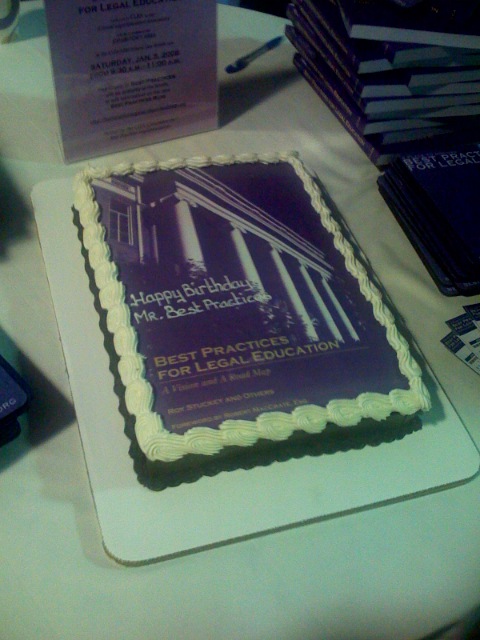
Mr. Best Practices’s Birthday

More Fun at AALSMore Happy Birthday RoyHappy Birthday Roy! 

Happy Birthday Professor Roy Stuckey!   Roy’s birthday was celebrated at the AALS Annual Conference. 

Input & Ideas from Jan 08 AALS Conference

It ‘s a new year for Blogging and here we are in the Exhibit Hall at the AALS Conference.  Come visit us on the 1st floor, make a left and go all the way to the end and you’ll find us against the wall!   Interestingly, we are right next to Harvard University Press! 

Conference attendees: please provide us with suggested blog topics.  Let us know what  to add to the Best Practices Blog resources.  How can we improve on the Blog format? To provide input and ideas, please reply to this post (below). Thanks for participating in this collaborative, progressive endeavor!

Mary A. Lynch,Albany Law School 

Blog Editor, Best Practices Implementation Committee 

Best Practices Author Responds in TaxProf Blog

Read it here- http://taxprof.typepad.com/taxprof_blog/2007/10/roy-stuckeys-ad.html