March 30th is Final Deadline for Proposals — Emory Law’s Conference on Teaching Transactional Law and Skills (June 1-2, 2018)

Hello All.

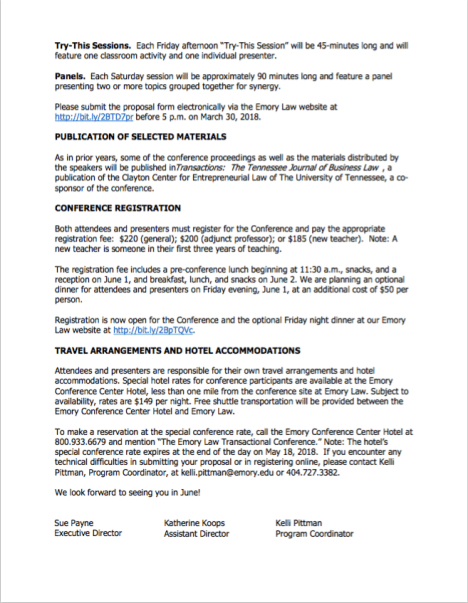
The end of the school year is fast approaching and we want to give you one last chance to submit a proposal demonstrating what you are doing to foster excellence in the teaching of transactional law and skills.

Therefore, we’ve extended the proposal deadline through Friday, March 30, 2018.

Please submit your proposals as soon as possible. After March 30th, we’ll turn all of the proposals over to our Program Committee, who will notify those accepted and begin putting together the Program Schedule.

Even if you do not submit a proposal, please register for the conference now.

We are reaching far and wide to embrace the whole community of transactional law and skills educators, so please encourage your colleagues – including new teachers and adjunct professors (both at reduced registration fees) – to join us. It will be a wonderful time to gather, talk, share, teach, learn, and celebrate.

Sincerely,

Sue Payne, Executive Director

12


Re-assessing the “drive” to measure learning outcomes

A recent NY Times editorial, “The Misguided Drive to Measure ‘Learning Outcomes” by Molly Worthen, prompted revisiting the purpose-driven nature of what are labeled “educational” trends and this trend in particular – especially as it relates to legal education. Although quantifying “learning outcomes” has been pushed at the secondary and undergraduate levels for a while, it is now being required of legal educators.  As a lawyer and legal educator faced with the direction to set and measure learning outcomes, I have found myself conflicted in part because I find its limitations and the funneling nature of metrics incongruous with its language of education drawn from Bloom’s taxonomies.  There is also a current of politicization in the “drive.” In the end, the unique responsibilities of law school faculty as lawyers and in planning and implementing a school’s educational program is significant. Those roles inform the use and effectiveness of setting goals and actively paying attention to our effect on students – after getting past the lingo, of course.

At the outset, I found myself skeptical of the trend’s origins as an “educational” tool at all.  As the Worthen piece points out, although the push to quantify undergraduate learning is about a hundred years old, the real drive grew in the 1980’s. That decade’s impetus for quantification of teaching came during a time known for materialism, yuppies, the rapid growth of technology, and then President Reagan’s promise to return  prayer to school. Given this origin in an era of consumerism and growing talk of “liberalism” in higher education, it is readily inferrable that assessing learning objectives was the product of accreditors and the institutions they control with financial and conservative goals; see, David Clemens “Student Learning Outcomes and the Decline of American Education,” August 31, 2016, fostering assessment less as an educational goal and more as a means of control.

Moreover, the idea of “measuring outcomes” is inherently a business or economics concept or a concept more aptly used when discussing computers; it thus seems inapposite in legal education unless education is truly primarily a business or the language is adapted.  Outcomes, inputs, and outputs are terms used when major donors, for example, look for data-driven proof that their resources produce something.  Outputs are readily measureable.  Outcomes, the effect on people served that occurs because of the resource use, are much less readily measureable.  A donor then withdraws support when outputs don’t exceed inputs or outcomes are unmet.  Worthen notes that outcomes measurement was extended to undergraduate education because of accrediting agencies that demanded a form of learning assessment as a means of demonstrating fitness to receive federal student financial aid – a sort of stand-in for the donor as fund provider.  The telling part of the development of learning outcomes measurement is its push from employers.  Worthen wrote “Employers report repeatedly that many new graduates that they hire are not prepared to work, lacking the critical thinking, writing and problem-solving skills needed in today’s workplace” quoting then President Bush’s 2006 Commission on the Future of Higher Education’s Report.  I’m hard pressed to find teachers or professors who demanded development of assessments.

The direct pressure to produce learning outcomes in legal education comes from the ABA – likewise after major law firm employers similarly decried a lack of practice readiness in student graduates. Their complaints arose concurrent with a downturn in the economy that led those same employers to reduce their internal practice training.  With law schools pushed to the consumer, business model of delivering education, the slide into measuring outcomes has occurred despite criticism.

And, much of what is written about measuring learning outcomes other than by its developers is highly critical. Several early critical articles start from the position that significant aspects of education are simply not measurable because in part, education is a process, not a product a la Jerome Bruner. Thus, they argue, attempting to “measure” learning outcomes is inconsistent with good education. E.g.,  James Mckernan, Some Limitations of Outcome-Based Education. Journal of Curriculum and Supervision. Volume 8. 343-353 (1993).  That critique suggests measuring learning outcomes assumes knowledge can be broken down into “micro-outcomes” in disregard of the epistemology of knowledge (Mckernan) as theorized by some like Herbert Dreyfus to include background and experience that cannot be readily measured. Others criticize outcomes measurements for shifting the emphasis from learning to some kind of outcome at all, thereby ignoring the open-ended nature of education and encouraging rigidification of curriculum and perspective.  E.g., The Unhappiness Principle (November 29, 2012)  https://www.timeshighereducation.com/the-unhappiness-principle/421958.article . In a related way, still others have criticized the move toward measuring “learning outcomes” because a teacher’s success is dependent on whether students learn regardless of what students bring to the classroom referencing post cognitive learning theory and because targeting “outcomes” encourages teaching to the middle or bottom of a class to meet stated outcomes while ignoring other students.

Worthen notes as criticism the “obsession with testing that dominates primary education [has] invaded universities” pointing out a focus and resource shift to assessment rather than education.  Consistent with this concern about emphasizing testing and assessment over exploration, other authors have pointed to apprehension about how pressure on students to succeed according to measured external standards without cultivating personal morality has led to law student depression and cynicism. See Lawrence Krieger, Institutional Denial About the Dark Side of Law School, and Fresh Empirical Guidance for Constructively Breaking the Silence, 52 J. Legal. Educ. 112 (2002); see also Larry Natt Grantt and Benjamin Madison, Self-Directedness and Professional Formation: Connecting Two Critical Concepts in Legal Education (draft).

At least one critique focused not on educational soundness but more on the regulatory purpose of measuring assessments.  In a piece written for a conservative nonprofit institute, the author wrote “learning outcomes and assessment are not about education at all; they are about control.” David Clemens “Student Learning Outcomes and the Decline of American Education,” August 31, 2016 https://www.jamesgmartin.center/2016/08/student-learning-outcomes-decline-american-education/.  The author went on to note how political sides view outcomes differently though both sides see the outcomes as a tool for control.  “The right sees [learning outcomes] as a way to enforce professor accountability, increase ‘productivity,’ and get rid of bad teachers and junk courses.  The left sees [learning outcomes] as a golden opportunity to promote progressivism through ideological outcomes that students must internalize in order to pass.” The same author went on to note by way of example how selecting outcomes such as “build awareness of the history and context of diversity and social justice in [the State]” are “not the sort of thing” that “my conservative friends had in mind” for student learning outcomes.

Assuming in law schools we somehow adapt the economics terminology to legal education, measuring learning outcomes seems to be a policy that will continue for a time.  In legal education, of great significance, of course, is the responsibility of faculty for setting the program of education. Even revisioning learning goals as learning outcomes, the questions remain: in law school, what is meant by education, what can and what should be measured, and what is there about law and law practice that should form the basis of legal education whether measured.    In a short piece “What is Education? Insights from the World’s Greatest Minds,” https://www.psychologytoday.com/blog/the-moment-youth/201405/what-is-education-insights-the-worlds-greatest-minds, Marilyn Price-Mitchell, Ph.D. offers, among other things, the following about education:

            “The principle goal of education in the schools should be creating men and women who are capable of doing new things, not simply repeating what other generations have done.” Jean Piaget

            “Education is what remains after one has forgotten what one has learned in school.” Albert Einstein

            “Education is the most powerful weapon which you can use to change the world.” Nelson Mandela

            The law, unlike computers and math, is like the people who make it – reasoned but imperfect, biased, aspirational, short-sighted, flawed, reflective of society, and constantly changing; legal education goals should reflect those dynamics.  Although some schools have sought regional accreditation from the same entities that accredit undergraduate schools, legal education itself remains distinguishable from education at other institutions if only because it is governed by a professional set of standards unique to legal education.  The ABA Standard 302 obligates accredited law schools to establish minimum learning outcomes in the following areas: (a) Knowledge and understanding of substantive and procedural law; (b) Legal  analysis  and  reasoning,  legal  research,  problem-solving,  and  written  and  oral communication in the legal context; (c) Exercise of proper professional and ethical responsibilities to clients and the legal system; and (d) Other professional skills needed for competent and ethical participation as a member of the legal profession.  “Micro-outcomes” are not required, and “understanding” is one of the outcomes under the ABA.  It seems counter-intuitive and inconsistent with the goals of legal education that “micro-outcomes” set for other university degrees should somehow supersede ABA standards. For example, though “understanding” seems not to be an appropriate outcome under Middle States standards, it is clearly an outcome under ABA standards. Certainly for purposes of remaining ABA compliant, it seems appropriate to read general education standards in light of the specialized standards of a legal education if only to ensure bar passage and ethical participation as a member of our profession.

Not surprisingly then, beyond knowledge, analytical, and communication objectives, the ABA requires professional skills and ethical responsibilities goals aimed at both clients and the legal system we serve. Consistent with the idea that the law is about people, the people who make and the people who serve and are served by it, ABA Interpretation 302-1 further states that other law schools may determine other professional skills including, among others, “cultural competency.”  Thus, it would seem that while “build[ing] awareness of the history and context of diversity and social justice” may not have been what was initially in the minds of those who pushed for measuring learning outcomes as a way of “increasing productivity,” awareness of cultural differences and building cross-cultural competencies is nevertheless a specifically enumerated learning outcome that law schools may set. Any outcomes created under ABA standards are significant to the how students may come to learn not only the rules, but to view the law in context and in practice.

Despite the economics origin and terminology of “measuring” “outcomes,” and the difficulty in measuring some learning goals in law school – at least those goals in addition to passing the bar exam – perhaps as a colleague suggested, we might recognize the opening to address the context in which law is made and practiced more.  Consistent with our oath’s commitment to uphold the Constitution and ethical participation in our profession, decide what can be achieved in addition to knowledge and understanding of procedural law and practice skills.  Start with the aspirational; establish goals that begin with awareness that can be measured, and then hope for the enlightenment that comes from the experience after awareness all the while recognizing we may not need to measure everything.


Deep Dive into Experiential Education in U.S. Law Schools

In May 2017, Eduardo Capulong (Montana) moderated a lunch presentation at the AALS Clinic Directors Conference on the new experiential education requirement found in ABA Standard 303, which requires one or more experiential courses totaling at least six credit hours.  Standard 303 also explains that an experiential course must be a simulation course, a law clinic, or a field placement.

For my presentation, I prepared an abbreviated history of how the ABA Standards addressed experiential education over the past several decades.  What I found most interesting as I explored the history was the hostility to experiential education by some legal educators from the inception of university-affiliated law schools in the 1870s.   After the presentation, some clinic directors and associate deans for experiential education came up and said that they found the history interesting and that I should write something up.

Well, I responded to their suggestion and started digging more into the history of experiential education in U.S. law schools.  The more I dug, the more surprises I uncovered. While I was struck with the hostility toward experiential education in law schools, some of more surprising findings are:

–concurrent with the hostility toward experiential education was a preference for a law professoriate with little or no practice experience starting in the 1890s;

— the AALS membership requirements essentially served an accreditation function in the first half of the 20th Century and the AALS even applied to be accrediting agency for law schools in 1969;

— the ABA Standards did not require law schools’ educational programs to be designed to qualify its graduates for admission to the bar and to prepare them to participate effectively in the legal profession until 1993; and

— something that may not be new but is still surprising, when the ABA first required “substantial instruction” in professional skills in 2005, “substantial instruction” was interpreted to mean only one credit, and some law schools even resisted that minimal amount of experiential education!

I came to realize that the history of experiential education in law schools is primarily a history of some members of the bar, such as Robert MacCrate, and some legal educators pushing the ABA to adopt Standards to nudge law schools to require some experiential education of all law graduates.  Eventually, that digging into the history of experiential education has resulted in a recent draft article The Uneasy History of Experiential Education in U.S. Law Schools.  This article analyzes the history of the ABA involvement in legal education leading up to the first mention of experiential education in ABA accreditation standards. Next, the article traces the development of the experiential education requirement in the ABA accreditation standards, paying particular attention to how the experiential education requirement has evolved from something law schools should offer to something law schools must require. Finally, the article concludes with some suggestions for the future of experiential education in law schools.  If any of this sounds interesting, you may want to check out the article here.  Thank you!

“Will Law Schools See a ‘Trump Bump?'” A Law Student’s Perspective.

Professor Ray Brescia of Albany Law School wrote an enticing article on the possibility that law schools are experiencing an increase in applicants from prospective students in response to the 2016 election, and Trump’s victory. The link is below, I strongly encourage you all to give it a read.

https://lawandsocialinnovation.wordpress.com/2018/02/23/is-the-law-school-trump-bump-a-thing/

While I personally envisioned attending law school and becoming an attorney from a young age, before the notion of a Trump America was conceived, nevertheless, my motivation to succeed spiked following the election.

I was lucky to begin law school in 2016, as it is a fascinating time to learn the law, procedure, and how the President and his administration’s actions may be in accordance or violation thereof.

I know I am not the only law student that feels this way. Regardless of which side of the political spectrum prospective and current law students reside, we are certainly seeing a time at which the motivation to make a difference is at a high. Students are taking action, whether its writing and calling legislators and senators, or forming political rallies to spread their word, or simply just beginning to engage in these conversations. Students are motived to be involved in the law and government on both the local and national level

I don’t know if the increase in law school applicants is a “Trump Bump,” but I do know that law students are responding to Trump, and want to be involved.


Self-Directed Growth

Cultivating self-directed growth in law students is among the most important roles that law schools have. Sure, knowledge of legal topics and analytical skills remains a priority. However, legal academia has increasingly learned that their students need more than that. A 2017 Survey of Law Schools stated learning outcomes demonstrated that a substantial number of schools included self-directed learning and professional development in the law schools learning outcomes. See, Learning Outcomes Database, on St. Thomas Law School Holloran Center website, at https://www.stthomas.edu/hollorancenter/resourcesforlegaleducators/learningoutcomesdatabase/learningoutcomes301c

Self-directedness is perhaps the foundational component on which students begin their growth as professionals. It begins with a commitment to evaluate oneself and accept evaluation of others on skills and competencies crucial to professional excellence. Dean Natt Gantt and I surveyed over 600 first-year law students at six different law schools of various sizes around the country. The results showed that a surprisingly large number, over forty percent, classified themselves in categories that conceded they were not self-directed. See https://papers.ssrn.com/sol3/papers.cfm?abstract_id=2997258 . Because such surveys usually reflect elevated evaluations (due to social desirability bias), the true category of students who lack self-directed skills is likely far greater.

We were sufficiently convinced by our work (and that of Professors Neil Hamilton and Jerry Organ) of the need to make development of self-directedness a priority that we, with our faculty’s approval, began a mandatory first-year course that begins the process of self-directed growth. We partnered with our School of Psychology and Counseling to have that school administer both personality and vocational interest testing. Students then receive evaluations from that department and later are paired with a faculty coach who stays with the student through graduation. The student and professor discuss the student’s self-evaluation of her strengths and weaknesses, as well as a 360 degree evaluation including others who know the student. By the middle of a 1L’s spring semester, our students have developed a written plan for professional development. That plan includes steps the each will take to develop the competencies important to the legal profession. It also includes concrete plans for venturing into the legal world.

The interesting question now is how to measure students’ progress in self-directedness. The preparation of written plans will help in this process. By their second and third years, we hope that students will have learned to take ownership of the need to develop the competencies of an effective lawyer and to pursue opportunities proactively. The challenge for us and for others who have embraced learning outcomes that include self-directedness (and other professional identity competencies) is to generate reliable assessments to determine whether our programs have led to progress in the competencies. Fortunately, a group of law professors from many law schools are working together, with the support of St. Thomas’ Holloran Center, to create rubrics that should allow schools to assess the degree to which students have advanced in self-directedness and the other skills associated with an effective lawyer. Rubrics and assessment tools on self-directedness, as well as other skills associated with professional identity formation, should be available within a year. That may sound like a long time. However, we just celebrated last year the ten-year anniversary of the Carnegie Report. The movement

to make Carnegie’s “third apprenticeship” a reality in law schools is well underway and, one only hopes, will continue to gain momentum.

Help Students Help Themselves: Make Them Put Their Phones Away

I am leading a writing lockdown right now.   Am I locked in a room writing? Not quite.  But I am in a quiet room, with about 25 other people, mostly students, who are similarly focused on a piece of writing.  We are all hoping that at the end of these two hours, we will exit the room with an accomplished piece of work.  But with careful planning and thought, we can make it more likely that will happen, and not just a happy coincidence. One thing we can do to improve focus and concentration: put our phones away!

I’ve written here before about the challenges we and our students face as we navigate the distraction filled world.  I titled an earlier blog post and law review article which dealt with the negative affect of distraction on learning Teaching the “Smartphone Generation”How Cognitive Science Can Improve Learning in Law School      (http://bestpracticeslegaled.albanylawblogs.org/2013/05/18/teaching-the-smartphone-generation/).  At the time that I wrote that law review article, I wanted to call it “Do Smartphones Make Us Dumber?”, but I was advised against that, hence the somewhat more academic and scholarly title. Since the writing of that article in 2013, more research has emerged confirming that our constant attention to phones negatively impacts our ability to pay attention. In fact, this summer, I was tickled to see this headline “Are Smartphones Making Us Stupid” (I guess I could have gone with my title).  My article argued that the constant shifting of attention between work and phone, to check email, text, check social media, etc. was not multitasking, as many believed, but rather, task switching, which negatively impacts mental efficiency.  The new article, which summarized a study recently published by the University of Texas at Austin, came to an even more distressing conclusion: “the mere presence of one’s own smartphone reduces available cognitive capacity”. The study’s authors found that cognitive capacity, that is, the brain’s ability to hold and process data, was significantly improved if his or her smartphone was in another room while taking a test to gauge attentional control and cognitive processes.  Even if the phone was turned off or put face down, the mere sight of one’s own phone seemed to induce “brain drain” by depleting finite cognitive resources.

So, back to the writing lockdown. Here’s how it works.  We invite students to sign up for a two-hour session and to bring a writing project.  We begin the session by encouraging students to put themselves in the best position to accomplish their writing goals.  First, we ask them to identify their goal, that is, to set their intention for what they will accomplish during the session. Second, we have students clear their physical space of any unwanted, unneeded, and potentially distracting material, including encouraging them to put their phones away. Not just turned down, but in a bag or someplace they cannot see it. I briefly explain why, referencing the recent study.  Third, we guide them in two minutes of deep breathing, helping them to prepare mentally for the work at hand. We suggest that distracting thoughts be jotted down so they will not be forgotten, but also need not be nagging at them while they are working.  Finally, we tell them to dive into the work.  This process, I have found, helps set the tone for a productive writing “lockdown”.

By the way, I did not bring my phone to the lockdown, and I accomplished my goal, too:  I wrote this post!

Stone Soup:  Do the Best Continuing Education Programs and Conference Sessions You Can

Don’t you hate it when presenters just talk at you for a whole program?

Adult learners generally do.

That’s why everyone suggests using interactive formats in which the audience regularly participates and doesn’t have just five minutes at the end to ask questions.

I’m sure that most readers of this blog who give presentations are keenly aware of this phenomenon and try to be as interactive as possible, sometimes asking the audience questions during the presentations.

This post describes the Stone Soup Project idea of using continuing education programs to produce and share knowledge about actual practice.

Enrich Your Programs

When your audiences consist of experienced practitioners, you can make your presentations shared learning experiences.  The presenters and members of the audience all can contribute valuable knowledge about actual practice.

As a presenter, you decide what ideas you want to convey.  You also can be strategic in planning questions to elicit things that you want to learn and that would be of interest to the audience.

One of the challenges in using educational programs to collect data is a tension between the goals of having speakers provide material to participants and gathering information from them.  Participants generally want to get information and ideas from the speakers and would be disappointed if the speakers skimp in their presentations.  On the other hand, experienced practitioners often want to share their experiences and learn from their colleagues’ experiences.  So the trick is to find a good balance of presenting and eliciting information.

If you want to use your program to elicit information from the audience, I suggest that you plan to make a record of the discussion and to distribute it after the program.  This preserves the ideas, which otherwise might fade in people’s memories.  It’s easy, doesn’t take a lot of time, and can create real value.

Record the Discussions

In this post, I described how I arranged to record and disseminate CLE presentations about lawyering with planned early negotiation.  I recruited a program organizer to take notes on a laptop, and I gave him this short document describing what to do.  Then I used his notes to write the blog post.

As an alternative, one could make an audio recording, though this approach has some potential problems.  The recording may not yield clear, audible language if the audience is widely dispersed in a large room.  Use of an audio recording also may trigger the need for an review by a faculty’s institutional review board (IRB) as there may be more confidentiality concerns about an audio recording.  By contrast, my instructions to the notetaker are to omit any identifying information and I told the audience that they could ask that their comments not be included in the notes.

Although a senior staffer at my school’s IRB told me that I didn’t need IRB review or approval, I followed the general principles of ethical research.  I produced this document to be given to participants when they checked into the program.  This includes the essence of informed consent documents without some of the Miranda-warning-type language.  I also described the process at the beginning of my presentation, as illustrated in my powerpoint slides.

Faculty using educational programs to collect and disseminate information might consult with their IRBs to determine what, if anything, they need to do to comply with any IRB requirements.

Distribute Insights from the Programs

After a presentation, you would prepare materials to distribute to the participants (and perhaps others).  I like to weave the notes into a short document similar to a magazine article or blog post in which I may add my comments and additional resources.  A simpler alternative is just to distribute unedited notes, though that may not be as useful for readers.

If you are presenting at a continuing education program, your host may arrange to email your summary to the participants and/or post it on its website.

If you present at a conference, you can circulate a sheet for people to provide their legible email addresses, which you can use to distribute the summary.

Disparate Institutional Service Workloads- Recognizing and Addressing the Problem

Faculty Governance and Academic Freedom Requires Committee Work

“Because faculty self-governance is integral to the effective functioning of law schools, and because that self-governance requires productive committees, the “reward” for efficient and strong faculty service work performance is often more service work. The opposite is also true. Faculty members who demonstrate lack of competence or responsibility when engaging in committee work are not called upon to serve.”

This quote comes from Addressing Social Loafing on Faculty Committees, an article Professor Mary Lynch and I recently published in the Journal of Legal Education.  The article identifies an institutional equity problem with significant career consequences.

Some Colleagues Do the Work While Others Reap the Rewards

As we note, “Socially responsible faculty members who fully engage in committee work help sustain a robust system of faculty governance. However, they do so at the expense of time available for their own scholarly pursuits. By ensuring the work gets done, they also provide some colleagues the freedom to disengage and focus on individual career-enhancing scholarly endeavors with no penalty and potentially significant individual rewards. This can create significant institutional inequities.”

The time spent on legal scholarship frequently  results in significant rewards.  Merit raises often depend largely upon scholarly productivity.  Prolific scholars get speaking invitations and enhance their national reputations, leading to potential additional job prospects.  Productive scholars also often get course releases, and some are light-loaded on committee work.  These workload releases allow faculty members the opportunity  to enhance their scholarly productivity and continue the cycle of rewards based upon that scholarship.

These benefits seldom inure to those who engage in the institution-sustaining work necessary to support faculty governance and the academic freedoms it protects.  In fact, the opposite is true.  Stellar committee work performance often results in additional committee work assignments, thus cutting ever more deeply into time available for scholarship.

Women Faculty Shoulder A Disproportionate Share of “Institutional Housework”

Institutional inequities when it comes to allocation of committee work and other internal service activities also raise potential gender equality issues.  Although many men do more than their fair share of committee work, multiple studies have found that that the lion’s share of what some have dubbed “institutional housework” falls on women faculty members’ shoulders.

For example, one study found that although both male and female undergraduate associate professors averaged a sixty-four-hour work week, institutional service work and other institutional commitments resulted in the women professors having 220 fewer hours than their male counterparts to devote to scholarly endeavors during the academic year.   Another study  found women undergraduate faculty at all levels of their career, and across disciplines, on average, spent more time on internal service work than their male counterparts.

I don’t know of any formal studies focused on legal education.  However, over ten years ago, Nancy Levit gathered anecdotal evidence suggesting that law schools are not strangers to “institutional housework” gender equity issues.  And, those equity issues may be on the rise.  At many schools, committee workloads have increased due to rapidly changing legal education models.  Some schools also have seen a reduction in faculty.  Thus many schools now look to clinical and legal writing faculty to take on significant committee work responsibilities. This inclusiveness in faculty governance is important.  However, clinical and legal writing faculty members are disproportionately women.  Asking these faculty members to shoulder a growing share of the institutional housework means they have less time to spend on the external work and scholarship upon which their promotions, and their academic reputations, often hinge.

Proposed Solutions

Disparate workloads often are not about who is assigned to particular committees, but rather they exist in context of who actually does the committee’s work.  In Addressing Social Loafing on Faculty Committees, we explore some of the potential reasons for internal committee workload disparities and propose some solutions.  For example, we suggest using “committee work contribution evaluations to highlight communal responsibilities, set clear expectations, communicate that certain behaviors are valued and important, and motivate change by setting normative standards for committee work participation.”   The article provides a sample rubric faculties could use to set normative expectations about committee work contributions for all faculty members.

We also suggest recognizing committee workhorses with more than a round of applause at a faculty meeting.  We encourage faculties and deans to consider the contributions to faculty governance made by committee workhorses and to reward those who perform outstanding service with release time from committee work to ensure they have time to engage in scholarship.

These are just two potential solutions. Many more likely exist.  The question is not whether there is a way to address the workload inequity problem.  Rather, it is whether deans and faculties are willing to openly admit the problem exists and to take the steps necessary to remedy it.

Why We Do What We Do

This week my former Penn State Law student Courtney Kiehl appeared on HLN sharing her experience as a child sexual abuse survivor. Courtney was sexually abused by her gymnastics coach for years as a young girl. Like many other courageous abuse survivors, Courtney’s resilience galvanized into a career path to law school. Advocating for other victims of sexual and family violence is her sole ambition, and she does it remarkably well for a woman who never wanted to be a lawyer. During college at UCLA, Courtney planned to work in public policy or direct victim services as soon as she graduated. Law school was never in the picture.  She has shared with me numerous times, though, her light-bulb moment while working with abuse victims frustrated with the legal system that often re-traumatizes them.  “I thought, oh, crap,” Courtney says, “I guess I have to go to law school.” And when the Sandusky tragedy unfolded at Penn State in 2011, she knew where she needed to be.

I met Courtney in 2012 as a 1L who explained her story and her career goals. She struck me as a typically green 1L with an atypical tenacity and motivation. She enrolled in my clinic, where she represented domestic violence survivors. The greenness ripened, and the tenacity and motivation fueled her growth into a highly engaged advocate. She became my research assistant, then my post-graduate fellow, then my research team‘s project manager. Courtney blossomed into a confident, capable contributor to our law and policy projects in academia. I urged her to stay on at Penn State, or elsewhere in legal education, or in any academic setting. She reminded me she went to law school to represent survivors. She returned to California when her grad fellowship ended.  I sent her countless job announcements for junior positions with law school clinics and policy shops in California. She reminded me she went to law school to represent survivors. We convinced her to stay on the research project working remotely for a year.  And when that year ended, she reminded us she went to law school to represent survivors.  She sought out, and found, a job with a highly regarded attorney who represents child sex abuse survivors. She lived her truth. She continues to speak out. And she reminds me every day, by living that truth, why we do what we do as legal educators.

Women Also Know Stuff: The Continued Bias Against Women in Academia and the Workplace

To women (and other) faculty members:
I’ve copied the links below to two interesting recent articles on the plight of female faculty members in the academy.
The first addresses the relative frequency, or lack thereof, of women speaking at colloquia.
The second, from a daily science update I receive, identifies some pressures female faculty members experience at a greater level than do males; The likely adverse effects of these demands on indicia such as frequency and depth of scholarly “output” are clear.
Do any of you notice these patterns at your institutions?

Stone Soup, Reflective Practice, Action Research, and Social Justice

Why did you go to law school?  Why did you decide to go into academia?  What do you want to accomplish in your work?  What do you hope for your students?

I recently read a great article that reminded me why I went to law school and became an academic.

Probably like many subscribers to this blog, I wanted to use the legal system to make the world better – and help students, lawyers, and others do so too.  As instructors, we hope to inspire our students to maintain good values and prepare them to do good deeds as they embark in the world as professionals.

This post summarizes my Indisputably blog post describing ways that you might do this as part of the Stone Soup Project.

Coming of age in the 1960s and 70s, I was particularly concerned about redressing historic injustices.  I appreciated that adversarial struggle, including litigation, was necessary to promote positive social change.  But I also recognized limitations of that approach and my interest in dispute resolution reflected my aspiration for a world in which citizens would be able to make progress through mutual respect and democratic cooperation.  While the dispute resolution movement has made some contributions to helping have-nots in society, that is not its focus or necessarily the result of its work.

I saw a way to tie these concerns together and provide a deeper rationale for the Stone Soup Project when I read Michèle M. Leering’s article, Enhancing the Legal Profession’s Capacity for Innovation: The Promise of Reflective Practice and Action Research for Increasing Access to Justice, 34 Windsor Yearbook of Access to Justice 189 (2017).  Since 1985, Michèle has been the executive director of the Community Advocacy and Legal Centre in Ontario, Canada.  She also is a PhD candidate at Queens University Faculty of Law in Canada.

My Indisputably blog post provides extended excerpts from her article to give you the gist of her ideas.  I encourage you to read the entire article if these ideas move you.

Here, I will include a few quotes from her article.  Then I suggest some ways that you might use Stone Soup in your courses to do action research so that you and your students might contribute to making this a better world, while providing outstanding instruction for your students.

Excerpts From Michèle’s Article

“This article explores the promise that ‘reflective practice’ and ‘action research’ offer for fostering a culture of innovation in the legal profession and the justice sector.  I believe that cultivating reflective practice beginning in law school and encouraging legal professionals and the organizations they work for to use action research strategies will synergistically contribute to a more reform-oriented and responsive legal culture and justice system.”

“At its most fundamental level, reflective practice requires skills in self-assessment–in the spirit of continually improving practice–to ensure one becomes a more proficient legal professional.  However, this is only the beginning; this minimum standard is then enriched by adding critical reflection of all kinds (on assumptions, on practice, on law, on justice, on ‘law as lived,’ on what constitutes legal knowledge), and self-reflection.  Integrating the insights gained from these reflective domains leads to further insight and richer professional knowledge.”

“Action research is a form of research that is used when there is a desire to improve practice and/or to create change with organizations or systems.  Using largely qualitative data collection methods, it is well suited to situations where little is understood about the problem or the lived experience. . . . It is ideally suited for supporting innovation in the access to justice sector because it encourages reflection and action in a cyclical process that incrementally and iteratively begins to change the situation while it is being researched.”

She concludes:  “To increase the willingness of legal professionals to engage in action research, a pragmatic approach to build this form of research would be to create succinct resource kits unique to legal education, the legal profession, and the justice sector needs.”

Stone Soup is the kind of “resource kit” that she describes.

How You Can Use Stone Soup Action Research in Your Courses

Michèle’s ideas combine theory, empirical research, teaching, legal practice, and social action.  In my Indisputably blog post, I suggest a few examples of how faculty can apply her ideas with a particular dispute resolution focus, which I summarize below.  These ideas can be applied in virtually any law school course.

We can constitute our classes as action research teams (along with all the other things we do in our courses).  Faculty can define the research questions (as Doug Yarn did in his mediation course, focusing on mediators’ case prediction behavior), students can define the questions (as a dispute resolution clinic class did following a mediation training unit), or faculty can arrange to do participatory action research, in which the stakeholders participate in the process of defining the research questions.

Some research projects could be designed to contribute to institutional development while others would analyze practice problems or focus on theoretical questions.

Examples of Institutional Design Studies

To conduct action research, students could conduct interviews of stakeholders in a system and possibly observe some proceedings.  Ideally, researchers would interview parties in addition to professionals.  This presents significant ethical and practical difficulties, however, so generally you would not include parties as research subjects.  Interviewing parties is possible, though you would need to undertake some additional, rigorous procedures.

Here are a few examples of systemic problems that your class could analyze, which may or may not address problems of disadvantaged groups.

  • self-represented litigants’ problems in navigating the courts
  • employees’ problems in making complaints to their employers
  • parties’ problems dealing with contracts with binding pre-dispute arbitration provisions
  • organizations’ problems in handling ongoing flows of litigation

Theoretical and Practical Problems

We all know that people sometimes don’t follow the theories we teach – though sometimes they do.  That’s what we have heard from colleagues whose students have done Stone Soup assignments.  Indeed, a major purpose of the Stone Soup Project is to have students inquire about the extent to which people do and don’t follow our theories.  Here are some examples of theoretical and practical projects that classes might work on collectively.

  • identify strategies for lawyers to deal with uncooperative and unrealistic lawyers and parties
  • identify strategies for lawyers to develop more productive relationships with clients
  • learn how lawyers and litigants evaluate likely court results (as research shows that most of them do a lousy job of it)

To use your classes to conduct action research, you would need to get research projects approved by the ethics research board at your school.  This can be a hassle and I plan to write a blog post with suggestions to make this as easy as possible.

Potential Outcomes

If your class undertakes an action research project, it can produce many different outcomes and products, including:

  • good, empirically-informed class discussions
  • compilation of students’ research into a single document, which might or might not be published
  • practical materials such as informational brochures to help self-represented litigants navigate the courts
  • materials to train professionals
  • (possibly confidential) briefings of stakeholders about research results
  • public conferences to discuss research results
  • recommendations for development or modification of institutional systems

From the initial Stone Soup experiments, we know that students generally are quite jazzed by these assignments.  They crave learning about the real world and love talking with lawyers and other practitioners.

Imagine how much more excited they would be if their Stone Soup activity made a positive contribution to society.

And imagine how you would feel if you develop a course that makes this happen – and you do so on a regular basis.

If Not Now, When?

Do these ideas touch your deep hopes and dreams?  If so, you can realize them through the Stone Soup Project.

Presumably it is too late to incorporate these ideas for action research into courses for the coming semester.  But I hope that you will seriously consider doing so next academic year.

If you haven’t finalized your plans for your courses this semester, you might include assignments in which students individually conduct interviews or observe cases.  This post includes materials to develop interview assignments.  Last year, there were more than 19 course offerings in which faculty used these assignments.  This post collects faculty’s assessments of the assignments in their courses.  In addition to traditional ADR courses, faculty used Stone Soup in courses on access to justice, evidence, externship, and trusts and estates.

If you will use a Stone Soup assignment this semester, please let me know and we can add you to the list of the inaugural cohort of Stone Soup faculty.

Clinical Faculty — Who are you? Who, who, who, who?

Robert Kuehn, Washington University School of Law

Though clinical faculty have largely moved out of the proverbial basement, they remain a distinct sub-group within most law faculties. Often labeled as something other than law professors (“clinicians”) because of their teaching methods and goals, faculty that teach law clinic and externship courses also differ as a group by gender, race, employment status, and salary from “podium” faculty teaching doctrinal courses. And unlike the movement out of the basement, it’s not clear that clinical and doctrinal faculty are moving closer to each other on those attributes.

So who are the faculty who teach law clinic and externship courses? Predominantly female, and more so today than in the past. In the latest survey by the Center for the Study of Applied Legal Education (CSALE) of over 1000 faculty who teach in a law clinic or externship course, 62% identified as female. Externship courses are more heavily taught by female faculty than law clinics, as 75% of full-time externship teachers are female. As the graph below shows, over the last decade an increasing proportion of clinical faculty are female.

Graph of Clinic Faculty make up by Gender
Faculty who teach legal writing are even more heavily female — 72% identify as female. In contrast, the ABA reports that females (now half of all J.D. students) make up 44% of full-time teaching faculty, and a significant part of that percentage is comprised of clinical and legal writing faculty.

Clinical faculty also are predominantly white, but less so than a decade ago. In the most recent CSALE survey, 21% of full-time faculty who primarily teach in a law clinic or externship identified their race/origin as something other than white. There was little difference in race/origin between externship and law clinic teachers. The percentage of minority clinical teachers has increased by over 50% since the first CSALE survey in 2007-08.
nullGraph of Clinic Faculty Make up by Race

Minorities make up a significantly greater percentage of clinical faculty than of legal writing and slightly more than law faculties as a whole. Only 11% of legal writing faculty are non-Caucasian, while 20% of all law teachers and approximately 32% of J.D. students at ABA-approved law schools are minorities.

There are no data on the percentage of LGBTQ faculty from available surveys of law faculty. The AALS Directory of Law Teachers surveys do ask whether the teacher is a member of the LGBT community. However, the AALS has not published reports on data from its annual directories since 2009.

There are stark differences in employment status between faculty groups. In 2016-17, only 23% of clinical faculty had tenure or were on tenure track; 9% had clinical/programmatic tenure/tenure track. The percentage of traditional tenure/tenure track clinical positions has declined from 31% in CSALE’s 2010-11 survey and 46% in 1998.[1]

Only 18% of legal writing faculty were tenured or on tenure track in 2016; another 6% were in positions with programmatic tenure/tenure track.[2] ABA data suggest that 90% of law faculty who primarily teach doctrinal courses (i.e., all 2013 full-time “teaching resources” minus clinical, legal writing, and skills teachers) are tenured or on tenure track.

Salaries are a final area of difference, even within clinical faculty. The table below illustrates differences in law clinic and externship teacher salaries between those entering or early in their teaching career and clinical faculty as a whole. There is no significant difference between the median salary for externship faculty and the median for law clinic teachers.

Salary Table

The median salary for legal writing faculty is estimated to be about $10,000 lower than the median for clinical faculty, based on a review of the median of average 2015 salaries for directors and other full-time legal writing faculty. Tenured and tenure-track faculty make considerably more than clinical and legal writing faculty. The median salary for an assistant professor on the tenure track was $105,000 in the 2015-16 SALT salary survey, approximately $20,000 more than clinical teachers at a comparable point in their careers and approximately $10,000 more than the median for all legal writing faculty. The median salary for a tenured professor was over $145,000.

Data, of course, present an incomplete picture of law faculties. And while we should be careful not to let our differences define us, it’s hard to move to where you want to be without first knowing who you are. This data will hopefully help answer “clinical faculty, who are you?”

[1] Richard K. Neumann Jr., Women in Legal Education: What the Statistics Show, 50 J. Legal Educ. 313, 328 (2000).

[2] Assn’ of Legal Writing Directors & Legal Writing Institute, Report of the Annual Legal Writing Survey (2016) (preliminary data from 2016 survey) (on file with author).

Jumpstart Outline: Ideas to Help You Make a Plan to Teach “Public Citizen” Lawyering in Any Law School Class

Best Practices for Legal Education and Building on Best Practices urge legal educators to help students develop their professional identities. One aspect of a lawyer’s professional identity is performing the role of “public citizen.” The Preamble of the professional conduct rules in most jurisdictions explains that lawyers are “public citizen having special responsibility for the quality of justice.”

We can help students begin to understand what it means to be a “public citizen” if we address the issue in concrete ways across the curriculum. The following outline provides some ideas for integrating public citizen lawyering into your course.  This is a long list, but there should be an idea or two that will work for your course, whatever its focus.

Use (or Adapt) Existing Course Materials, Exercises, and Activities to Make Explicit Connections Between the Course and the Lawyer’s Work as a Public Citizen

  • Find the Public Citizen Lawyers in Your Current Textbook. Are there lawyers in your textbook that are fulfilling the public citizen role? Discuss them when you see them.
  • Use Course Materials to Help Students Identify and Discuss Injustice. Help students become justice-seeking lawyers by helping them identify injustice. In the chapter Social Justice Across the Curriculum (in Building on Best Practices), Susan Bryant identifies seven questions that can be used in any class to help students explore injustice.
  • Discuss Needs for Law Reform in the Subject Area of the Course. When you encounter areas of needed law reform in course material, discuss how lawyers can play a part in making that change.
  • Use Writing Assignments to Give Students Experience Advocating for Law Reform. For writing assignments that require students to recommend or draft proposed changes to the law, make the explicit connection that this one way that lawyers fulfill the public citizen role: they advocate for improvement in the law. Provide them avenues to publish, discuss, and otherwise publicize their work.
  • Lawyer Speakers Should Be Asked to Discuss How they Serve. If you ordinarily invite lawyers to class to talk about course related topics, prompt them to talk about the things they do to serve the public and the legal profession.
  • Integrate Social Justice Issues Into a Course Exercise. Is there an exercise you currently use to develop knowledge or a skill in which you can introduce an issue of social justice? For thoughts on designing and debriefing that exercise, see Susan Bryant’s chapter Social Justice Across the Curriculum in Building on Best Practices: Transforming Legal Education in a Changing World, at pp. 364-66
  • Prompt “Public Citizen” Discussion in Journaling Exercises. Prompt students to reflect upon public citizen issues in their course journals. What are areas where they see a need for law reform? What could they do to address those issues now and in practice? Suggest that students talk to lawyers (with whom they work) about how they serve the public and the profession. Ask the student to reflect on those discussions in their journal.

Create New Activities and Exercises that Integrate Course Material and the Lawyer’s Role as Public Citizen

  • Prompt Students to Create a Professional Development Plan.Particularly in classes where students may have common career goals (such as in an externship or capstone class), prompt students to write about their values, interests, and strengths, and to make a plan for the future, including a plan for service.
  • Integrate Pro Bono or Service Learning Into the Class. Find an opportunity for the class to represent a client or clients or serve a community organization or population that is connected to the subject matter of the class.
  • Create a Law Reform Activity for the Class. Engage in action as a class to reform the law in an area of need connected to course material. For suggestions see Mae Quinn’s article Teaching Public Citizen Lawyering: From Aspiration to Inspiration, 8 Seattle J. for Soc. Just. 661 (2010).
  • Require Students to Interview a Lawyer. The interview should cover course-related material as well as the lawyer’s service to the poor, the public, and the profession.
  • Organize a Book Club. Identify a non-fiction law-related book with a connection to your course material and that provides a springboard for discussing the lawyer as public citizen. A great book about pro bono service and its impact on both client and lawyer is William H Colby’s Long Goodbye, The Deaths of Nancy Cruzan. A book that prompts lawyers to think about the ingredients of a happy life – including pro bono work and “serving a larger social purpose”– is Nancy Levit and Douglas Linder’s book The Happy Lawyer: Making a Good Life in the Law.

Share Information about Yourself as a Public Citizen

  • Be Inspiring. Tell an inspiring story about what another lawyer’s service meant to you or about what your service may have meant to someone else – and how that made you feel.
  • Talk About Yourself as a New Lawyer. Tell stories about your experiences as a new lawyer attempting to fulfill the public citizen role. What did you learn from those activities? Did you have mentors that inspired or encouraged you?
  • Note the Times When You Struggled. Share the times in your career when you have struggled with balancing the demands of practice, your personal life, and serving the public. What worked for you and where do you continue to struggle?
  • Incorporate Examples Connected to Course Subject Matter. Weave in examples of what you currently do to serve the public and the profession and explain why you serve.
  • Revise Your Faculty Webpage to Emphasize Your Public Citizen Work. Include your pro bono service activities, service to the profession (committees, CLEs, etc), and board service on your law school profile – not just your C.V.
  • Promote Your Service to the Public and Profession on Social Media. Alert your law school communications person to stories about your service activities so that students and alumni can learn about what you do through law school social media. Also, promote these same things in your own use of social media.

Fulfill the Public Citizen Role with Students Outside of the Classroom (Not Necessarily Connected to a Course)

  • Provide Access to Justice. Participate with students in organized pro bono events or service activities.
  • Improve the Law. Enlist students to help you prepare to testify or do research about a suggested change in the law – and bring the student along when possible.
  • Serve the Profession. Ask students to help you with a CLE – from preparation to attending and presenting with you. Or invite students to participate in a bar committee or bar event with you.
  • Identify a Need and Fill It. Work with student organizations you advise to identify a group with interests related to the organization. Find out their needs and make a plan to partner with them.


What inspires the scenarios and characters in your final exam questions?

As we wrap up another season of grading, I return to the thought that grading finals can feel like reading the same story again and again. This task is slightly more entertaining for me if the story involves some interesting characters or scenarios. Here are a few places I look for inspiration when I write final exams.

  1. Real Cases. Sometimes, a case in the news serves as inspiration for a final exam. That happened this fall when my PR final posed a question involving a lawyer who solicited clients in a funeral home in a state where he was not licensed. Other times, I work backwards and pick an issue I want to address in my final (like Rule 19 in civil procedure) and then find a case involving that issue. (For the Rule 19 case, I once used a scenario based on Diaz v. Glen Plaid in which the defendant asserted that the University of Alabama was an indispensable party in a case involving the trademark-protected image of a houndstooth elephant).
  2. TV Lawyers. The set-up for my essay question is often a memo from a lawyer asking a junior lawyer to help with a client’s problem. I often base that senior lawyer’s name on a tv lawyer. Through the years, those attorneys have included Alicia Florrick, Ally McBeal, Jimmy McGill, Kim Wexler, and many others. The facts have nothing to do with these lawyers or their tv shows. The names are really just for my personal amusement.
  3. Other Characters from TV and the Movies. Beyond tv lawyers, I sometimes look to other tv shows and movies for inspiration for scenarios and character names. My civil procedure exam once described a federal lawsuit arising from a bowling accident involving characters from The Big Lebowski. Knowledge of the movie does not help exam performance, but often inspires a joke (perhaps something about a rug that really tied the room together) that makes exam grading easier for a moment. I have learned not to make the scenarios sound too much like something that might be happening on the actual show. (During the show’s heyday, a student complained I had included “spoilers” in an exam question involving Nashville. I assured her that the scenario was just my imagination and that I had not spoiled anything she was planning to watch on DVR once finals were over).
  4. People I Know.  Even if I have the scenario, it is hard to come up with the multitude of character names needed for a three-hour exam. I tend to return again and again to the names of people I know. Most of my exams include character names inspired by my childhood neighbors, elementary school classmates, and law school friends. (I finally admitted this to my law school friends and the conversation quickly turned to how much worse it is to take a law school exam than to write or grade it. I did not try to win that fight).  My civil procedure exam typically includes a character named after my own civ pro professor.
  5. People My Students Know. Finally, another source of character names is people that my students know: their own law professors. I would never use my colleagues’ names in a scandalous scenario, but rather in a (mildly) funny scenario that the students will appreciate. For example, a multiple choice question on my civil procedure exam described my students’ contracts professor suing me for breach of contract.

In truth, reading dozens of exams involving these characters does not make the month of December “fun” (or make it feel like the “vacation” that my mom thinks I get at this time each year).  But it helps a little.

An Open Letter to My Fall 2017 Professional Responsibility Students

In my ten years of law school teaching, I have had so many great classes but I have never had a class quite like yours. It is not just that you made me feel good about the future of the legal profession. You did that, but the thing that was special was the atmosphere you created in the classroom. I think you all learned more as a result.

I tried to say some of this to you on the last day of class. But I have thought about it more since then, and I want to say this publicly. My purpose is twofold: I want to say thank you to the sixty of you, and I want other law students to know what they can do to get more out of each class.

In a large class, it can be hard to feel that everyone is engaged in the material and participating in the discussion. But that happened this semester. As the semester progressed, I tried to piece together what was happening. I think the following things that you did were especially important:

  • You all contributed to the conversation. Many of you regularly raised your hands because you wanted to add something to the class discussion. And every single one of you participated when I asked you to discuss a case or answer a question. You all were consistently well prepared for class. There were no free riders in this class.
  • You never belittled or talked about one another during class. I have to admit, I watched and waited for you to be disrespectful to one another in small (but typical) ways – but it never happened. Anyone who has ever taught a law school class knows what I was expecting. Students roll their eyes and whisper to one another about the student who tells a long story, who asks a convoluted question, or who acts especially interested in the material. But I never saw you treat one another with anything but respect.
  • You used your laptops to take notes. I know when students are using their laptops to chat with one another during class – because I see a large number of people smile at the same time, all looking at their laptops and not me. I never saw that in your class. Those of you who used laptops seemed to be taking notes. I know there may have been moments when you looked at Facebook or answered an email from your mom, but it was never obvious that you were doing that. And I appreciate that and so do your classmates.
  • You were willing to play along. I often asked you to role-play during the class. And you did it! You did not complain when I asked you to defend the deposition of a belligerent client, talk through whether your law firm could accept a case adverse to your sister, or bill time to a bunch of fake clients for three days. I think you learn more when you play the part of a lawyer, and I appreciate your willingness to go along for the ride.
  • You made connections with other courses. You did not resist when I asked you to see that the attorney-client relationship is an agency relationship – the same thing you were studying in business associations. You did not complain, “this isn’t civ pro” when I asked you to recall something you studied in civil procedure last year and see its relationship to PR. You were able to explain the connection between legal malpractice and the negligence law you learned in your 1L torts class. Instead of denying that you studied these topics in other classes – which past students have often asserted with a straight face – you were open to seeing how these bodies of law fit together.
  • You made connections between the class and the legal profession. Many of you started to recognize professional responsibility issues outside of the classroom. You told me about stories you read in the news and sent me links to court documents and outrageous attorney ads. You told me about experiences – good and bad – that you had with lawyers as their employees and their clients. You felt passionately that bar applicant Tarra Simmons should be given the opportunity to take the Washington bar exam. As future members of the legal profession, I am glad that you now feel equipped to comment intelligently upon these issues.
  • You expressed thanks and showed respect. I love that many of you said big, warm hellos to one another and to me when you walked into the classroom each morning. I appreciate the way that you nodded when your classmates made good points and the way that you made eye contact with me when I talked. So many of you took the time to say thank you – often in writing – when we discussed something in class that you enjoyed or that you expect to use in practice. In all of these ways, you were good role models for me. You reminded me to take the time to make connections with the people around me and to say thank you.

If you learned something this semester and enjoyed the class, it was because of what you and your classmates did in that classroom. A professor can only do so much. A professor can be well prepared for each class and bring a passion for the material. But the real magic happens – or doesn’t happen – because of what the students contribute to the class. During this past semester, I often thought, “I wish other law students could see what is happening here.” Maybe this letter will give them a glimpse of what I saw and what students are capable of doing in any law school classroom.

Thank you.