
The Economic Value of Law Clinic Legal Assistance

Robert Kuehn, Washington University School of Law

Each year law school clinics provide free legal assistance to tens of thousands of clients, most of whom would otherwise go unrepresented. The work of clinic students and faculty allows clients to advance or defend their rights or obtain assistance or funds to which they are entitled, assistance that is in many ways invaluable to clients and their communities. While the benefits of clinic work can be difficult to monetize, it is possible to estimate the dollar value of the millions of hours of free legal assistance law clinics provide each year to individuals, governmental agencies, and non-profit organizations. As explained below, law clinic students alone provide tens of millions of dollars in pro bono legal services each year.

During academic year 2020-21, 114,520 J.D. students were enrolled in ABA-approved law schools.[1] The ABA ceased collecting data on law clinic course enrollment in 2016. But in the six years prior, schools reported that enrollment each year in their clinics (“seats filled”) was between 85% to 76% of the total number of seats available for enrollment (“seats available”), decreasing in percentage each year from 2011 to 2016.[2] Because there is no evidence of a noticeable increase in enrollment in experiential courses since 2016,[3] a reasonable assumption is that of the 32,062 reported seats available in 2020-21, around 24,000 students (75% of 32,062) actually enrolled in one of the school’s clinics (21% of all J.D.s). Only a handful of clinics charge a fee for their services and approximately 10% of the clinics in the 2019-20 Center for the Study of Applied Legal Education (CSALE) survey might assist some for-profit organizations, though even those are generally of limited means.[4] After excluding those categories of clinic work, it is reasonable to conservatively assume that in 2020-21, approximately 22,000 clinic students provided their free assistance just to individuals, government entities, and non-profits.

The CSALE survey collected information on 950 law school clinics. The median number of credits awarded for just the clinic student’s field or casework (i.e., non-classroom activity) on behalf of clients was 3.5, with each credit representing 42.5 hours of work under the minimum standard set by the ABA. The average clinic student, therefore, worked 149 hours during the term on the casework portion of their law clinic course. Thus, during the 2020-21 academic year, the 22,000 students in law school clinics are estimated to have provided approximately 3,278,000 hours of free legal assistance to individuals, government entities, and non-profits.

The Supreme Court held that in awarding legal fees to prevailing parties, paralegals and law clerks are to be awarded fees at market rates, and courts also award fees for comparable clinic student work at market rates.[5] One national survey of typical billing rates for paralegals found that law firms charge their clients between $100-$200 per hour, with most falling in the median of that range;[6] another survey found that rates for non-lawyers across states ranged from $99 to $220 per hour.[7] If law student work is conservatively valued at a market rate of $100 per hour, as cases support,[8] clinic students are estimated to have provided over $325 million in free legal assistance in 2020-21.

Alternatively valuing student time at the lower prevailing wage rate also shows the enormous economic value of clinic assistance. Wages for law students vary widely, from around $20-25 per hour in some areas and for some types of law offices and clients, to $100 per hour for summer work at elite law firms. There is no Bureau of Labor Statistics median wage for law student employment. However, the median wage for paralegals and legal assistants is $27.03 per hour.[9] Using this lower valuation of student time, law clinic students still provided over $88.5 million in free legal assistance in 2020-21.

Clinic Students2020-21 HoursValue/HourTotal Value
Market Rate3,278,000$100.00$327,800,000
Wage Rate3,278,000$27.03$88,604,000

An Association of American Law Schools survey of law schools also sought to value student pro bono services. It reported 4.7 million hours in donated legal services by students during academic year 2018-19, valued at the general rate for volunteer time of $25.43 per hour, for a total value of $119 million.[10] The survey only obtained information from 103 schools and the questionnaire did not define or limit what a school could count as pro bono service or break out hours by the type of service reported (i.e., law clinic, externship, or student organization activities).[11]

Public service is a core value of legal education[12] and pro bono legal activities a professional responsibility of law professors.[13] Although schools often bemoan their costs, law clinics play a primary role in fulfilling these ideals by providing local communities with millions of hours of much-needed legal assistance and hundreds of millions of dollars in free services each year.


[1] ABA, 2021 Standard 509 Information Report Data Overview, https://www.americanbar.org/content/dam/aba/administrative/legal_education_and_admissions_to_the_bar/statistics/2021/2021-509-enrollment-summary-report.pdf.

[2] ABA, 509 Required Disclosures─Curriculum, https://www.abarequireddisclosures.org/Disclosure509.aspx.

[3] Robert R Kuehn, Implementation of the ABA’s New Experiential Training Requirement: More Whimper Than Bang (Spring 2021),  https://papers.ssrn.com/sol3/papers.cfm?abstract_id=3837606.

[4] Robert R. Kuehn, Margaret Reuter & David A. Santacroce, 2019-20 Survey of Applied Legal Education (excluding clinics described as entrepreneurship/small business, intellectual property, technology, and transactional), https://uploads-ssl.webflow.com/5d8cde48c96867b8ea8c6720/5f8e46e59e39d4dc82e70a54_Report%20on%202019-20%20CSALE%20Survey.10.19.20.pdf.

[5] Missouri v. Jenkins, 491 U.S. 274, 285 (1989), https://supreme.justia.com/cases/federal/us/491/274.

[6] CosmoLex, How Much Should Our Law Firm Bill for Paralegal Work?, https://www.cosmolex.com/resource-center/running-a-law-office/how-much-should-our-law-firm-bill-for-paralegal-work.

[7] Clio, 2021 Legal Trends Report 63, https://www.clio.com/wp-content/uploads/2021/08/2021-Legal-Trends-Report-Oct-26.pdf.

[8] See, e.g., League of Wilderness Defenders/Blue Mountains Biodiversity Project v. U.S. Forest Serv., 305 F. Supp.3d 1156 (D.Or. 2018); Davis v. Lancatser, No. 4:13CV1638 HEA (E.D. Mo. Jan. 18, 2019), https://casetext.com/case/davis-v-lancatser.

[9] U.S. Bureau of Labor Statistics, Occupational Outlook Handbook – Paralegals and Legal Assistants, https://www.bls.gov/ooh/legal/paralegals-and-legal-assistants.htm#tab-1.

[10] Association of American Law Schools, AALS Law Student Pro Bono Hours Survey Report (2019), https://www.aals.org/aals-newsroom/2019-aals-law-student-pro-bono-hours-survey-report.

[11] Association of American Law Schools, AALS Law Student Pro Bono Hours Survey Questions (2019), https://www.aals.org/wp-content/uploads/2019/09/AALS-Law-Student-Pro-Bono-Hours-Survey-Questions-2019.pdf.

[12] Association of American Law Schools, Law Student Pro Bono Contributions (2019), https://aalsweb.wufoo.com/forms/w1fuc2201qpe1pe.

[13] Association of American Law Schools, Law Professors in the Discharge of Ethical and Professional Responsibilities, https://www.aals.org/about/handbook/good-practices/ethics.

Shifting Law School Faculty Demographics

By Robert Kuehn, Washington University School of Law

In 1980, one-third of law students and only 14% of all law teachers were female, and a mere 9% of students and 4% of faculty were identified as non-white. Today, law faculties are more diverse by gender and race/ethnicity. Yet, the demographics of faculty subgroups diverge widely and, importantly, faculty remain less diverse than their students.  

Focusing principally on law clinic and field placement teachers (full time, excluding fellows), over two-thirds identified as female (cis or trans) in the latest 2019-20 Center for the Study of Applied Legal Education (CSALE) survey. The graph below reflects a trend of increasingly female clinical faculty beginning in the late 1980s/early 1990s and continuing through all five tri-annual CSALE surveys:[1]


Newer clinical teachers are even more predominantly female ─ 73% of those teaching three years or less are female. Within clinical teaching areas, those who primarily teach field placement courses are more predominantly female than those who primarily teach in a law clinic — 82% of field placement teachers are female compared to 65% of clinic teachers.

By comparison, 47% of all full-time law teachers were identified as female in 2020 law school ABA annual reports, an increase from 40% in 2011, 32.5% in 2000, and 24% in 1990. However, ABA results include the overwhelmingly female clinical and legal research and writing faculties. If clinical (67% female) and legal writing (70% female) faculty are removed from the 2020 ABA totals, women constitute fewer than 38% of full-time non-clinical/non-legal writing faculty, as illustrated below.[2] In contrast, 54% of J.D. students in 2020-21 were female, compared to 47% in 2010, 48% in 2000, 43% in 1990, and 34% in 1980.

Faculty have increased in racial and ethnic diversity since 1980. The percentages of full-time clinical teachers by race/ethnicity are shown in the table below. Surveys indicate steady, but slow, growth in the percentage of full-time non-white clinical teachers (excluding fellows) over the last four decades.

Clinical Faculty Race/EthnicitySALT 1980[3]SALT 1986AALS 1998[4]CSALE 2007CSALE 2010CSALE 2013CSALE 2016CSALE 2019
White95%92%87%87%86%83%80%78%
Non-White5%8%13%12%13%15%17%18%
Other/2 or More Races<1%1%1%3%3%3%

Among newer clinical teachers of three years or less, the percentage of white teachers was slightly lower at 76%. Within clinical teaching, 77% of primarily law clinic instructors and 83% of primarily field placement teachers are white.

In the 2020 annual reports, 21% of full-time law faculty were identified by their schools as “minority,” an increase from approximately 17% in 2011, 14% in 2000, and 10% in 1990. The most recent ALWD/LWR survey identified 13% of legal research and writing faculty as non-white, multiracial or other, compared to 12% reported non-Caucasian in its 2010 survey.  

Similar to gender, law school faculty are less racially/ethnically diverse than their students: 34% of students were identified in 2020 annual reports as minority, an increase from 24% in 2010, 21% in 2000, 14% in 1990, and 9% in 1980.

 Available surveys and reports do not include recent information on the age of law faculty. There has been no change, however, over the five CSALE surveys since 2007 in the median number of years of prior practice by those teaching full time in a law clinic or field placement course, remaining approximately eight years. Excluding those hired into temporary fellow positions, similarly across CSALE surveys the median number of years of prior practice experience among newer faculty teaching three years or less in a law clinic or field placement course has been eight years.

In sum, while the diversity of law school faculty has been increasing over the past four decades, it still lags behind the gender and racial/ethnic diversity among students. And even though schools are hiring increasingly more female faculty, women continue to be disproportionately hired into traditionally lower status/lower paying clinical and legal writing positions.[5] There may be no easy fix to these issues, but the first step towards addressing them is to be aware of the numbers.


[1] “SALT” percentages are from Richard H. Chused, Hiring and Retention of Minorities and Women on American Law School Faculties, 137 U. Pa. L. Rev. 537, 556-57 (1988) (also reporting 14% of all law teachers as female and 5% as non-white in 1980). “Angel” percentages are from Marina Angel, The Glass Ceiling for Women in Legal Education: Contract Positions and the Death of Tenure, 50 J. Legal Educ. 1, 4 (2000).

[2] The 2020 ABA annual reports identified 4,399 female and 4,986 male full-time faculty (5 reported as “other”). Removing 1,157 female clinical teachers (67% of the 1,727 full-time clinical faculty reported by the 95% of schools that participated in the CSALE survey) and 649 female legal research and writing teachers (70% of the 927 full-time LRW faculty at the 169 of 203 ABA schools that participated in the 2019-20 ALWD/LWI Legal Writing Survey) results in 2,593 full-time female non-clinical/non-legal writing faculty. Further removing 848 male faculty identified in the CSALE and ALWD/LWI surveys results in 38.5% full-time non-clinical/non-legal writing female faculty. If the missing 5% of schools in the CSALE survey and 17% in the ALWD/LWI survey are accounted for, 37% of 2020 full-time non-clinical/non-legal writing faculty were female.  

[3] The 1980 and 1986 SALT surveys excluded faculty from minority-operated schools and, therefore, likely underrepresented non-white faculty.

[4] “AALS” percentages are from an AALS Clinical Section database reported in Jon C. Dubin, Faculty Diversity as a Clinical Legal Education Imperative, 51 Hastings L.J. 445, 448-49 (2000). [1] Robert R. Kuehn, The Disparate Treatment of Clinical Law Faculty (2021), https://papers.ssrn.com/sol3/papers.cfm?abstract_id=3760756.

[5] Robert R. Kuehn, The Disparate Treatment of Clinical Law Faculty (2021), https://papers.ssrn.com/sol3/papers.cfm?abstract_id=3760756.

Teaching Students the Art of Giving (and Receiving) Feedback and Sharing IDEASS


By Kaci Bishop, UNC School of Law

Law students may be accustomed to receiving feedback, but as lawyers, they will also be called on to give feedback.  They may review a colleague’s brief or contract, adapt samples, help moot a case or supervise a summer or new associate, etc.  Learning how to give feedback effectively can also help them develop their critical eye to assess and revise their own work.  Giving feedback effectively is thus another skill worth teaching. [1]

In my classes, students have opportunities to exchange feedback with peers on written assignments through structured peer reviews and through moots and case rounds.  More informally, they exchange feedback regularly with their partner as they work on their clients’ cases, and as we debrief together in team meetings.

To be sure we have a shared vocabulary and framework for giving feedback, I include in the beginning of the semester a lesson on giving feedback.  It also sets a tone for receiving feedback.  My stated objectives for the lesson are to (1) reflect on how they have received and given feedback in the past; (2) explore what it means to have a growth mindset; (3) learn a framework for giving effective feedback; and (4) practice using that framework.

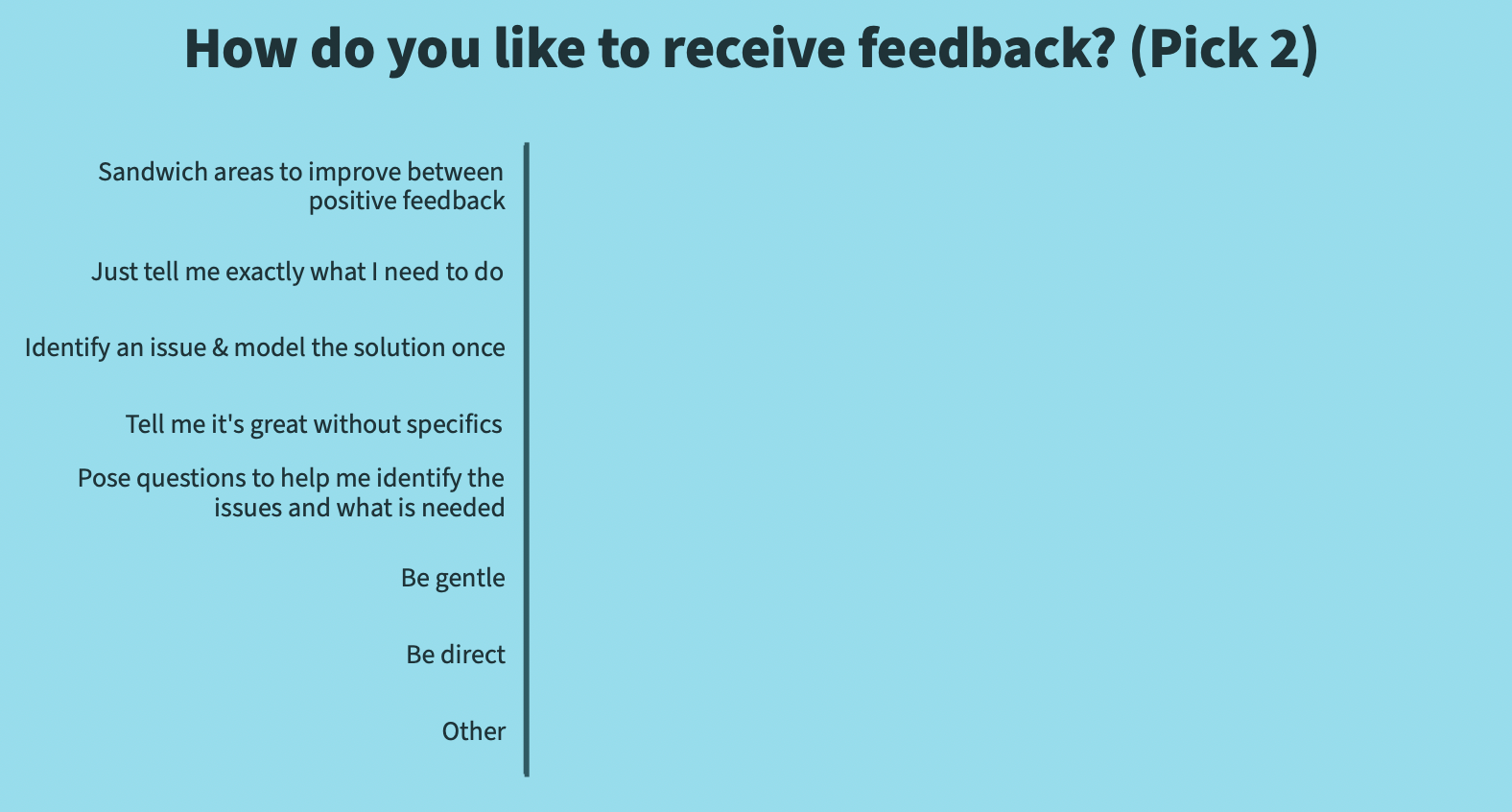
I begin by having them answer polls about what goals or concerns they have had when giving feedback in the past and then how they like to receive feedback.  Often, the polls reveal that most students want to help someone improve their work but are concerned they will hurt the receiver’s feelings—while they themselves prefer direct and honest (which students often frame to me as “harsh”) feedback.  We discuss these tensions, and circle back to them throughout the class and the semester.  We also explore and discuss the differences between direct and directive feedback, and I share how I usually give feedback (e.g., asking them questions to help them puzzle out what they need to do to make the product more effective or sometimes identifying the issue and modeling one but letting them find where they did it other times).

Figure 1: Sample Poll Question Assessing How Students Like to Receive Feedback

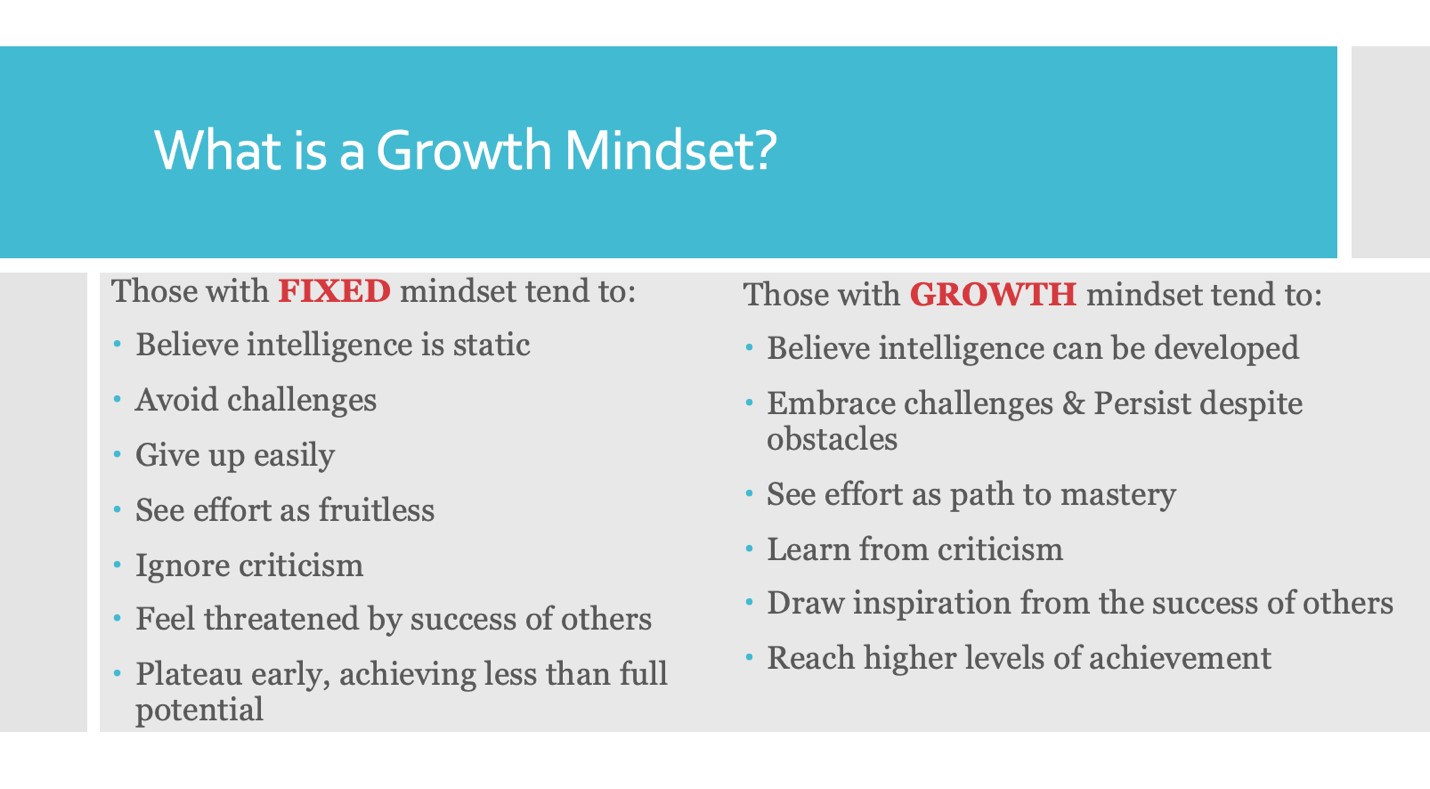
Discussing the polls segues to talking about what it means to have a growth mindset, because the polls usually demonstrate that the students’ best experiences in giving and receiving feedback were when they were open and ready to learn.  I introduce (or re-introduce) Carol Dweck’s Mindset theory work, highlighting the differences between the fixed mindset (intelligence is static) and the growth mindset (intelligence is malleable).  I emphasize how we all occupy both mindsets at different times, even though we may gravitate to one over the other. I emphasize, too, how we can learn to recognize when we are occupying a fixed mindset and then work to reorient ourselves to be in one of growth.[2]  For example, as a 1L, I struggled to grasp Contract law.  It would have been easy to give up and conclude that I was just not a Contracts person and write off the class (and my ability to understand it).  That’s a fixed mindset.  To succeed, I had to shift to a growth mindset.  I had to shift to thinking that while I was not yet understanding Contracts, I was capable of understanding it and needed to put forth more time and effort to do so. 

Figure 2: Slide with a summary of Carol Dweck’s mindset attributes.

One’s mindset is important for feedback—both receiving and giving. When a person is occupying a fixed mindset when receiving feedback, she is entering the exchange with the goal of receiving validation and approval.  She will be more resistant to criticism, no matter how constructive.  Similarly, when giving feedback, a person occupying a fixed mindset may offer feedback aimed more at demonstrating how smart he is or with performing if in front of other people than responding to the goals of the person seeking the feedback.  Alternatively, someone giving feedback while occupying a fixed mindset may not think he has anything of value to add and thus not offer much in the exchange.  Getting into a growth mindset—for both the receiver and giver of feedback—and seeing the exchange as an opportunity for both to learn and improve is essential for sharing feedback effectively.  If both the giver and the receiver are occupying a growth mindset when exchanging feedback, they will learn and draw inspiration from each other and propel each other to higher levels of achievement.

In addition to having a growth mindset, I advise the students that when giving feedback, they should focus on the skills or product not on the person, personality, or identity.  And their feedback should be constructive; meaning, it should be based on observations not opinions, be concrete and achievable, and limited.  The giver of feedback should not overwhelm the receiver with tons of pieces of things to correct and should always include at least one thing that should be preserved because it is already effective.

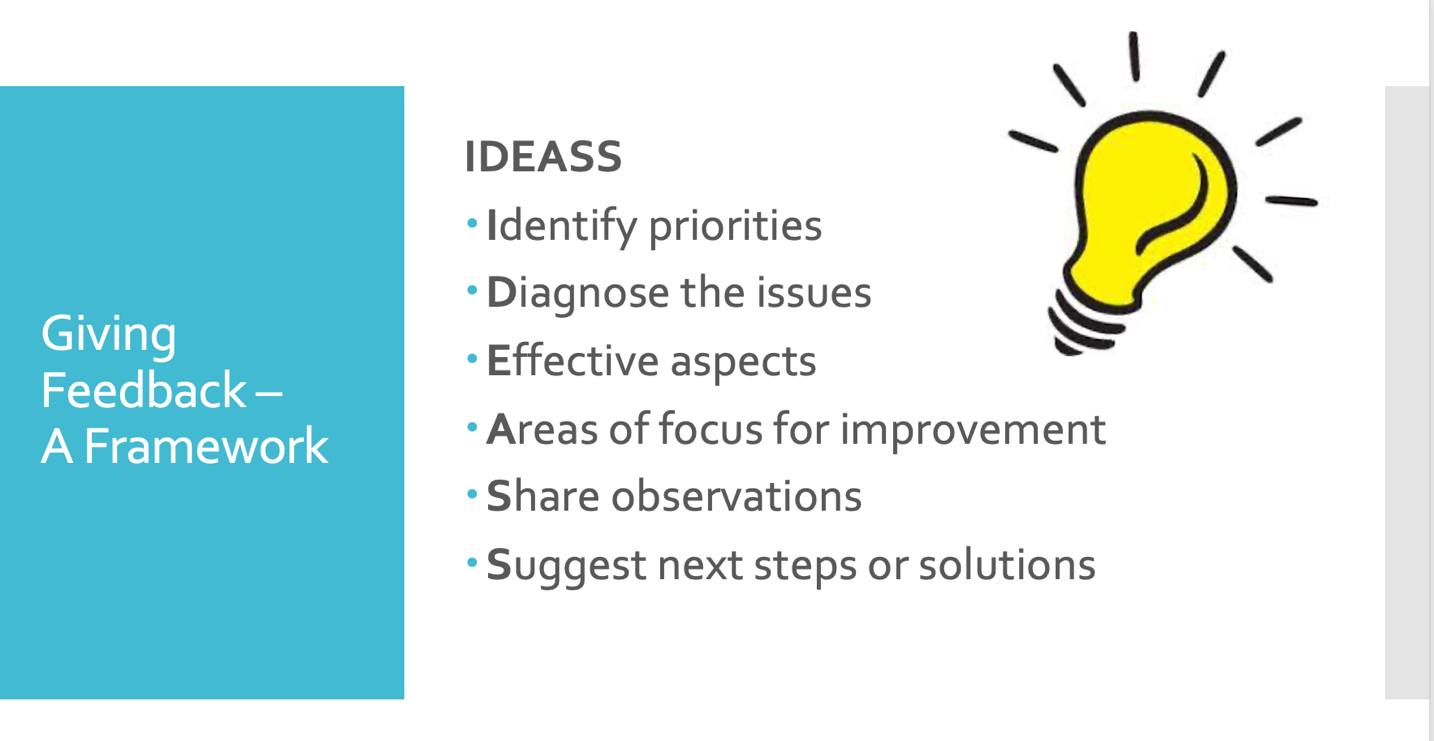
I then share the following framework for giving feedback, complete with the (possibly silly) mnemonic: IDEASS.

Figure 3: IDEASS Framework

The first objective when someone is asked to give feedback to another is to identify the priorities or goals of the person seeking the feedback.  What would the receiver most like to get out of the peer review, moot, or rounds?  What feedback would be most helpful?  How do they prefer to receive feedback?  Are there particular questions the receiver has that they are seeking answers to?  When is the product due and how much time do they have to revise?  These questions help set expectations to guide the exchange.

The student then needs to diagnose the issues.  This may be difficult; it’s also crucial because it focuses the feedback and helps to train the analytical skills and critical eye of both the giver and the receiver.  To diagnose the issues, the giver of feedback needs to understand and articulate what the underlying norms or rules of the skill or product are.  For example, if giving feedback on headings in a brief, the underlying rule for effective headings might be that they should be framed as conclusions that blend law and fact allowing the writer’s arguments to appear as an exoskeleton of the brief.  For a direct exam, the underlying rule might be that the questions should be open-ended rather than leading. These underlying issues or rules might mirror what the receiver of feedback identified as their priorities.  They might have asked for help making their direct exam more open-ended, for instance.  If the underlying norms or rules for the product are not clear, the giver of feedback should askthe person seeking feedback what they intended or how they chose to do what they did, then the giver can share observations about the product or skill.

The student giving feedback should share one or two effective aspects and then one or two areas of focus for improvement.  Often “feedback” seems only to encompass the latter but sharing what worked well or what was effectively done helps the giver know what to keep or what to replicate going forward.  Both feedback about effective aspects and those that could be improved or more effective should be shared as what the giver observed.

Sharing observations, not opinions, helps both receiver and giver to continue to occupy a growth mindset and to maintain the goal that both are learning through the exchange.  The giver should focus on what they noticed about the skill or product and reflect or even replay what the person seeking the feedback said or did.  For example, if the student seeking feedback on a direct exam asked a leading question, the student giving the feedback might note: “you asked your client: ‘Were you trying to leave your partner when you went to stay at your grandmother’s?’ That is a leading question.”

After reflecting what she noticed, the student giving the feedback can then suggest next steps or solutions.  How might someone do it differently next time?  The student may also model a solution.  She might, for example, say: “Instead, you could ask: ‘Why did you go to stay at your grandmother’s?’”  Alternatively, the student giving the feedback might ask the student who did the direct exam to arrive at a solution by saying something like: “How might you ask an open-ended question to get the same point?” At this phase, if possible, the person seeking the feedback could try again or revise the product, incorporating the feedback.

Putting it all together, a student’s feedback on the direct exam hypothetical may look like this:

  • You wanted me to assess your direct exam.
  • Your questions have a good rhythm and build upon each other in a way that allows your client’s story to come out persuasively.
  • Some of your questions were not yet open-ended. For example, at one point, you asked your client: ‘Were you trying to leave your partner when you went to stay at your grandmother’s?” That is a leading question.  Instead, you could ask: “Why did you go to stay at your grandmother’s?”

Beyond sharing IDEASS with their peer, I encourage students to also use growth language[3] in giving feedback—such as the words: yet, and, and opportunity—and to express gratitude by thanking each other for the time, feedback, and opportunity to help.  Then, to finish the lesson, I have my students practice using the framework with a simulation.  I share a video of a simulated client interview (e.g., one from the Legal Interviewing and Language Access Film Project, created by Lindsay M. Harris and Laila L. Hlass, which as one of the participants in the lightning session at the AALS Clinical Conference in the spring of 2021 noted is the gift that keeps on giving!) and have the students share their feedback to the student interviews in the video.  The students thus get to practice using this IDEASS framework for feedback in a low-stakes way.  We can then revisit this shared vocabulary and framework as needed throughout the semester when they are called upon to give feedback to a peer—and continue to build this skill along with many others.


[1] This blog post summarizes the lightning session at the AALS Clinical Conference 2021 by the same name.

[2] In addition to exploring Carol Dweck’s work, here are some other resources for incorporating her mindset theory into legal education: Corie Rosen, The Method and The Message; Heidi K. Brown, The Emotionally Intelligent Law Professor; Paula J. Manning, Word to the Wise; and Megan Bess, Grit, Growth Mindset, and the Path to Successful Lawyering;

[3] I explore growth language in more depth in my article on Framing Failure in the Legal Classroom.

Negotiating Trauma and Teaching Law

By: Mallika Kaur, UC Berkeley School of Law and Executive Director, Sikh Family Center

As a human rights advocate focused on gendered violence work, about seven years ago I began employing the term “negotiating trauma” (while developing a class of the same name for UC Berkeley School of Law) in order to encourage fellow lawyers to consider, recognize and better prioritize the many emotional interplays in our everyday work. 

This new article focuses on trauma & the classroom. I propose adopting “a combination of simple strategies… that better acknowledge trauma (whether or not the professor chooses to use that term, and whether or not the class is a small seminar or large lecture) is to everyone’s advantage in today’s law school.” Like with other negotiations, we could apply a zero-sum approach to the various players’ emotions involved in legal teaching or choose to instead engage the complexity to generate better, perhaps deeper, and eventually more valuable learning and lawyering. 

The Abstract:

HOW DO YOU NEGOTIATE TRAUMA AND EMOTIONS IN YOUR CLASSROOM? Posing this open-ended question to law professors not only begets more questions, but also often elicits a reflexive retort: law professors dare not present themselves as mental health experts and law schools have mental health resources for students having difficulties. The difficulty of this approach is that in 2021, most law students are no longer willing to accept that their legal education must suppress emotions, including trauma. For classrooms where professors may be less comfortable with emotional discussions, they may find themselves challenged and perhaps even feel obstructed from teaching their subject matter with the freedom and expertise it deserves. Are we simply dealing with an overly sensitive generation? Or are we being pushed to make overdue changes that will improve legal teaching, legal education, and eventually the profession? 

Citation Information

Kaur, Mallika. “Negotiating Trauma & Teaching Law.” Journal of Law and Social Policy 35. (2021): 113-119. https://digitalcommons.osgoode.yorku.ca/jlsp/vol35/iss1/6 

Round and Round We Go: The Stages of Rounds applied to a AALS Clinical 2021 Lightning Session

By Cori Alonso-YoderSherley Cruz, Vanessa F. Hernandez

Stage 1: Description of the Issue

“In almost every small group of clinicians at clinical conferences, someone raises the subject of ‘improving rounds.’”  – Elliott Milstein & Sue Bryant, Rounds: A “Signature Pedagogy” for Clinical Education?   

While this year’s virtual AALS Clinical Conference differed from prior years, clinicians’ desire to maximize rounds remains a constant. These facilitated classroom discussions are what Professors Elliot Milstein and Sue Bryant called a “signature pedagogy” for clinical legal education. Indeed, rounds figure as a meta exercise of clinical education. By giving up total control, rounds may feel challenging or unpredictable. Yet, year after year, rounds remain a principal teaching tool. Because, as observed by Milstein and Bryant, “when the conversations go well, they are precious sources of learning.” 

In 2019, a group of us compared notes to discuss their use of rounds.[1] We learned that we had similar approaches, but that there was also great flexibility in our practices of rounds. At the Rounds on Rounds Session, we hoped that by sharing our experiences we could learn from one another while also amplifying different models of rounds. To our delight, 136 conference participants also wanted to learn new ways of teaching rounds.

Stages 2 & 3:  Questions to Clarify and Problems Identified

Our initial goals for the AALS lightning session were to 1) introduce the concept of rounds; and 2) to share different approaches to rounds. To seek feedback from our participants, we used a Google form survey to learn more about our audience’s familiarity with rounds (especially the “ traditional Milstein/Bryant five stages”), while also soliciting ideas on different approaches. In particular, we sought to introduce the concept of rounds for student learning and as a tool for clinicians to use in their own development as supervisors and educators. 

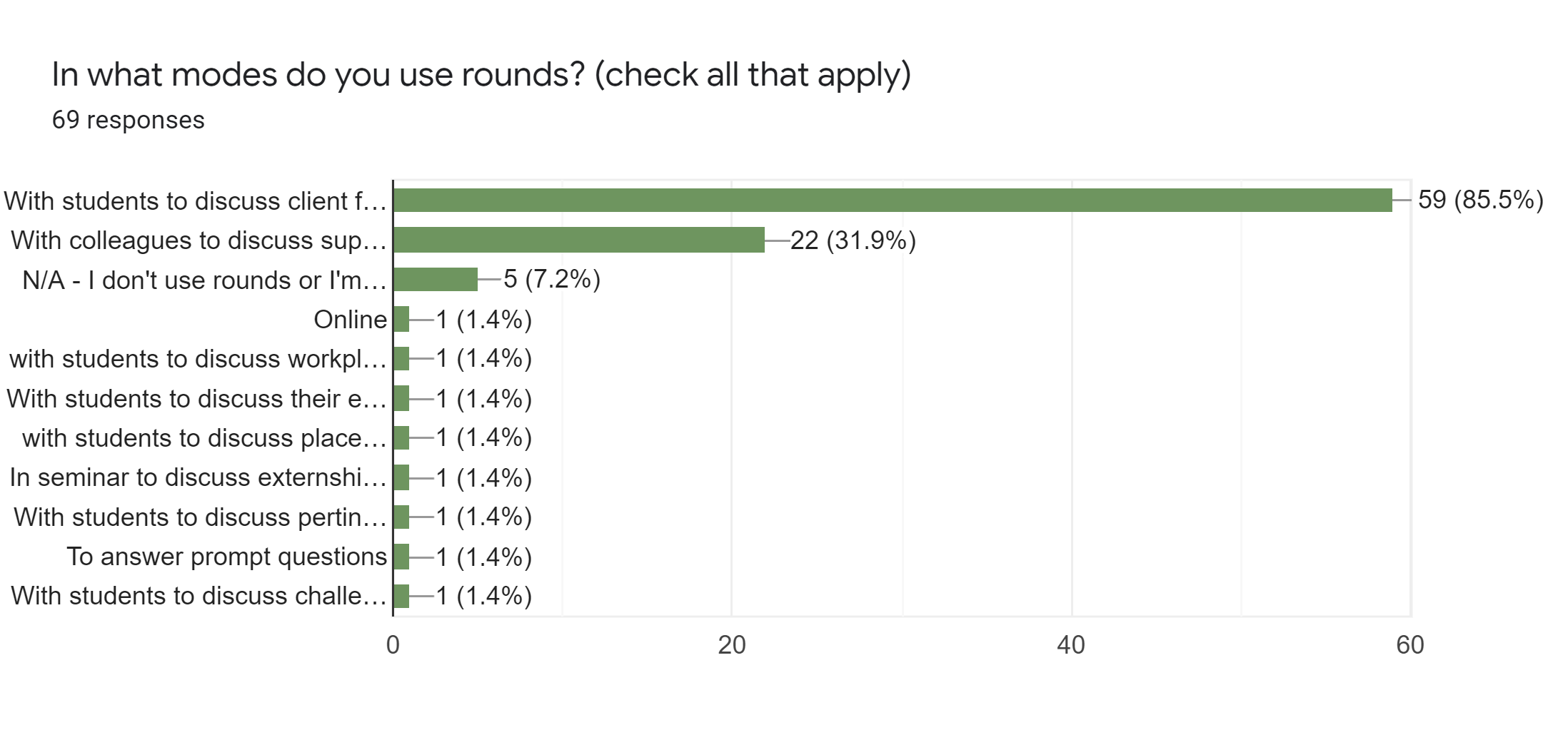
From our survey, we learned that over 90% of our 69 respondents currently used rounds. Of these, the vast majority (more than 85%) reported using rounds in discussion with students about client fieldwork. Only about 30% of respondents mentioned using rounds with colleagues to discuss supervision of students. Almost 10% of respondents, 7.2%, responded that they didn’t use rounds or were unsure if they used rounds.

Figure 1. Responses about rounds modes used by participants.

The survey also asked respondents to identify their priorities for learning within the session. Most of the respondents, 63.8%, indicated that they were most interested in learning about maximizing their use of rounds to discuss lawyering skills.

Figure 2. Responses about priorities for learning in the lightning session.

These responses helped us focus our discussion for the remaining time and to clarify our goals for the session.

Stage 4: Goals Clarified

Based on the responses from students, we returned to our dual goals of 1) introducing rounds as a teaching tool; and 2) sharing practices for rounds.

Stage 5: Lawyering Strategies Exchanged/Proposed Solutions

To set the stage for the nearly 10% of respondents not presently using rounds, we presented some of the foundational concepts related to use of rounds.

Figure 3. A slide with the “Milstein/Bryant” rounds structure from the lightning session.

Participants took part in a How Do You Use Rounds Google Doc “quick write” to share their perspectives on what is working in rounds and where they experienced challenges. Having 150 participants trying to access a Google Document at once “crashed” the shared doc. Despite the technical difficulties, we were able to spark a rich discussion from the quick write. We took a fresh look at the first few stages from a cultural, racial, gender, and other differences perspective, which provided an opportunity for conversations about bias, stereotypes, and their impact on third parties.[2]  

Stage 6: Lessons Learned

Perhaps it is poetic justice that a 30-minute lightning discussion on rounds with nearly 150 participants would feel rushed and incomplete.

Many clinicians in the quick write exercise expressed their feelings of struggling to find time for rounds, or properly developing the conversation. We, the presenters, faced similar struggles in getting out all that we hoped to share with our session, but were encouraged by the enthusiastic responses from our colleagues.

Among the helpful conversations that developed with participants after the formal conclusion of the Zoom session, we identified the need to develop materials to foster student led discussion and participation. One participant asked for readings to provide to students in advance of rounds. Another participant wanted to learn more about one of our practices in requesting students prepare a pre-rounds memo.

This session confirmed that challenges and opportunities with structuring rounds will likely remain a topic to which we continue to circle back. We look forward to the next “go round” on this topic.


[1] This group included Cori Alonso-Yoder,  Sherley Cruz, Vanessa F. Hernandez, Nadiyah Humber, and  Katie Ladewski Jarosz.

[2] This innovation was credited to Professor Alexander Scherr at the University of Georgia. The exercise was particularly resonant as an intervention given the conference’s larger theme of “Recognizing Our Past and Building for Our Future.”

Registration is Open: Ensuring Equality in Legal Academia: Strategies to Dismantle Caste (webinar, May 10, 2021)

Co-produced by the Sections on Legal Writing, Reasoning, and Research and Academic Support

The AALS Section on Academic Support and the Diversity Committee of the Section on Legal Writing, Reasoning, and Research are co-hosting a panel presentation webinar titled “Ensuring Equality in Legal Academia: Strategies to Dismantle Caste” on Monday, May 10, 2021 from 2:00 – 3:30 p.m. EST exploring the caste system in legal education recently highlighted by Dean Darby Dickerson (UIC John Marshall School of Law) during her tenure as AALS President and memorialized in her article, “Abolish the Academic Caste System.” 

The caste system is a pernicious, but largely neglected, dynamic in legal academia.  As Dean Dickerson noted in her article, most, if not all, law schools maintain a caste system, with legal skills, academic support, and clinical faculty on the bottom rungs.  Exacerbating the problem is that these faculty members are largely women and persons of color, who do the lion’s share of work involving student interaction but are provided the least in terms of pay, job security, and respect.  The caste system in legal academia, like all caste systems, assigns value to certain members of the profession while devaluing others.  Thus, many legal skills, academic support, and other non-tenure track faculty do not get proper recognition or fair compensation for their many contributions, which inflicts harm on academic programs and law schools as a whole. 

Deans Michael Barry (South Texas College of Law Houston), Danielle Conway (Penn State Dickinson Law), Larry Cunningham (Charleston School of Law), Susan Duncan (Mississippi School of Law), and Michael Hunter Schwartz (McGeorge School of Law, University of the Pacific) will join moderator Dean Dickerson to discuss the detrimental impacts of such a caste system and potential solutions to the problem, with a particular focus on legal writing and academic support professors.  The panel will address how law schools and others can mobilize institutional support for skills professors, capture the value-add that skills professors bring to legal education, open up pathways to tenure, and minimize inequities.  As members of a profession that is dedicated to serving justice, eliminating the caste system is more than a matter of expedience.  It is a moral imperative. 

To register for this exciting webinar, click here.  Advanced registration is required.  Registration is free and open to anyone in the legal education community, including students, faculty, and staff.  For more information, including the presenters’ biographies and program objectives, go to AALS’ Events webpage. 

It’s Grading Season! Have you checked your bias?

By: Anne Gordon, Clinical Professor of Law and Director of Externships, Duke Law School

I’ve often heard colleagues say that they love teaching so much their law school wouldn’t even need to pay them for it . . . but grading is a different story.  Grading is time-consuming and stressful, two things that none of us needs as we finish up an uncommonly difficult year.  We all know that taking the time to check that stress is good for our health.  You may not know that it is also critical for reducing your bias.  Mitigating our biases is critical to ensure accurate student assessment, as well as the relationship-building that is so key to our mentorship and supervision.  This article, an excerpt from a paper in the Spring issue of the Clinical Law Review, will illustrate how biases shape our thinking, show the link between stress and bias, and provide concrete ways to mitigate our bias – critical for avoiding biased behavior toward our students – in grading season and beyond.

Brains and Bias

Our brains sort through information we encounter in the world by creating schema, automatic characterizations that allow us to go on “auto-pilot” as we process information throughout our day.  These allow us to be efficient: we can distinguish a plastic bag from a log in the road while driving and react appropriately, even without conscious thought.  Our automatic judgments can also activate in ways that aren’t helpful, however, when those schema intersect with actual or perceived social characteristics like race or gender, including harmful stereotypes.

Humans are also plagued by cognitive biases, other decision-making shortcuts that can lead us to erroneous conclusions.  These biases can combine with our stereotype-based biases to produce damaging effects for our students.  For example, it is well-documented that humans harbor an Anchoring Bias, the tendency to “anchor” judgments on the first piece of information offered, and Confirmation Bias, the tendency to selectively search for information that confirms prior beliefs or judgments.  If you team-teach your clinic, you should also be on the lookout for the Bandwagon Effect.  This is our tendency to have our attitudes and beliefs shaped by others, due to our innate desire for social harmony.

It is easy to see how these biases can interact with the stereotype-based bias described above.  For example, a professor’s bias may put a student in the schema of “low performing;” if the student then turns in a poor first assignment, the professor’s cognitive bias serves to “anchor” his perception of that student in subsequent interactions.  Confirmation Bias then kicks in, and the professor seeks out errors that conform to her initial judgment of the student as being low performing.  The teacher “knew” that this student would struggle, and that’s what the professor sees.  This is what we seemed to see playing out in a recorded conversation between Georgetown professors – a conversation that got one of them fired.  The converse of Confirmation Bias is also true – students judged as competent receive the benefit of a teacher’s subconscious willingness to overlook evidence to the contrary (and may also miss out on opportunities to learn). 

The interaction of these effects has been borne out in the research.  One study by Dr. Arin Reeves showed how lawyers found more errors in a writing sample that they thought had been written by a Black associate, despite identical errors in a “white-written” sample.  The study’s authors concluded that Confirmation Bias caused the partners to look more carefully for errors in the “Black lawyer’s” work, and more easily disregarded errors by the white lawyer, who fit their stereotype of a generally competent professional.   While this study has not been replicated among law faculty, it would be easy to see how it could play out in our evaluation of our students.     

Stress Amplifies Bias

The conditions of teaching, especially in stressful times, create a perfect storm for our biases to manifest.  When we are stressed, low on blood sugar or sleep, or engaging in sustained intellectual engagement (think a stack of student work to evaluate), we become cognitively depleted.  Cognitive depletion leads us to fall back on our biases, simply because the associations are already there – even where we might be able to keep those biases in check if we were at our best.  Cognitive depletion and stereotype bias feed off each other, where the more stressed we are, the more biased we become.  This can take shape in two ways: first, for biased teachers, stress amplifies their bias.  But it also means that teachers trying to overcome their bias, or trying to communicate a lack of bias to their students, are taxed in a way that can result in – you guessed it – bias.  Studies have shown that the more cognitive resources teachers spend trying to communicate a lack of racism to their students, the more cognitive depletion that results.

Our biases manifest in interactions with our students, in the form of decreased eye contact, nervousness, discomfort, awkwardness, speech errors, stiffness, and other subtle avoidance behaviors that convey dislike or unease, possibly due to fear of being labeled a racist, or fear of being met with hostility by our students.   These behaviors, so subtle that they may not be perceptible even as we’re doing them, are therefore less controllable through conscious will – you can’t just will yourself to blink less.  Members of minoritized groups, however, can sense the awkwardness, leaving them wondering: was that constructive feedback due to actual performance, or instructor bias?  Or was that positive feedback due to professors’ over-correcting their biases, opting or a “great job” instead of giving them the real story about their abilities?  This ambiguity is often a contingency of under-represented students’ identity, and ultimately creates a dynamic where students are not fully capable of gauging their own performance, not fully able to accept and make use of our feedback, and not fully able to engage in the learning process.

A Good Time to Make a Change

As we go into our grading, feedback, and evaluation season, therefore, it is imperative that we take affirmative steps to mitigate our bias, and the stress that amplifies that bias.  These measures can fall roughly into three categories: the first is addressing our own bias, the second is reducing our cognitive load, and the third is changing our processes.  Here’s a useful frame used by psychologist Jonathan Haidt at NYU.  The frame here is that in each of us there is an elephant and a rider, walking on a path. The Rider is our rational side; our evidence-based decision-maker.  Our Elephant is our emotional side – it acts based on feelings and instincts.  The Path is our environment, our systems.  Here’s how it works: although the rider holds the reins and appears to lead the elephant, there’s only so long the rider can struggle with the elephant before the six-ton animal just takes over.  The elephant might do what the rider wants for a while, but where there’s a struggle, the elephant will always win.  Fortunately, because the elephant goes on auto-pilot so often, it’s happy following a path – and it will follow the path of least resistance.

So according to Haidt, in order to change, you need to do three things: tame your elephant, strengthen your rider, and shape your path. The first, taming your elephant, requires mitigating your own bias.  This requires sustained work to rid ourselves of negative internalized stereotypes, through training, exposure to cross-cultural diversity, and nurturing a growth mindset (making you less likely to favor only those you’ve identified as “smart”).

Strengthening our rider means stopping ourselves from falling back on our biases – we do this by reducing the conditions that are ripe for bias to present (in other words, reducing cognitive load).  One way to do this is through mindfulness practice, which can increase our ability to become aware of our emotions and biases, and therefore better able to engage our self-regulatory processes, so we can act in a manner congruent with our values.  Another simple-to-describe (if tricky to implement) way to stop a retreat into cognitive overload (and bias) is to try to reduce the number of cognitively taxing activities before student interactions.  Interpersonal stress, impending deadlines, a sleepless night, and even bodily discomfort can lead to cognitive taxation.  So try not to schedule an entire day of back-to-back supervision meetings, or a student meeting directly after a stressful faculty meeting.  Get extra sleep, exercise, and stretch during your feedback week.  Don’t grade student work after watching the news.  And here’s more good news: another easy way to re-charge one’s cognitive batteries is to eat a snack.  Researchers have proven that some of the effects of cognitive depletion can be undone by ingesting glucose.  So go ahead and eat that leftover Easter candy – it’s for your students.

The final way to reduce bias is by shaping the path: de-bias our process.  Formulas, or evaluation rubrics, can help mitigate these problems by making performance metrics explicit, concrete, and consistent.  In addition to leading to less biased grading, a good rubric will also help the teacher, by easing the pain of a stressful feedback discussion.  Where teachers can be precise and name concepts, they can be clear with their feedback. Without such clarity, the message teachers seek to convey for future learning may be muddied, awkward, and cause cognitive strain (which amplifies our bias and impairs our students’ learning).

Those lucky enough to be team-teaching have the good fortune to be able to engage in a practice known as a calibration session, where the individual faculty members write preliminary appraisals of the students, including proposed ratings.  Then the faculty meet and show their proposed ratings along with the rationale behind the rating.  These sessions have the advantage of mitigating bias in the first place (because faculty are pressed to base their judgments on objective measures) and may cause further elimination of bias when forced to confront their own ratings against others’. 

As we round out our semester, reading our final student assignments, scheduling our final feedback conversations, and recording our assessments, it is imperative that we also make the time to check our biases.  As you sit down to grade, remember the Elephant, the Rider, and the Path, and do the work required to make your feedback and evaluation fair.  Our students deserve it.

The Imperative and Power of Empirical Research

By Anahid Gharakhanian, Southwestern Law School

Allison Korn and Laila L. Hlass’s Assessing the Experiential (R)evolution, recently published in Villanova Law Review, should be celebrated as a much needed example of empirical investigation and analysis in legal education, specifically experiential education.  As aptly noted in the Experiential Education section of Building on Best Practices, “[l]egal education urgently needs empirical research on what methods will best promote deep learning that transfers to practice.” 

For many years, the experiential teaching community has had the benefit of the triennial CSALE Study, providing extensive data about the infrastructure of clinics and externships.  Now Korn & Hlass’s empirical work provides data about the proliferation of deans/directors of experiential education and growth in experiential curricula.  This data sets the stage for the important questions they raise about what law schools are doing about the following:  “working to uplift experiential programming as an essential part of the institution,” and “core to the law school curriculum”; “taking steps to identify, recruit, and support clinicians of color”; and ensuring security of position and voice in law school governance.  Korn & Hlass’s work, along with CSALE’s compilation of data since 2007 about applied legal education, serves as an essential foundation for posing these important questions and joins the clarion call of others that rigorous empirical research is critical in every aspect of our assessment and advancement of experiential education – the students’ learning, role of experiential curricula, and diversity of and equity for experiential faculty. 

I think about the critical importance of empirical work from the vantage point of externships or field placement courses, which provide a singularly unique bridge to practice and where so much of the student’s experience occurs outside of the classroom and the externship professor’s direct observation.  Anecdotally we know that these real world experiences are very important to a student’s professional development and practice readiness as a new attorney.  At the same time, the ABA and some in legal education have worried about the educational rigor outside of the law school setting.  What’s needed is exploration of our impressions and perceptions through rigorous empirical work.  In the world of externships, this translated into research questions that Carolyn Young Larmore, of Chapman University, Fowler School of Law, and I took up in a year-long, multi-school study, assessing students’ success at externships and factors contributing to it (involving three law schools in the same geographic area, with very different externship program designs, and widely different incoming credentials – with 2019 median LSATs of 153, 158, and 168).  The study yielded helpful information about the importance of externships to practice readiness.  Also, a notable finding of our study – related to access – was that students from all three surveyed schools achieved very similar levels of externship success (measured in terms of first-year practice readiness), regardless of widely different entering credentials as well as the academic component of the externship programs.  Similarly, the study found that law school GPA plays a very limited role in predicting externship success.  You can see how this data could be a powerful tool in creating access for law students, from many diverse academic backgrounds and schools, to career-shaping professional experiences while in law school and beyond.

As we tackle empirical questions in experiential education, it’s helpful to think about backward design.  In the case of the experiential programming that we offer to our students, a couple of recent national studies are enormously helpful: IAALS’s Foundations for Practice, a relatively recent national study about what foundations entry-level attorneys need to begin a successful legal career (which is the study that Carolyn and I used to define externship success in our own study – i.e., how close are externs by the end of their externship to first-year practice readiness); and the very recent study by IAALS and Professor Deborah Jones Merritt, Building a Better Bar: Capturing Minimum Competence, with one of its two objectives to “[d]evelop and promote understanding of the minimum competence needed to practice law” (and the second one to “[a]lign the bar exam with research-based concepts of minimum competence”). 

To borrow from IAALS and Professor Merritt, the key here is being guided by research-based concepts.  Whether assessing our students’ learning (as Carolyn and I tackled in our externship study), or raising questions about the role of experiential curricula, and diversity of and equity for experiential faculty – as Korn & Hlass have done – we need to engage in more empirical research and use this powerful tool to inform and advance the critical work of experiential education and educators.

Lawyers are Leading Higher Education as Advocates Call for More Formal Leadership Training in Legal Education

Patricia E. Salkin*

My recent research on the exponential increase in the number of lawyers leading colleges and universities has prompted an exploration into the what it is in legal education that prepares lawyers for key campus leadership positions. Since the 1980s the number of lawyer presidents has almost doubled every decade, starting with 47 in the 1980s and reaching a high of 289 in the 2010s. Some of these lawyers leaders have government experience, others served as general counsel, and many have had significant fundraising experience.  The number of women lawyer presidents has also increased paralleling their rise to prominence within the legal profession.

Lawyers are prone to describe themselves as creative problem solvers who possess necessary leadership skills for success as leaders in law firms, government, business and increasingly in higher education. But are lawyers born leaders or do lawyers acquire leadership skills as part of their formal academic training?  Until very recently, few if any law schools historically included leadership training as a distinct topic of study in the curriculum. In fact Professor Deborah Rhode wrote in one of the first newsletters of the AALS Section on Leadership, “As you all know, it is a shameful irony that the occupation that produces the greatest number of American leaders has done so little to effectively and intentionally prepare them for that role. Although the legal profession accounts for only about .4 percent of the population, it has supplied a majority of American presidents, and innumerable leaders throughout the public and private sector. Few of these individuals receive any formal leadership training in law schools.”  She reiterated this sentiment during an AALS interview calling on law schools to embrace the need for more formal leadership training, which can and should be more intentionally learned.

Surprisingly, contributions to the Best Practices in Legal Education blog have paid little attention to this critical topic. Scattered posts have focused on the addition of a new course at one school, the establishment of the new AALS Section on Leadership and a workshop for law professors interested in integrating leadership related topics into classes, and the launch of the Leading as Lawyers Blog.   Yet the call for more deliberate inclusion of leadership studies in legal education is rising. Thanks in large part of the efforts of Baylor Law Associate Dean Leah Teague, in 2017 the American Association of Law Schools charted the new Section on Leadership, “to promote scholarship, teaching and related activities that will help prepare lawyers and law students to serve in leadership roles.” A panel discussion moderated by Baylor Dean Bradley J.B. Toben on Leadership Programming in Law Schools at the 2020 Baylor Law School Vision for Leadership Conference noted that 80 of the 203 law schools now have some form of leadership development for students. UIC John Marshall Dean Darby Dickerson posited that because of legal training, lawyers are well-positioned to be leaders in a VUCA world (volatility, uncertainty, complexity and ambiguity).  She explained that lawyers are trained to: continuously ask hard questions; find the essence of the problem by breaking it down into subparts – taking it apart and putting it together again; use multiple perspectives; be problem-solvers; analyze and cope with fact gaps and ambiguity; understand agreements and honor commitments; communicate clearly and concisely; and be life-long learners. All of this and more are important skills for effective leaders.

In one of her seminal books, Deborah Rhode, writing about leadership traits of lawyers, noted that despite the robust literature on “trait theories” of leadership, the context and roles in which lawyers function are critically important. She explained that the widely accepted traits of successful leaders include:

            values (such as integrity, honesty, trust and an ethic of service);      

            personal skills (such as self-awareness, self-control, and self-direction);

            interpersonal skills (such as social awareness, empathy, persuasion, and conflict

            management);

            vision (such as a forward-looking and inspirational); and

technical competence (such as knowledge, preparation and judgment). (Rhode, Deborah, Lawyers as Leaders, Oxford University Press 2013)

The Center for Creative Leadership identified ten core skills that effective leaders possess, only a few of which overlap with Rhode’s list:  integrity; ability to delegate; communication; self-awareness; gratitude; learning agility; influence; empathy; courage; and respect.  Two skills that lawyer pride themselves on, creativity (e.g., creative problem solvers) and innovation are missing from this list.  The intersection between leadership and creativity has not been widely studied.  Ben Heineman, Jr., in his essay on Lawyers as Leaders, called upon law schools to require students to create and not just critique as part of their education. In a recently published article, University of Idaho College of Law Professor John Dykstra made a compelling case for fostering and teaching creativity in the law school curriculum, and he suggested ways in which it can be incorporated into Legal Writing programs.

All of these identified traits and/or skills could be deliberately mapped through the curriculum in addition to offering focused seminars on leadership for lawyers.  For example, Columbia Law School has developed a Leadership Competency Matrix that focuses on how lawyers lead self, lead others and lead change through: vision and strategy, management and teamwork, problem solving, cultural literacy, and learning and improvement.   

The good news is that law schools are starting to heed the call for increased leadership training. In addition to the annual Baylor Law conferences, in November 2019 the Freedman Institute of Hofstra University’s Maurice A. Deane School of Law hosted a conference at the Association of the Bar of the City on training lawyers as leaders.  Formal programs on leadership for lawyers (e.g., more than simply a course) exist at a number of schools including:  Baylor Law School,  Santa Clara University School, University of Tennessee College of Law, Cleveland-Marshall College of Law, and the Moritz School of Law at Ohio State University.  The following is an illustrative but not exhaustive list of law school courses and programs on leadership: Albany Law; Baylor Law; Berkeley Law; Cleveland-Marshall School of Law; Columbia Law; Creighton University School of Law; Elon Law; George Mason University- Antonin Scalia Law School; NYU Law; Ohio State’s Moritz College of Law School; Santa Clara Law School; Stanford Law School; Tennessee College of Law; Texas A&M School of law; University of Chicago Law School; University of the Pacific McGeorge School of Law and Pritzker School of Law Northwestern University; University of San Francisco School of Law; and Villanova University School of Law School.

In January 2021 the legal profession lost a giant with the passing of Deborah Rhode the Ernest W. McFarland Professor of Law and the Director of the Center on the Legal Profession at Stanford Law School. One way in which legal academy can pay tribute to Professor Rhode is to continue to answer her call for more formal training on leadership across the law school curriculum.

*Patricia Salkin is Senior Vice President for Academic Affairs for Touro College and University System and Provost for the Graduate and Professional Divisions at Touro College.  She is the former Dean of the Jacob D. Fuchsberg Touro Law Center.  This piece is based upon her PhD dissertation research at the University of the Arts (PhD in Creativity anticipated May 2022).

Registration is Open for the “Teaching Multicultural Lawyering” Conference!

By

By: Kim O’Leary, Professor, WMU-Cooley Law School and Mable Martin-Scott, Professor, WMU-Cooley Law School


Dear Colleagues,

We are pleased to announce registration is open for our online conference Teaching Multicultural Lawyering: Development, Integration and Conversation at WMU-Cooley Law School.  There is no charge to attend.  

Information about registration, schedule and the conference topics and panelists follow.   The focus of the conference is teaching multicultural lawyering in a variety of forms.

The online conference will take place on Thursday, March 11 (from Noon-3:30 p.m. EST) and Friday, March 12, 2021 (11 a.m.-4:30 p.m. EST).

Registration Information

Register at https://www.eventbrite.com/e/teaching-multicultural-lawyering-development-integration-and-conversation-tickets-124694060291. 
Please note that space is limited.  The deadline for registration is February 19, 2021.

Conference Schedule

The conference agenda is designed to accommodate the many demands on your time by focusing on two afternoons with two sessions each day and a keynote panel discussion on Friday.

While we understand there are many competing demands on your time, we encourage you to attend the full event if possible.  This conference will bring together law professors who teach this subject in different ways.  We would like to build on this shared knowledge to explore the possible ways we can teach these important issues to law students.

The conversations will be enriched and most effective if participants attend all presentations and activities that we have planned for these two afternoons.

That said, we know that everyone will not be able to attend all the sessions.  We only ask that when you sign up for a small group session, you are reasonably sure you can attend that small group.  You do not have to enroll in every small group opportunity.

Program Overview

The following is a brief overview of the conference.  Some of the sessions will have break-out groups to facilitate small, in-depth discussions.  We look forward to welcoming the distinguished speakers and panelists!  Listed below are panelists who are confirmed.

Thursday, March 11 (from Noon-3:30 p.m. EST)

Session 1:  Introduction; Multicultural Lawyering: Development and Teaching the Course

Professor O’Leary (co-moderator), Professor Martin-Scott (co-moderator), and WMU-Cooley Law School students

Session 2:  Learning Objectives and Assessment Regarding Multicultural Curricular Offerings
 

Professor O’Leary (moderator); Professor Dan Sheaffer, WMU-Cooley Law School; and, Catherine McCollum, Director, Teaching and Learning Center, WMU-Cooley Law School


Friday, March 12, 2021 (11 a.m.-4:30 p.m. EST)

Distinguished Panel Discussion:  Insights from Those Who Have Led the Way

President and Dean James McGrath (moderator); Dean and Professor Leonard M. Baynes, University of Houston Law Center; Dean and Donald J. Farage Professor Danielle Conway Penn State Dickinson Law, Professor Berta Hernández-Truyol, University of Florida, Levin College of Law; and, Professor Emerita Vernellia Randall, University of Dayton School of Law

Session 3:  Incorporating Multicultural Topics Into Law Courses

Professor Paula Johnson, Syracuse University College of Law; Professor Arlene S. Kanter, Syracuse University College of Law; Professor Suzette Melendez, Syracuse University College of Law; and, Professor Mary Szto, Syracuse University College of Law


Session 4:  Professional Identity and Multicultural Lawyering

Professor Martin-Scott (moderator); Professor Janice Craft, University of Richmond School of Law; and, Professor Lucy Jewel, University of Tennessee College of Law


Please contact us at mcl@cooley.edu with questions and if you would like to be added to our interest list to receive updates and other details as they become available.  Anyone who registers for the conference will receive regular updates.


We hope you can join us!

Kim O’Leary, Professor, WMU-Cooley Law School

Mable Martin-Scott, Professor, WMU-Cooley Law School

Law Deans Issue Joint Statement on the 2020 Election and Events at the Capitol

Today, a diverse group of law deans issued a statement reaffirming our profession’s integral role in advancing and protecting the rule of law. The full statement is below and linked here with a growing list of the deans who signed.

As we begin our spring semesters amid this upheaval and assault to democracy, I find it helpful to reflect upon how we teach students to absorb the weight and responsibility of membership in this profession. A few years ago, Carolyn Kaas, Paula Schaefer and I presented on the topic of “Lawyer as Public Citizen” and shared a number of ways to incorporate teaching this particular aspect of professional role assumption across the curriculum. We asked, fundamentally, how to teach students to look beyond public service and pro bono work as silos, and to absorb the profound responsibility to uphold the rule of law and to serve in ways that educate and encourage the public to partake in democratic endeavors.

We asked:

The preamble to the ABA Model Rules includes a calling to the lawyer as “public citizen,” but what does that mean? In what ways are all lawyers required to perform in the public citizen role after graduation, and how can we prepare them for it?  How do proficiencies associated with the lawyer’s responsibility as a public citizen become a more explicit outcome of legal training? 

We came up with lists of activities and topics; members of the audience met in small groups to discuss how their teaching did or did not address the role of lawyer as public citizen. But the message was clear: we need to look beyond the particular topics we teach and engage students in accepting deep responsibility for this work regardless of their eventual professional roles in the legal system.

For further reading, Chapter 6 of Building on Best Practices includes a number of essays on the pedagogy of professional role assumption.

Please let us know how you are including talks, exercises, and space for reflection as return to the semester.

Source: https://law.yale.edu/sites/default/files/documents/pdf/law_deans_joint_statement_1.12.21_final.pdf

The Disparate Treatment of Clinical Law Faculty

By: Robert Kuehn, Washington University School of Law

In her recent presidential message, Abolish the Academic Caste System, the president of the American Association of Law Schools (AALS) called on law schools to address the caste system within law faculties by providing parity in security of positon and salary to non-tenure/tenure track faculty, such as the overwhelming majority of law clinic and externship instructors.[i] Data from the just completed Center for the Study of Applied Legal Education (CSALE) 2019-20 Survey of Applied Legal Education of  95% of law schools and 1,300 law clinic and externship instructors show widespread disparate treatment of clinical instructors (i.e., law clinic and externship instructors) and a lack of progress in providing parity between those who teach in law clinics and externships and those teaching doctrinal courses.[ii]

In 1998, 46% of clinical teachers were in tenure or tenure-track positions.[iii] Yet as the chart below indicates, the percentage of clinical faculty in tenure/tenure track positions, even when including lesser status clinical/programmatic tenure positions, has declined to just 29%, and decreased by more than 30% over just the last 12 years (temporary appointment clinical fellows excluded from all tables).


  Source: CSALE 2019-20 Survey of Applied Legal Education

Though there have been notable exceptions at a few schools, law clinic and externship hiring has disproportionately been for contract positions since the 2010 downturn in law school applications and accompanying financial challenges.

This increasing pattern of hiring non-tenure track clinical faculty can be seen below when comparing employment status to years of clinical teaching. Forty-six percent of clinical faculty teaching more than 12 years are in traditional or clinical/programmatic tenure or tenure-track positions. In contrast, only 23% of those hired within the last four-six years and just 16% of those hired in the last three years are in tenure/tenure-track positions. Although some clinical faculty hired into non-tenure-track positions may be permitted to move later into tenure-track positions, those limited instances cannot account for the increasingly lower status among more recently hired clinical instructors.


Source: CSALE 2019-20 Survey of Applied Legal Education

Non-tenure status has consequences for clinical faculty, beyond the limited participation in faculty governance and lower prestige that generally come with appointments other than traditional tenure. The table below compares the salaries the over 70% of law clinic and externship faculty not tenured/tenure track with the salaries reported by doctrinal faculty at the same schools. These clinical faculty are paid, on average, $30,000 per year less than their doctrinal colleagues at similar points in their careers. Even when salaries of clinical faculty with traditional or clinical tenure/tenure track are included in the calculations, clinical faculty on average make over $20,000 less than their doctrinal colleagues.

Sources: CSALE 2019-20 Survey of Applied Legal Education; 2018-19 SALT Salary Survey

The disparate treatment of clinical faculty in tenure appointments is most pronounced at schools ranked higher in the U.S. News annual law school rankings. Among schools with at least half of their clinical faculty in tenure/tenure-track positions, only one school ranked in the top 25 primarily appoints clinical faculty to traditional tenure-track positions, yet over 36% of the 50 lowest ranked schools provide this status to their clinical faculty.

Source: CSALE 2019-20 Survey of Applied Legal Education

Some law school clinical education programs even treat types of clinical instructors differently, providing less security of position and salary to those who teach in externships. CSALE survey data show that externship instructors are less likely to have traditional or clinical tenure/tenure track when compared to their law clinic peers (25% vs. 38%) and are almost 15 times more likely to be primarily in an administrative position with only occasional teaching responsibilities and sometimes little training in externship pedagogy.

Source: CSALE 2019-20 Survey of Applied Legal Education

Salaries of externship instructors also are considerably lower, with median annual salaries, on average, $20,000 less per year than those of law clinic instructors:

Source: CSALE 2019-20 Survey of Applied Legal Education

The latest CSALE survey shows that in spite of occasional stories about a school adopting tenure for its clinical faculty, the AALS president is right ─ the academy remains highly caste-like in its disparate treatment of clinical faculty, especially at higher ranked schools and even within clinical education programs at some schools. Indeed, if anything, progress toward parity appears to be slipping as an increasing percentage of new teaching positions in law clinics and externships are without the security of position and salary of doctrinal faculty.

The AALS has moved lately towards an Executive Committee comprised entirely of deans and former deans. If the members of the Executive Committee support their president’s call to end the caste system, they could act to do so at their own schools and call upon their fellow deans across the country to do the same.


[i] Darby Dickerson, Abolish the Academic Caste System, AALS News (Fall 2020), at https://www.aals.org/about/publications/newsletters/aals-news-fall-2020/presidents-message-abolish-the-academic-caste-system/.

[ii] Center for the Study of Applied Legal Education (CSALE), 2019-20 Survey of Applied Legal Education (2020), at https://www.csale.org/#results.

[iii] Richard K. Neumann Jr., Women in Legal Education: What the Statistics Show, 50 J. Legal Educ. 313, 328 (2000).

[iv] 2018-19 SALT Salary Survey, SALT EQUALIZER (Nov. 2019), at https://www.saltlaw.org/wp-content/uploads/2015/03/SALT-salary-survey-2019-final-draft.pdf.

Welcome, 2021! – and a Round-Up of Pedagogy Sessions at this week’s AALS Annual Meeting

Dear readers, authors, commenters, and friends far and wide:

Happy New Year!

We look forward to another year of exciting and thought-provoking discussion with you through the Best Practices for Legal Education blog. 

We begin 2021 with the AALS annual meeting, being held virtually, that you can access here

The conference will include some fantastic programs to help us share skills and techniques in this tumultuous teaching environment. We’ve compiled a round-up of the sessions best suited for those interested in deepening our grasp of pedagogy across a wide range of subject areas. Please feel free to comment below on what you’re learning as the conference progresses!

Tues. Jan. 5

4:15-5:30pm: Section on Civil Rights, Co-Sponsored by Criminal Justice: Teaching About Civil Rights During Incarceration

4:15-5:30pm: Section on Commercial and Consumer Law, Co-Sponsored by Teaching Methods and Technology, Law, and Legal Education: Teaching Commercial Law in the 21st Century

4:15-5:30pm: Section on Professional Responsibility: Bright Ideas and Best Practices for Online Teaching in Professional Responsibility Courses

Weds. Jan. 6

11am-12:15pm: Section on Pro Bono & Public Service Opportunities, Co-Sponsored by Clinical Legal Education, Leadership, and Poverty Law: Calling Out and Leaning In to Racial and Class Inequities in Experiential Learning Opportunities

2:45-4:00pm: Section on Global Engagement, Co-Sponsored by Teaching Methods, Technology and Law and Legal Education: Virtual Mobility: Innovating and Promoting Global Legal Education in Times of Crisis

4:15-5:30pm: Section on Criminal Justice: Beyond 2020: Decarceral, Anti-Racist and Non-Traditional Teaching

Thurs. Jan 7

2:45-4:00pm: AALS Discussion Group: How the Pandemic Made Me a Better Teacher – Lessons Learned and Plans for Change

4:15-5:30pm: Section of Family and Juvenile Law: Family Law – Creative and Experiential Teaching Tips

Fri. Jan. 8

2:45-4:00pm: Section on New Law Professors: Spreading the Word – Law Professors as Teachers, Scholars, and Legal Influencers

4:15-5:30pm: Section on Teaching Methods: Best Practices for Creating and Administering Mid-Term Exams

4:15-5:30pm: Section on Women in Legal Education, Co-sponsored by Clinical Legal Education, Legal Writing Reasoning, and Research and Teaching Methods: Gender, Power, and Pedagogy in the Pandemic

Friday, Jan. 8 2:45-4:00

Sat. Jan. 9

2:45-4pm: Section on Balance in Legal Education, Clinical Legal Education, and Leadership Joint Pedagogy: Teaching Leadership Skills in a Time of Crisis

As you consider your own teaching and writing, please consider posting your original content with us.  You can learn more about the purpose and history of the best practices blog here.

With best wishes for a great 2021,

Melanie and Davida

Clinical Law Review seeks applications for five vacancies on Board of Editors

The Clinical Law Review seeks applications for five vacancies on the Board of Editors. The Board urges you to think about whether you would be interested, and to think about others whom you would encourage to apply. 

Members of the Board of Editors serve for a term of 6 years. The term of the new Board members will commence in January 2022. The primary role of the Board members is to edit articles for the Review. Because this is a peer-edited journal, the editing process is collaborative. Board members also serve as small group facilitators in the annual Clinical Law Review Workshop. There is at least one meeting per year of the Board, usually held at the annual Workshop. 

Applicants should submit (1) a C.V. and (2) a statement explaining their interest in the position and highlighting relevant aspects of their experience.  The Board seeks applications from people committed to the work of the Review and will prioritize applicants from underrepresented groups and applicants with diverse experiences in and approaches to clinical legal education. Applications must be received no later than January 31, 2021. Please e-mail them to CLRBoardApps2021@gmail.com.  

The committee to select new Board members is always co-chaired by two current Board members whose term is expiring. We (Jeff Selbin & Jennifer Koh) will be serving this year as the co-chairs of the Selection Committee. The other members of the committee will be designated by the three organizations that sponsor the Clinical Law Review — AALS, CLEA, and NYU — each of which will designate two committee members. 

We encourage you to contact us or other current or former Board members with any questions or for information about service on the Board. We and other Board members have found the experience to be very rewarding. 

The other current members of the Board are: Muneer Ahmad, Sameer Ashar, Susan Bennett, Warren Binford, Marty Guggenheim, Margaret Johnson, Jen Lee, and Alex Scherr. The current members whose terms are ending, along with ours, are: Muneer, Susan, and Warren. 

The current Editors-in-Chief are Phyllis Goldfarb, Randy Hertz, and Michael Pinard. 

Those who previously served on the Board are: Jane Aiken, Amna Akbar; Tony Alfieri, Wendy Bach; Bev Balos, Margaret Martin Barry, Ben Barton, Juliet Brodie, Angela Burton, Stacy Caplow, Bob Dinerstein, Jon Dubin, Cecelia Espenoza, Keith Findley, Gay Gellhorn, Michele Gilman, Carolyn Grose, Peter Toll Hoffman, Jonathan Hyman, Peter Joy, Minna Kotkin, Deborah Maranville, Bridget McCormack, Binny Miller, Kim O’Leary, Ascanio Piomelli, Mae Quinn, Paul Reingold, Brenda Smith, Jim Stark, Paul Tremblay, Nina Tarr, Kim Thomas, Rod Uphoff, and Leah Wortham. The Emeritus Editors-in-Chief are Richard Boswell, Isabelle Gunning, and Kate Kruse. The late Steve Ellmann was a founding Editor-in-Chief of the Review.

We look forward to hearing from you. — Jennifer Lee Koh & Jeff Selbin 

New article explores legal bases for exemptions from in-person teaching during the Coronavirus pandemic

From Gary Simson at Mercer Law:

In It’s Alright, Ma, It’s Life and Life Only: Are Colleges and Universities Legally Obligated during the Coronavirus Pandemic to Exempt High-Risk Faculty from In-Person Teaching Requirements?, Mercer Law Professors Mark Jones, Cathren Page, Sue Painter-Thorne, and Gary Simson examine colleges’ and universities’ legal obligations to allow faculty to opt for online, rather than in-person, teaching during this pandemic. They focus on the group of faculty whom they believe colleges and universities have the clearest legal obligation to protect – those who, according to the Centers for Disease Control and Prevention, appear to be most vulnerable to getting seriously ill or even dying if they contract the coronavirus. In the language of the CDC, their focus is faculty members “at increased risk of severe illness from COVID-19,” which, according to the CDC, means anyone who has reached age 65 or who has one of various medical conditions, including cancer, chronic kidney disease, pregnancy, hypertension, and more.

The authors maintain that four separate legal sources are best understood as requiring colleges and universities to exempt high-risk faculty from any in-person teaching requirement. Two of the four sources are federal statutes that qualify as major statements of national policy – the Americans with Disabilities Act and the Age Discrimination in Employment Act.  The other two sources are important state-law doctrines with strong support in the American Law Institute’s most recent restatement of the law of torts – protection from intentional infliction of physical harm, and protection from intentional infliction of emotional distress. The authors express the hope that their arguments will persuade college and university leaders to exempt high-risk faculty not simply to avoid possible legal liability but also out of a recognition that a college or university policy at odds with legal sources as weighty as the four discussed speaks very poorly for the institutions those leaders are charged with leading. 

For the article, see https://papers.ssrn.com/sol3/papers.cfm?abstract_id=3684190.