Teaching Self Reflection

Self reflection is a valuable skill which should be taught across the law school curriculum.   Engaging in self reflection will serve students’ life long personal and professional development.  While self reflection is perhaps not the first topic that comes to mind when thinking  of a typical law school curriculum,  it may be one of the most important, as self reflection aids learning in all areas.  To reflect, we process information, synthesizing and evaluating data with the hope of translating what we’ve learned about ourselves to contexts beyond the original situation in which we learned.  That is what lawyers do with every new client or situation.   Shouldn’t we teach this important skill alongside others fundamental to lawyering?

Students may not have thought concretely and specifically about their learning processes prior to entering law school. They may view their academic successes and failures as isolated and unrelated events.  However, upon reflection there likely are threads which run through those successes and failures which could prove instrumental to further development.  Law school requires higher order thinking, which may not have been required of students before.  To allow students to develop these abilities, in addition to teaching black letter law, we must also teach students to reflect:  on their work to enhance its meaning and on their experiences to encourage insight and complex learning.

While self reelection might appear to be an inward and solitary process, that is not always true. Reflection can be enhanced by thinking about our learning with others and the classroom is a perfect place to introduce it to students.  In fact, the ABA has opined in relation to revised standard 302(d) that self evaluation may be one of the “[o]ther professional skills needed for competent and ethical participation as a member of the legal profession”. While clinicians have been teaching self evaluation and reflection for some time, it is a skill which can be taught and practiced in any law school classroom.

Some easy ways to introduce self reflection into a class include:

  1.  Ask students to complete a self reflection of the content of their graded work–what did they do well, what do they plan to improve upon, etc.  This helps students to actively internalize their role in the learning process, rather than being passive recipients of grades and information.
  2. Have students reflect on the process of doing the work itself– what came easily, what did they struggle with, and why.  This allows students to become better learners as they implement changes in response to their own observations. This can be done in writing or orally in class if time permits.  If your class is too big to allow every student to share their reflections, have students volunteer or randomly select a sampling of students.  This way students can also appreciate others students’ learning process.
  3. After students receive a graded assignment back and have had time to review it, have students comment on something they have now “learned”, after looking back at their work.  To the extent a common thread appears in the students’ reflections, the teacher can identify topics with which students may have collectively struggled.  The teacher can model self reflection by commenting on how their teaching of those topics could be adapted in the future.  Even better, the teacher should continue to reflect and make appropriate changes as needed.
  4. One of my favorites:   I ask my students to identify questions they wish they had asked me before an assignment was due. This helps students once again recognize that they are not merely passive recipients of information, but rather, that they can and should control the process and seek guidance when appropriate. If they recognize this, it will allow them to ask for help and take charge of their own learning more appropriately in the future.

Bilingual Legal Education for Spanish-English Speakers

A few years ago, I wrote a piece for the Journal of Legal Education asking whether it was time to think about providing bilingual education in the United States (see S.I. Strong, Review Essay – Bilingual Education in the United States: An Idea Whose Time Has Come, 64 J. Legal Educ. 354 (2014), https://papers.ssrn.com/sol3/papers.cfm?abstract_id=2884836).  In that piece, I noted that although the longstanding connection between law, language and the state traditionally led law schools to provide legal education in a single language, contemporary lawyers are increasingly likely to need foreign language skills in both domestic and international settings. As a result, I suggested that U.S. law schools might consider taking steps to improve U.S. lawyers’ ability to operate in multiple languages, as is routinely done in a number of European nations.

This is not to say that U.S. law schools do not offer courses meant to help students achieve fluency in the legal language of other jurisdictions. Some do.  However, U.S. law schools lag far behind their European counterparts in this regard.  Furthermore, U.S. legal educators suffer from a lack of resources for instructors of foreign legal language courses and from the absence of any discussion about what constitutes best practices in the field.

Some help in this regard may be forthcoming as the result of the work of the International Academy of Comparative Law, which will be considering bilingual education in 2018 at its upcoming World Congress in Japan (see http://iuscomparatum.info/recent-news-test-2/).  Various members of the American Society of Comparative Law will be in attendance at that meeting and will hopefully be able to bring back some ideas about how U.S. law schools can improve their curricular offerings.

In the meantime, however, there is a resource already available to those teaching across the Spanish-English linguistic divide that provides a new, potentially revolutionary approach to bilingual legal education. Comparative Law for Spanish-English Lawyers: Legal Cultures, Legal Terms and Legal Practices / Derecho comparado para abogados anglo- e hispanoparlantes: Culturas jurídicas, términos jurídicos y prácticas jurídicas (Edward Elgar Publishing, Ltd., 2016) (see http://www.e-elgar.com/shop/comparative-law-for-spanish-english-lawyers) is an entirely bilingual text that goes “both ways,” as it were, so as to help those involved in teaching legal Spanish to native English speakers (as would be the case with many J.D. candidates) as well as those involved in teaching legal English to native Spanish speakers (as would be the case with certain foreign LL.M.s).

The goal of the book is to help those who are conversationally fluent in a second language achieve legal fluency in that language while also contextualizing the analysis in a comparative paradigm.  The text was co-written by Professor S.I. Strong of the University of Missouri, Professor Katia Fach Gómez of the University of Zaragoza and Professor Laura Carballo Piñeiro of the University of Santiago de Compostela to offer practical, doctrinal and linguistic insights into a variety of English- and Spanish-speaking jurisdictions, thereby providing comparisons not only across the Spanish-English divide but also within each language.  Given the nature of this particular language pairing, the book necessarily addresses various issues resulting from the differences between the common law and civil law, although the discussion is not limited to that type of binary analysis. The book is suitable for both group and individual study, and provides useful tips for academics, practitioners and law students.

Hopefully books like this will not only help those who are currently interested in Spanish-English bilingual legal education, they will also trigger a larger discussion about both the need for and the shape of bilingual legal education in the United States and elsewhere. Indeed, that sort of conversation seems long overdue.


Adding Your Name to the Professor Watchlist

Most of you have probably heard of the Professor Watchlist, a website that seeks to “expose and document college professors who discriminate against conservative students and advance leftist propaganda in the classroom.”

As the AAUP notes, “This website poses a clear threat to academic freedom. Over the past century, such lists have been used to harass and intimidate faculty, and have a chilling effect on academic freedom and free speech.”

One way to stand in solidarity with those who have been named to this list is to voluntarily place yourselves on this list.  If you would like your name to be added to the list,  the  link is:

https://actionnetwork.org/forms/add-my-name-to-the-professor-watchlist?source=direct_link&

You also could consider spreading the word to colleagues at your school and in other departments.

As our core values come under attack, addressing those attacks both empowers us and demonstrates to our students that lawyers must continue to take the lead in fighting for social justice – especially in times where doing so may present personal or professional risks.

Playbook for Student Resistance

In the aftermath of the national election, many students are looking for ways to respond to what they see as a greater need for and focus on social justice in their studies and their field work as students.  In the early 1990s, as a law student, I was honored to have been a part of a team of students, faculty, and practitioners that brought a legal action to halt the U.S. government’s detention of HIV+ Haitian refugees on the US naval base on Guantánamo Bay, Cuba, long before that site became a household name.  I have written about that experience here, and include a few practical pointers for students looking to take on similar social justice projects today.  Please share the piece if you think it helpful to any of your students.  If of interest, a full-length, law review-style treatment of these issues is also contained in a forthcoming piece in the New York Law School Law Review.

Dealing with the Aftermath of the Election

I just re-read Mary Lynch’s passionate and thoughtful post about teaching to students traumatized by the election, along with comments in response.  I share many of the reactions described there.

In the aftermath of the election, I wrote several posts on the Indisputably blog that complement these ideas.  These posts are part of a general theme emphasizing the importance of seeing the world through others’ eyes.  This is an important practical orientation for lawyers and other dispute resolution professionals in their work.  I think it is also valuable for dealing with conflicts in our daily lives as well as in the political realm.

In a post entitled, How Can We Build Common Ground Between Bubbles?, I suggested that probably most of us live in bubbles as society has become more polarized and less emotionally safe.  I described how many people, on all sides of the political lines, feel painfully disrespected by the others.

I suggested that it may help to start by using a neutral, mediator’s mindset to sympathetically understand how the world looks from others’ “bubbles” without evaluating the merits of the views.  A fundamental part of the conflict reflected in the election seems to be about identity – who is worth respect and help and who is not. Recognizing the reality of people’s experiences and empathizing with the pain felt by people on all sides is really hard especially because some people feel that acknowledging others’ problems is an implicit devaluation of their own problems.

Starting by understanding different perspectives does not require that people believe that there is equal merit on both sides.  I certainly don’t believe that.

In a later post, I suggested that the approach and tone of then-Senator Obama’s 2008 More Perfect Union speech provides a good model for trying to build common ground.  It described perspectives of blacks and whites in the US, and judged them sympathetically without suggesting that one was better than the other.

After serious effort to understand others, we should judge as Senator Obama did. All ideas are not equally valid or beneficial (or harmful).  So being non-judgmental isn’t a good solution. People should not agree just for the sake of agreeing.  Rather, I think that people should try to constructively engage in conflict, though that’s easier said than done.

I also posted two messages from the National Coalition on Deliberation and Dialogue.  One provides general suggestions and resources for dealing with the aftermath of the election. The other provides tips for better Thanksgiving conversations.  These ideas may be helpful for family gatherings during the upcoming winter holidays.

Of course, these posts provide more detail about all of this.  They stimulated a number of comments, including some controversy about how to best manage holiday conversations.

I wish I felt confident about a solution to recommend for constructively dealing with the highly polarizing conflict reflected in this election.  I don’t.  I hope that the ideas in my posts may be helpful in figuring this out.

The Voices We Can’t Hear: How Student Loan Debt Helps Maintain The Status Quo

When I began this blog post, I admittedly started in a completely different direction. I kept coming back to a topic that has always intrigued me; how is it that the students we teach get to the point where they are in our class or clinic?  What was the path that brought them here? What were their motivations and what did they originally seek out to accomplish? But I also wonder, and what led me to this particular topic is, who could be here, but isn’t?

This post addresses in part, one of the challenges that presents itself for both current and potential law students. Debt. I often wonder if we are doing enough as law professors to encourage students to not only enter public interest work but make sure motivated and passionate students who face multiple barriers, including socioeconomic and class background, are able to view law school as a realistic option in the first place. One of the ways I believe we can bridge the gap between underrepresented student groups of all types and the traditional law student is supporting (and assuring students are informed about) loan forgiveness programs such as the Public Service Loan Forgiveness Program (PSLF).

For those of you not familiar with the program, PSLF is a program that allows an applicant to have their federal loan debt forgiven after 120 on-time payments while working in qualifying nonprofit, government or other public interest employment. For law students who want to work in public interest, this can make law school more realistic.

PSLF has been on the chopping block in Congress a few times in recent years and, admittedly, a selfish fear comes to mind with the new incoming administration: will it support programs like this? This topic may seem unimportant given the serious concerns we and many of our students have (and are aptly described in Mary Lynch’s recent blog post). We know we must support our students. But I keep coming back to the voices of the talented, dedicated students who never made it to law school, and not for lack of talent or ambition.  Many of the voices who are locked out are likely those who are able to speak to economic and racial injustice better than most in our elitist profession.

Statistically, law school debt has affected some groups more than others. Here I focus on one example; first generation college students who go on to attend law school. According to the LSSSE 2014 Annual Survey, first generation students have more debt than non-first generation students. This is thought in part to be attributed to lower levels of family income and support, and educational degree expectations and plans. 48% of Hispanic, 43% of black/African-American, 25% of Asian and 23% of white law students are first generation college students.  Among other factors, the exorbitant cost of law school closes the door of opportunity to be a lawyer before many even have a chance to pass through it. Some are willing to take on the debt to pursue higher education, but for those who aren’t—or realistically can’t—the door is not only closed but appears locked.

Generally, first generation students in law school are in the minority, at 27%. They usually have to work outside school, and they are able to participate in less extracurriculars as a result.(LSSSE)  A 2015 op-ed from the National Law Journal  spoke to how the neediest students end up with more debt because scholarships are often merit-based (LSAT scores) instead of based on financial need. Considering the correlation between high parental education and high LSAT scores, the author argues that the neediest applicants are doubly disadvantaged; “They are least likely to gain admission and, even if admitted, they are least likely to be awarded the most generous scholarships.”

Putting this into perspective, the numbers surrounding law school costs and debt—with which I’m sure you are all familiar—are staggering:

In 2014, the average law student graduating from a private law school accumulated $122,000 in student loan debt, and the average public law school graduate had accumulated $84,000. This does not include an average of $30,000 in student debt for undergraduate studies. By contrast, according to a 2014 survey by the National Association for Law Placement, the starting salary for a legal aid lawyers was $44,600, and for prosecutors and public defenders, starting salaries for each were approximately $50,000.” Public Service Loan Forgiveness: ABA Supports Preserving Federal Public Service Loan Forgiveness-One Pager 

A common argument against keeping programs such as PSLF is that students are uneducated about the consequences of loans and should be held responsible for the payments. Doing the math, it doesn’t make much sense to take on a debt of $140,000+ only to have a chance of working in a highly-competitive job in the $40,000-50,000 range. With the consequences of loan debt so apparent, and the alternatives so few, we are in fact telling future public interest lawyers that they are bound to a life of high debt unless they receive a scholarship or they (or their families) can afford the high tuition.

Programs like PSLF can be a threat to the enormous profit the federal government makes on student loans every year.  At the same time, from an economic perspective, less loan debt means more spending power, which results in more money being pumped into the economy, housing market, etc. As a society, we pay a lot of lip service to the importance of an education and then chide students for taking out loans to afford that education.  High debt has delayed many borrowers from getting married, having families, and buying houses. If nothing else, maybe the fact that borrowers with loan forgiveness would pump money back into the economy will sway the incoming President, who has already spoken out against the high costs of education and the profit the government makes from student loans. Even considering the political compromises that go into budget proposals, I was disheartened that President Obama proposed to limit the PSLF loan forgiveness to $57,500 in his 2015 budget proposal. As a former community organizer and law professor, he was no doubt aware of the high costs of law school and low pay of public interest work. It remains to be seen what our President-elect will do.

Loan forgiveness programs like PSLF made a career in public interest attainable for me. Many first generation students like myself, whose families couldn’t financially support us through college and law school, made a tough decision that others call irresponsible. I don’t regret my choice. But my ability to spend a career working as a social justice advocate will suffer if PSLF is taken away. And many incoming law students who, but for PSLF, law school would otherwise not be possible, will be cheated of a chance to pursue their dream of doing the same.

We need public interest attorneys. Many who currently have a career in public interest entered law school to do what they are doing now. Let’s keep the option open to all passionate, dedicated, and talented persons who want to work for social justice, regardless of their background or differences, seen and unseen. Support these programs at the federal and state level in any way possible. I have been inspired by the efforts of the ABA’s campaign #Loan4Giveness which followed the proposal to cut the PSLF program, as well as SALT’s B.A. to J.D. Pipeline events.  We hear a lot about educating students on the realities of job prospects and debt post-graduation. While vital, it’s equally important to recognize the injustice involved in limiting public interest jobs to those who can only afford law school without incurring substantial debt.  More generally, it’s also important to consider how the elite structure of law school encourages a select applicant pool values certain admission criteria that only continues keeping out the under-represented.

Support students by making them aware of these programs, and by sharing your own story if you or someone you know has benefited (or could have benefited) from such a loan forgiveness program. I would like to echo Jill Engle’s July blog post in saying that the privilege we have, has given us a platform. The ability to go to law school is an opportunity that not everyone has been presented with. The voice that comes with being an attorney is incredibly powerful when used for the right purpose, and if we allow schools to remain elitist institutions where anyone can apply but few can afford on their own, the status quo will not change and diverse voices will go unheard.


Keeping an experiential identity in bar passage reform

Much of the attention of legal educators nationally has been on bar results lately. Given the widespread decline in bar passage in recent years, that is a reasonable and appropriate trend. But in that response, law schools must be careful not to lose the other key parts of their identities in working to correct bar results. That includes continuing to emphasize the value of experiential learning.

ABA Standards 303 and 304 ensure that a baseline of experiential credits (six) will remain. But schools should not stop there: they should also continue to emphasize the value of experiential courses to students and explore ways to expand experiential opportunities as feasible. Yes, students need to be rigorously prepared for the bar exam. After all, many jobs in law are not attainable without passing a bar exam. But they also need to develop skills that the bar exam does not test but that are needed in practice including legal research, interpersonal skills, problem-solving generally, and many others.

Experiential courses often can help foster such skills. Though the bar exam does test and help build some core lawyering skills (like analysis, issue spotting, and critical reading), and bar reform efforts often promote further the development of these skills, the exam focuses heavily on memorization, especially in states without a performance exam component. Memorization prep is not an adequate foundation for successful lawyering.  If a school loses its identity by being consumed by its bar passage efforts, it might not encourage the full spectrum of goals a law school needs to nurture.

In short, a law school focusing (rightfully so) on bar passage must continue to grow as a law school in other ways too. And if a school did sacrifice its overall mission in the name of bar results, it would likely create other issues such as job placement and alumni disengagement problems. While offering the credits required by Standards 303 and 304 is a vital first step, it is an insufficient distance traveled towards serving law student development. We must prepare students both to pass the bar and to be a lawyer thereafter.

Examining the Bar

The Wall Street Journal reports the ABA is proposing an accreditation requirement that 75% of a law school’s graduates sitting for a bar exam must pass it within two years. The article recounts several arguments for and against this proposal, but does not question the underlying assumption that passing a bar exam indicates preparedness for practice.

Obviously, as long as licensure is required and can be obtained only by succeeding on this test, it seems reasonable to require that most graduates be able to pass it. But a fuller discussion of the issue would ask whether aspects of bar exams themselves are a problem that needs to be addressed. Ben Bratman has written insightfully on this issue, both on this blog and elsewhere.

Feedback to Students on the Skills Assessed in Exam Answers

Legal writing is not the only course that teaches written analysis. Doctrinal courses do too. Legal writing skills, including research and preparation of a work product over days or weeks, develops important skills. The skills of writing essay answers in doctrinal courses are unique in many ways. Although legal writing skills overlap with the analysis required in an exam, many skills are different. Students have to be able to analyze fact patterns and select issues, typically under time pressure. They must state rules precisely. They must apply relevant facts to rules and often reach sub-conclusions on the way to an ultimate conclusion (e.g., the citizenship of different types of parties on the way to determining whether complete diversity exists). Even more subtly, students have to make judgments under pressure about where to spend limited time in an essay answer because the issue is more important than others, facts are disputed and could lead to different conclusions based on one’s analysis, or the like.

ABA Standard 314 now requires “meaningful feedback” to students. It does not draw the line at meaningful feedback on student’s ability to brief cases, to answer Socratic questions, or other parts of the learning process. The skills of an essay exam (perhaps mixed in with multiple choice) will determine a student’s semester grade. Yet, if there is an area in which doctrinal classes have provided the least feedback (indeed, arguably, the least training in the first instance), it is in essay exam writing. First-year law students are led to believe that they’ll be equipped to answer exams if they read and brief cases, attend classes, prepare outlines, etc. Yet many are not prepared and learn only after having gone through the experience of exams, following up to see what the professor was looking for in an answer, and adjusting as they make their way through law school.

Having recently given my first graded mid-term in civil procedure, I’m convinced that I have not in the past (without such a mid-term) prepared students as well as I could have in performing the particular skill involved in time-pressured written analysis of legal problems. I recently had my class take an essay in which they had an hour to write an essay answer responding to a challenging jurisdictional essay. I then prepared a rubric showing the point range for each part of the answer and, for every student, provided a copy that reflected the points the student earned (or failed to earn) on each part. As is usually the case when I grade at the end of the semester, I saw some very good written analysis in a small segment of exams. What bothered me is that I had met with other students throughout the semester, know they had worked hard, and really believe they knew the concepts but had not yet developed the skill of exam analysis. They just needed an opportunity to write an essay answer under time pressure and see, through the rubric and our class discussion, how they could answer more efficiently and effectively.

After grading the midterms and providing them with the rubric, I carved out a class and devoted it solely to going over the exam, how to spot issue and organize them, how to recognize facts that ought to have been analyzed thoroughly, and how to work toward a logical conclusion.

I realized that this mid-term (and particularly the feedback) seemed to bring home to most students the connection between what they had learned and how they needed to express it. The growing awareness among a larger group of students about what they would have to do to answer essays was the most striking part of this process. Students had their exams, with the personalized rubrics in front of them. After the review class, students had to write a paper summarizing what they learned from the mid-term, what they did positively and could build on, where they need to develop skills, and exactly how they will go about developing the skills.

So, ABA Standard 314 has helped not only the students but this professor. I now know that I need to regularly include assessments on which I provide feedback such as I did on this mid-term. The results on the final exam in my Civil Procedure class may improve as a result of the formative assessment—or they may not. However, I believe my students in this class have received the kind of feedback that allows them to make improvements and to practice putting what they know on paper. They at least have the chance to perform well.

Teaching to the Traumatized

This past week has been a difficult one for law teachers and law students alike. The National Law Journal reported efforts made by law schools to support shocked students amidst “an emotionally charged and grim atmosphere” while taking “pains to ensure their election–related events are nonpartisan and respectful of all political positions.”  The Journal noted that the legal academy has a “well-established liberal bent” and quoted a California law professor who opined that perhaps some students were shocked because “the media and the polls did not prepare them for the actual result.” I can attest that what my colleagues and experienced this week was not the whining of a “liberal elite,” nor the unexpected disappointment of those certain their candidate who upheld their beliefs was sure to win.  What we experienced was having to teach and mentor the traumatized.

First, let me give you some background. I teach at a small, private, law school in upstate New York where one is just as likely to teach a former farmer who has never stepped foot in New York City as a New York City native who thinks Albany, New York is cow country. Often, you are teaching both together in the same class. Located in a capital city, we are very used to having students actively involved in opposing campaign teams sitting side by side in class and sharing notes.  As New York lawyers, we do not take offense at direct, unembellished, sometimes abrasive language.   A large number of our students wear business attire to class because many of them are working while attending law school; another group are primarily caring for children while enrolled in classes. There are very few trust-fund babies. Our students have an old-fashioned work ethic and are generally more civil, polite and deferential to elders than one might expect in 2016.  We emphasize open office doors and immersive faculty-student contact in good times and in bad.  Historically, we have been known to have a law and order bent and most years produce more prosecutors than the national average. Our students are also more diverse and female than when I started teaching in 1989.

As a professor who currently teaches students to prosecute domestic violence abusers and sexual assaulters and who has had countless listening sessions with victims and survivors of sexual assault and intimate partner abuse, I found that I was asked to call upon that knowledge to support, counsel, and simply listen to students. Trauma- informed lawyering calls for connecting “a person’s behavior to their trauma response rather than isolating their actions to the current circumstances and assuming a character flaw.” Sarah Katz, Deeya Haldar, The Pedagogy of Trauma-Informed Lawyering, 22 Clinical L. Rev. 359 n5  (2016) citing Sandra L. Bloom, Why Should Philadelphia Become a Trauma-Informed City, Briefing Paper Prepared for the Philadelphia Mayoral Forum, sponsored by the Scattergood Foundation (2015), 

First, I acknowledged that most of the fears expressed were not unreasonable or “crazy”. And man o man, are their fears reasonable.

  • It was reasonable for female students to fear that their birth control coverage could or would be eliminated and that their personal control over their own bodies could be eliminated again during their careers. (Note that while I was typing this blog post line the following New York Times article popped up on my computer trying to analyze whether the new President and his team will do just that. http://www.nytimes.com/2016/11/12/us/politics/trump-birth-control-climate.html?_r=0)
  • It was reasonable to fear for immigrant family members who might need to make a safety plan and keep documentation very secure because of the rhetoric around immigration.   (Our Immigration Clinic Professor Sarah Rogerson has had to quickly pivot to address the uncertainties her students face in trying to properly advise clients with immigration issues in the face of what has been threatened during the campaign)
  • It was reasonable for students to fear that younger family members would be more at risk because of the President-elect’s inflammatory language targeted at communities of color, Mexicans, and Muslims or that they would be more at risk because of their transgender identity.   https://twitter.com/i/moments/796417517157830656
  • It was reasonable for my prosecution students to fear that working at the Department of Justice in the new era included might mean threatening and jailing political opponents. See Legal Intelligencer (A presidential candidate, in a script written and performed by despots everywhere, threatens to lock up his political opponent if he prevails. Of all the feared abuses of government power, isn’t this the most frightening of all-the power to falsely accuse and wrongly imprison?)

Second, I deferred to the expertise of my students on non-gender issues. And man oh man, are they experts. In anti-domestic violence work, we often say “She is the expert on the abuser.” That analogy was apt here.  Our students who have faced hateful racial or sexual orientation/identity slurs, illegal stop and frisks, and unwarranted suspicion because of their Muslim religion understand in a visceral and concrete way the signals and the risks for safety that I can only imagine and predict intellectually.  And just like survivors of abuse, they were right about predicting the coming violence. The Southern Poverty Law Center has counted at least 200 incidents since the election and the list keeps growing. https://www.splcenter.org/hatewatch/2016/11/11/we-counted-over-200-incidents-hateful-harassment-and-intimidation-election-day. These incidents include a Victory parade by the KKK and children being exposed to racial epithets in public school.

Third, it was appropriate for my students to be stunned by the Jekyll and Hyde quality of America. Survivors of abuse talk about being stunned when the first time the abuser raises a hand or when the violence dramatically escalates is during pregnancy. It seems counter-intuitive.  Similarly, my students married themselves to the American dream of fairness. They worked hard, they thought their race or gender or ethnicity or religion would not bar them from reaching their dreams. Students interpreted the voting statistics understandably as a hateful, fearful rejection of them and their dreams.  A wide swath of the American populace – the folks that as lawyers they want to represent and serve – failed to stand up at the polls and say NO to hate and bias.

Fourth, although on paper our Constitution and civil rights protection are terrific, in practice they are only as good as the human beings who are elected to uphold them. Just as it is counterproductive and dangerous to advise survivors of violence that the legal system will be fair, protect the innocent and hold the abusive accountable, so too it would be fool hardy and dangerous for me to try to comfort my students by minimizing their concerns and assuring them everything will be fine.

Fifth, my colleagues and I had to find ways to empower students, just as a client-centered lawyering or victim-centered prosecution would. Some of us spent much time doing this through faculty office conversations, checking in with students in clinic workspaces or in hallways or the cafeteria. I sent e-mails quoting Tolkien, Harry Potter, Langston Hughes, and Leslie Knope and video clips of Maya Angelou’s “Still I Rise” and welcomed suggestions back regarding James Baldwin and Van Jones.  On threads on our faculty e-mails, we shared advice and ideas and reactions.  Two of my colleagues decided to take the trauma and fold it into an empowering teaching activity about lawyering. Professor Christian Sundquist  reacted to the upset and depressed-looking faces in front of him on Wednesday in his Tech and Privacy Law class by asking the students to engage in a short reflection exercise on how they would describe the impact a Trump presidency may have on the status of privacy law and rights (e.g., surveillance, health decisional rights, etc.). The students thanked him for artfully addressing the “elephant in the room.” Another colleague, Professor Keith Hirokawa, who teaches Environmental Law, noted the “awkwardness in the air” and the distracted human beings sitting in front of him given that a climate change denier is the lead Environmental voice on the transition team. He adapted his teaching this week using a class design model provided by Professor Victor Flatt assigning students to think through and draft memoranda to the Presidential transition team on Environmental Issues.  A faculty peer observer noted

One takeaway from observing this class was that Keith was able to hold space for students with diverse opinions, while also providing a cathartic space for students who are grieving the outcome of the election. By engaging the students in the work that real lawyers are doing as we speak in Washington, DC and New York (the two host sites of the transition team), students were able to process their reactions through tangible legal research and policy analysis, developing their skills as emerging attorneys and (hopefully) finding some comfort in the law.

Sixth, we focused on self-care for students, staff, alums, colleagues and ourselves. We gave out hugs and food, took walks with students, and discussed exercise, nature, loved ones, favorite comfort activities. We explored how to create boundaries with those who were jubilant about their candidate’s victory.  I thought about the readings I provide students on vicarious trauma and how to overcome it and about Professor Jill Engle’s wonderful article “Taming the Tigers: Domestic Violence, Legal Professionalism, and Well-Being,” 4 Tenn. J. Race, Gender & Soc. Just. 1 (2015) describing how she and her clinic students struggled with the trauma induced by the death of their client at the hands of her abuser, just three days after they had served him with a divorce complaint. Professor Engle focused on her role as a “self-aware mentor” focusing and modeling self-care, balance and mindfulness. She reached out to other law professors and colleagues for help in navigating teaching through the crisis and she allowed the students to move from the stage of engaging in healthy professional self-awareness to using the emotions and trauma as a catalyst for social justice activity.

I also recalled the advice of well-respected researchers in the area of lawyer and law student mental health. Professor Engle aptly notes, “[G]reat teachers care how students are doing in life. Teachers that care about people help counter declining civility in the legal profession and convey the idea that people and their feelings matter.”  NANCY LEVIT & DOUGLAS O. LINDER, THE HAPPY LAWYER: Making a Good Life in the Law, 54 (2010). Professor Lawrence Krieger’s research leads him to assert that, “[f]aculty modeling is an indirect, but pervasive and powerful source of messaging to students about the appropriateness of authenticity, conscience, interpersonal awareness, and humility,” and that, “[s]elf-reflection . . . should lead us to conscious modeling of authenticity, inspiration, and the holistic personality our students will need as professionals dealing every day with the complex interpersonal situations typical of law practice”. Human Nature as a New Guiding Philosophy for Legal Education and the Profession, 47 WASHBURN L.J. 247, 289-90 (2008)

Seventh, we have started to assemble good information to provide for those students who want to use their legal skills, their empathy, their passion and their hurt as a catalyst for change. Just as good client-centered lawyers provide information about the law and the legal system to clients, in a hopefully non-judgmental way, so too we need to be resources for those students whose traumatic reaction progresses to energy around creating change. (More about that in my next post).

Many of our readers this week have done all I describe above and probably much more. If you are in the stage of the process in which you need to exercise self-care to truly be an authentic self-aware mentor, I encourage you to attend to that restorative need. If you have already moved into action on social justice, I applaud you. If you are thinking about the many lessons which are critical for legal education at this moment and how to teach them without reference to particular political outcomes, I invite you to post a comment below.  You are Great Teachers All.

A Student-Led Initiative to Promote the Public Good in all Classes

“The first thing I lost in law school was the reason I came.” This famous line from Bill Quigley’s Letter to a Law Student Interested in Social Justice represents the disheartening reality for countless law students. Many scholars have documented and studied how ingrained and widespread this disenchantment and disengagement with public interest law has been in legal education. Because of this, some progress has been made in law schools; schools are diversifying offerings, expanding experiential opportunities that are based in communities, and more. Despite these efforts, the struggle to maintain one’s vision and identity remains challenging.

Faced with this reality, a student group at Denver Law – the Chancellor’s Scholars – successfully created and launched the Pledge for the Public Good, an effort that aims to elevate and embed the idea of serving the public good within all classes. With over 20 student organizations in support, more than 60 full-time professors voluntarily signed the Pledge. The Pledge has been a remarkable example of faculty responding to student calls for action, and of student and faculty collaboration more broadly. We wrote about this effort in a law review article published this past spring. (Alexi Freeman & Katherine Steefel, The Pledge for the Public Good: A Student-Led Initiative to Incorporate Morality & Justice in Every Classroom, 22 Wash. & Lee J. Civil Rts. & Soc. Just. 49 (2016)).

Textually, the Pledge is quite simple. It asks professors to pledge that they are dedicated to fostering consciousness of the public good in students and to helping students develop their professional identities from day one in law school. To fulfill this dedication, the professor commits to helping students understand the moral dimensions and social context of the law. The Pledge then lays out examples of ways this can be done, such as incorporating a discussion concerning the social context of cases, explaining how a particular topic in the course relates to the greater public good, or bringing in a practitioner to share a perspective.

Many professors already engage in one or more of these suggested methods. The Pledge validates the efforts of those professors and encourages them to continue to embrace such techniques. For those who may not already intentionally seek out ways to integrate a public good component in their classrooms, the suggestions are not hugely burdensome, but can make a real difference in the student experience. In fact, a survey of students after the first semester of implementation indicated that 72% of them identified professors making connections to the public good.

When the students initially proposed the Pledge, some questions arose. Is this a loyalty oath? What about academic freedom? How about elevating other important skills and values? Are we still preserving the 1L classroom? How can professors find the time? As discussed in the article, our students developed an intentional organizing strategy that ultimately addressed these questions and allowed the initiative to achieve success.

There are many different ways to fully immerse public good values and ideals into legal education and ultimately, we need initiatives like the Pledge and countless others to pop up at every law school across the country to truly make an impact. Our article provides a mini template to help others develop something similar that aligns with their school’s vision, culture, and history. Share this with your students, and more importantly, we encourage you to ask them whether there’s something they can do to impact their law school experience, promote the public good, and help others never forget the reason why they came to law school, AND how you can help them achieve their goals. The Pledge was Denver Law’s students’ vision. What’s yours?

-This was written by 3L Denver Law student Katie Steefel and Alexi Freeman, Denver Law faculty and advisor to the Chancellor’s Scholars

Why Don’t People Complain? Implications for Defense Counsel. And Some Practical Ethics Hypos for Students.


The presidential election campaign this year has provided several teachable moments for law students and lawyers and this post focuses on one of them.

Unless you have been hibernating for the past few weeks, you know that a number of women have accused Republican candidate Donald J. Trump of sexual misconduct.  Mr. Trump and his supporters have denied the claims, arguing that the fact that the women did not complain at the time of the alleged incidents undermines their credibility.

Rather than focusing on the merits of these particular claims, this post uses dispute resolution literature to describe why people often don’t complain, especially about sexual misconduct and discrimination.  Then it discusses implications for defense counsel and their clients of the lack of complaints by people with potentially valid claims.  And finally it offers some hypothetical situations for law students to consider about how they would act when representing defendants.

Naming, Blaming, and Claiming

The following two classic, companion articles analyze how complaints do or do not occur.  William L. F. Felstiner, Richard L. Abel, & Austin Sarat, The Emergence and Transformation of Disputes: Naming, Blaming, Claiming . . . , 15 Law and Society Review 631 (1980-81);  Richard Miller & Austin Sarat, Grievances, Claims and Disputes:  Assessing the Adversary Culture, 15 Law and Society Review 525 (1980-81).

To illustrate the evolution of disputes, consider the case of Lilly Ledbetter v. Goodyear.  Ms. Ledbetter worked for Goodyear from 1979 until she retired in 1998.  Shortly before she retired, she received an anonymous note with the salaries of three men doing the same job as she did but who earned 15% to 40% more than her.  She sued Goodyear and the jury awarded her about $3.3 million, which was later reduced to about $300,000.  In 2007, in a 5-4 decision, the U.S. Supreme Court ruled that she could sue only for actions occurring within the prior 180 days, and that she did not prove that discrimination occurred within that period.  In response, Congress enacted the Lilly Ledbetter Fair Pay Act of 2009, providing that the statute of limitations for presenting an equal-pay lawsuit begins on the date that the employer makes the initial discriminatory wage decision, not at the date of the most recent paycheck.

Naming – “Perceiving Injurious Experience” (PIE).  The first step is that potential complainants must perceive that they have suffered an injury.  Until Ms. Ledbetter received the anonymous note, she did not perceive that she had experienced an injury.  After receiving the note, she perceived that she had been injured by receiving lower compensation than similarly situated men.

I picked the Ledbetter case because it dramatically illustrates this first step in the process that can lead people to complain (or not).  Many other situations aren’t so clear.  If someone bumps into you in public, for example, you may feel that your body or dignity has been injured – or you may just write off the experience as a normal part of life.

What is perceived as injurious is subjective and a matter of social definition.  In the Mad Men era, before sexual harassment was legally and socially recognized as wrong, for example, female employees experienced bosses’ sexual conduct as a hazard but not the source of personal injury.

There are individual differences in propensity to perceive things as injurious.  Some people regularly feel victimized by a lot of things that others would simply accept without much thought.

Some, including the courts, might not recognize certain experiences as injuries but people may feel that they were injured nonetheless.

Blaming – Feeling Grievance.  Blaming is the next step in what Felstiner et al. call the “transformation” of PIEs into disputes.  Blaming is when a person believes that someone or some entity is at fault for the person’s perceived injury.  Of course, people don’t always blame someone else for their injuries.  Instead, they may consider an injury as just a fact of life, an act of God, or their own fault.  Sadly, some blameless victims blame themselves for acts that abusers are solely responsible for.  And people sometimes unfairly blame others for things that the others are not responsible for.

In Ms. Ledbetter’s case, once she learned of the disparity in pay, she blamed Goodyear, her employer.  While this may seem like an obvious response these days, we used to justify paying men more than women on the theory that they had to support their families.  Given that mindset, many women accepted that this was just “the way things are” and didn’t particularly blame their employers.

Claiming – Demanding Redress.  Of course, when people blame others for their perceived injuries, they may demand some form of redress.  These demands may take many forms such as payment of money, restoration of the prior status quo, cessation of injurious behavior, and apologies, among others.

Sometimes people make claims even when they don’t believe that they are injured and/or don’t blame others.  For example, people who commit insurance fraud presumably don’t believe that they have been injured but demand payment.  Indeed, some wealthy individuals and business fear (sometimes with good reason) that some people file fraudulent claims against their targets assuming that the claimants can get payments to make them go away.

In Ms. Ledbetter’s case, she demanded payment from Goodyear.  However, people who blame others may make no demands for many reasons.  Some believe that it wouldn’t be worth the effort because they believe that their demands wouldn’t be satisfied or the time and effort required would outweigh the benefit.  Some fear negative consequences such as retaliation or damaged reputations.  For some, the process of pursuing a remedy would keep them stuck in dealing with the problem when they would just prefer to move on with their lives.

Disputing – Pursuing Rejected Demands.  Some people respond to complaints by promptly taking action satisfying the complainants, at least enough for the complainants to stop pursuing their complaints.  Of course, some people reject the complaints in whole or part and the complainants continue to pursue the complaints.  Pursuing unsatisfied complaints is disputing.

In Ms. Ledbetter’s case, Goodyear did not satisfy her demands and she pursued the dispute all the way to the Supreme Court.  Sometimes unsatisfied complainants consult lawyers and/or file lawsuits, but not always.  In addition, complainants may drop complaints for many of the reasons that some people do not make complaints at all.

Empirical Data on Naming, Blaming, and Claiming.  The Miller and Sarat article presents data from the classic Civil Litigation Research Project about patterns of naming, blaming, and claiming in what they call “middle-level” disputes, i.e., those involving claims of at least $1000.  (When the data were collected in 1980, this was the equivalent of almost $3000 in today’s dollars.)  The article uses helpful graphics of pyramids to illustrate the patterns of attrition as some people who blame others do not complain, and some complaints do not turn into disputes, and some complaining disputants do not consult lawyers or file suits.

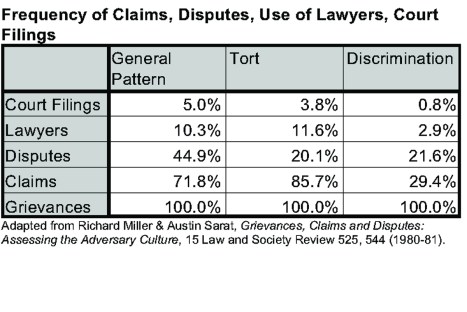
The following table shows how patterns of attrition vary in different types of problems.  The data refer to the percentages of situations for people who perceive injuries.  It shows the percentages of these situations that lead to complaints, disputes, and use of lawyers and court.
indisputably-133-why-dont-people-complain-table


The general pattern in the study was that 71.8% of grievances became complaints against others, 44.9% of the grievances were disputed, in 10.3% of the grievances the grievants consulted lawyers, and in only 5.0% of the grievances, the grievants filed lawsuits.

For situations that would be considered torts, there was a higher percentage of situations that turn into claims (85.7% vs. 71.8%) and a much smaller percentage that turned into disputes (20.1% vs. 44.9%).

The pattern in situations involving perceived discrimination was quite different.  There was a lower-than-average incidence of complaints (29.4% vs. 71.8%).  However, almost three quarters of discrimination complaints turned into disputes (21.6 / 29.4) whereas less than a quarter (20.1 / 85.7) of tort complaints were disputed.

What accounts for this difference?  For torts, the insurance system is designed to receive and resolve complaints and there generally isn’t much stigma or risk of retaliation for filing complaints.  For the large number of relatively small complaints, insurance companies and other defendants typically prefer to pay the claims promptly than spend resources disputing them.

People with discrimination grievances may doubt that they will receive satisfaction by making complaints.  Issues of discrimination often are ambiguous and difficult to prove. Filing complaints may invite scrutiny of the grievants’ own behavior.  Indeed, employees often are wary of being branded as “troublemakers” and this may be particularly true for discrimination complaints.  They risk subtle and not-so-subtle forms of retaliation, which could make their situations worse.  So the low rate of complaining should not be surprising.  People who have decided to complain presumably have decided to do so despite the risks just noted and once they have done so, they may be particularly determined to pursue their claims.

The data analyzed by Miller and Sarat is more than 35 years old but I suspect it generally reflects modern reality.  I haven’t looked for recent studies, but if you know of any, please share them in a comment below.

Complaining About Sexual Misconduct

Since the publication of the Access Hollywood tape of Mr. Trump’s comments about his interactions with women, a number of women have come forward publicly to describe what they experienced as sexual misconduct by Mr. Trump.  He has categorically denied all the claims, argued that the women have improper motives, and threatened to sue the complainants.  He has argued that the fact that they did not make any demands on him soon after the alleged incidents casts doubt on the veracity of their claims.  I do not express any opinion here about the merits of the particular claims about and by Mr. Trump.

Instead, let’s consider why people who perceive that they have been injured by sexual misconduct often would not make demands on the people who committed those acts.

The Trump controversies have prompted an outpouring of reaction by women who felt injured but didn’t press any claims as well as by analysts of these phenomena.   Columnist Dahlia Lithwick provided an historical review, which may be particularly useful for younger law students.

Clearly, many women identified with the experiences described by Mr. Trump’s accusers.  Soon after the Hollywood Access tape was released, author Kelly Oxford tweeted, “Women: tweet me your first assaults,” under the hashtag #notokayWithin a few days, 27 million people had responded.  Similarly, the hashtag #Whywomendontreport has also attracted a lot of responses.  Many women never told anyone of their perceived injurious experiences except perhaps some close friends or relatives.

In an article entitled Women Know Why Donald Trump’s Accusers Stayed Silent for So Long, Rachel Sklar wrote, “Women who dare to come forward to report stories of being sexually molested find their stories doubted, their behavior questioned, their credibility impugned.  Did they imagine it?  Do it for the attention?  Were they lying about it (because reporting sexual assault is always the path to riches and respect, right?)  Why didn’t they stop it?  The litany of responses is familiar by now:  You were flirting, weren’t you?  What were you wearing?  My, that was a short skirt.  Wait, were you drinking? Boys will be boys! . . . This is grotesquely magnified when accusations are leveled at famous or powerful men. . . . Not only are women expected to receive and submit, but they are expected to laugh off behavior that is otherwise invasive and threatening, to ‘not make a big deal’ about it.”

Mr. Trump’s attacks on his accusers reflect a general fear about complaining.  Liz Plank wrote that “Trump isn’t just trying to attack these women;  he’s signaling to others who may come forward.  By metaphorically naming and shaming them, and implicitly inviting his followers (who have a history of horrifying harassment) to do the same, he wants to terrify any other women from coming forward too.”  Indeed, Mr. Trump has threatened to sue his accusers.  This reinforces a message to women that it generally is dangerous to complain even when there aren’t explicit threats.

Slate writer Christina Cauterucci wrote, “Female friends and acquaintances, including several Slate colleagues, have told me that Trump has resurfaced deeply buried or forgotten memories of sexual assault, some stretching back to childhood. . . .Trump has also caused some women I know to rethink past sexual violations they’d previously explained away to themselves as misunderstandings or petty instances of ‘boys being boys.’  Trump’s talk and his accusers’ allegations are awakening long-dead zombies in our memories, forcing us to confront assaults we’d never labeled as such.”

The Miller and Sarat data and the recent outpouring of personal testimonies demonstrate the low level of complaining about perceived sexual misconduct and discrimination.

This is a serious problem for many reasons.  It is simply wrong that large classes of people feel injured but are too intimidated to present their claims.  This violates our notions of procedural justice, which are based on the assumption that people have reasonable opportunities to complain and be heard fairly.  Although some of unclaimed grievances may not be valid, presumably a substantial proportion of the grievances have real merit.  Even people with good-faith claims that are not valid are entitled to present them.  The wrongdoers’ pattern of behavior violates our social policy embodied in laws to protect people from sexual assault and discrimination.  Meritorious grievances that are not pursued constitute an undeserved transfer of wealth to wrongdoers from the people they have victimized.  And the low level of enforcement of legal protections effectively encourages people to continue a pattern of wrongful behavior because of the low probability that victims will complain.

These are complex problems that deserve serious efforts for social remedies.  These issues are beyond the scope of this post, however.

Implications for Defendants and Defense Counsel

In our legal system, parties are assumed to advance their own interests, not advance any other party’s interest or social policy.  Under the logic of the adversary system, it is up to would-be plaintiffs to complain if they wish, on the assumption that truth and justice will be produced through the adversary process.

This theory may approximate reality when the parties have roughly equal power and there aren’t serious impediments to use of the system.

The theory doesn’t work so well when there is a serious mismatch of power and social deterrents to use of the dispute resolution system as in the case of many sexual assault and discrimination grievances.

Of course, would-be defendants have no duty to encourage grievants to bring complaints against them.  Indeed, that would seem crazy in what Professor Jonathan Cohen calls The Culture of Legal Denial, 84 Neb. L. Rev. 247 (2005), where the “normal practice within our legal culture is for injurers to deny responsibility for harms they commit.”

Indeed, some defendants and their lawyers regularly use the Bart Simpson defense strategy: “I didn’t do it, nobody saw me do it, there’s no way you can prove anything!”

Defense counsel may take any legally permissible actions to resist charges against their clients.  ABA Model Rule of Professional Conduct 3.1 states:  “A lawyer shall not bring or defend a proceeding, or assert or controvert an issue therein, unless there is a basis in law and fact for doing so that is not frivolous . . ..”  Rule 4.4(a) states:  In representing a client, a lawyer shall not use means that have no substantial purpose other than to embarrass, delay, or burden a third person . . ..”  Tactics that are not prohibited are permitted.

Mr. Trump frequently has used litigation, as documented by USA Today, and frequently has threatened suit, as he did with the accusers of sexual misconduct and the New York Times for publishing an article about two of the accusers.  The American Bar Association declined to publish a report on Mr. Trump’s litigation history reportedly out of fear he would sue them (though ABA officials say that the report violated its policy of being non-partisan).

According to the Washington Post, “When Donald Trump has needed a legal brawler, he has often turned to Marc Kasowitz, a hard-edged Manhattan attorney whose website cites a description of him as one of the most ‘feared lawyers in the United States.’” The general counsel for one of Mr. Kasowitz’s clients was quoted as saying, “When there’s a tough, call it rough-and-tumble kind of litigation, those are the guys I would go to. . . . They’re not afraid to get their hands dirty.”

Of course, many defendants and their lawyers routinely take tough positions in litigation, which is considered normal in our legal culture.  Should they act any differently in cases involving sexual misconduct or discrimination because of the greater vulnerabilities described above?

As a matter of legal ethics, going easier on such (would-be) plaintiffs would be problematic because of lawyers’ duty of loyalty to their clients.

Yet some lawyers may find it distasteful to aggressively litigate against such vulnerable parties, especially if they believe that their claims are valid.  Rule 1.16(b)(4) states that a lawyer may withdraw from representation if “the client insists upon taking action that the lawyer considers repugnant or with which the lawyer has a fundamental disagreement.”  Although withdrawal is possible under these circumstances, probably very few lawyers take this route.

Practical Ethics Hypos

The following are hypothetical questions for law students to consider.  Although they might seem most appropriate in professional responsibility courses, they go beyond technical issues of legal ethics.  Professors might also use them in a range of legal practice courses as well as courses on gender, discrimination, and business operations, among others.

These questions involve businesses in which you, as their lawyer, have strong evidence that they have committed wrongdoing against vulnerable parties.  Although this post has focused on allegations against Mr. Trump, the following questions do not involve him because people have such strong feelings about him that responses may be colored by those feelings.

Instead, consider run-of-the-mill corporate giants or substantial mid-size firms.  Focus primarily on grievances by people who perceive that they have been injured by sexual misconduct or discrimination committed or approved by high-level business leaders.

In a case of alleged serious sexual misconduct that you believe occurred as alleged, which, if any, of the following tactics would you use?

  • Use the Bart Simpson strategy, essentially taking the approach for your client, “He didn’t do it, nobody saw him do it, there’s no way you can prove anything!”
  • Vigorously and visibly investigate the accuser’s past, in part to intimidate her from pursuing her claim.
  • Interview the accuser’s family, friends, and associates about the alleged incident, in part to embarrass the accuser and pressure her to drop the case.
  • Make public statements consistent with your legal position, challenging the accuser’s motives, character, and behavior.
  • Vigorously litigate the case, increasing the accuser’s costs and dragging out the process, in part to pressure her to accept a heavily discounted settlement.
  • Threaten to sue the accuser for defamation or actually do so.
  • Take actions that may violate the ethical rules but that are commonly used in practice and are unlikely to result in professional discipline or malpractice liability.

What other actions might you be willing to take or not in this case?  What principle distinguishes actions that you would or would not take?  How would your responses differ, if at all, if the case involved other issues such as fraud, product liability, health and safety violations that business leaders initiated or at least knew about and failed to stop and that involved plaintiffs with relatively few resources?

Now add the following assumptions to the preceding hypothetical case.  You are a recent law graduate, a year into practice, and you have a job with a law firm that regularly represents large businesses.  The job market is tight and you feel lucky to have your job.  You like your job and hope to become a partner in the firm by demonstrating your abilities and value to the firm and its clients.  You generally are comfortable with the positions your firm takes on behalf of its clients but you feel uncomfortable in this case.  You are afraid of the reaction by senior lawyers in the firm if you express your concerns or suggest withdrawing because the client is a major client for your firm and it adamantly wants to pursue a hard-line strategy to discourage other possible plaintiffs from filing suit.

How do these assumptions change your responses to the preceding questions, if at all?  What can you do to preserve both your professional opportunities and your personal integrity?

Discuss.


Lessons in the Delicate Art of Confronting Offensive Speech

A New York Times article with that headline observes that we are “in a political season when ethnic, racist and sexual slurs, not to mention general insults, seem to have become part of everyday chatter.”

Dealing with offensive comments can be hard for people generally and there are particular challenges for lawyers.

The article states that listeners’ objections can curb the behavior, but listeners understandably fear damaging relationships and inviting retaliation.  On the other hand, when people are uncomfortable and don’t speak up, this can effectively encourage speakers to continue their offensive remarks.

“A body of psychological research shows that even mild pushback against offensive remarks can have an instant effect — as difficult as that can be, especially with a boss, a friend or a celebrity.”

One expert said that “sexual banter often takes place among men who are friends, and that ‘the function of it is to promote bonding.’”  She said that “[m]en may feel that if they challenge conversation they find tasteless, or simply don’t join in, ‘they’re spoiling the mood at a minimum and possibly putting their relationship to the group at risk,’ she said.  And sometimes they worry that ‘it will raise doubts about their masculinity or heterosexuality,’ or that they will become targets of bullying.”

Challenging others’ comments that feel inappropriate can trigger strong reactions about both people’s identities and whether they are good or bad human beings.

Experts quoted in the article suggest tactics such as changing the subject, engaging in diversionary behavior, and humor.  For example, one expert suggested a response, “I love satire. It’s so weird that people believe that for real and it’s so cool you called that out.”

The director of an LGBT project sends volunteers to go door to door to talk with people. He said, “We are seeking out people who are prejudiced, and they’re using offensive language.  And if you correct that language, just use different words yourself, and your tone and demeanor are kind, people are very responsive, and you don’t have to get into a screaming match.”

This approach seems to be based on deliberate use of empathy.  The volunteers’ kindness presumably conveys understanding and sympathy with people who use offensive language.  And it reciprocally invites the speakers to empathize with the volunteers and the people they seek to help.  The program director said that it “softens” the attitudes of about ten percent of people, so it is far from changing the attitudes of most people.  But perhaps even that ten percent is significant.

While it may be tempting to directly characterize others’ statements – such as saying, “That’s sexist! [racist, a lie, etc.]” – that approach risks stimulating escalation and defensiveness.  It may stop the immediate behavior but it may also lead to counterproductive arguments, cause resentment, and actually reinforce problematic attitudes.

Lawyers not only have to deal with their own personal reactions but also have to manage their professional responsibilities to be respectful.  This may be especially difficult when they encounter problematic attitudes from their own clients.  Lawyers often worry that clients will doubt that the lawyers will fight hard enough, so it can be particularly difficult for lawyers to challenge their clients.

While it may seem counter-intuitive to demonstrate empathy with people who express ideas that feel offensive, it may be an effective tactic.  And it may open people to be more empathetic with others.  This approach may also be helpful strategically by getting people to consider their situation more realistically, recognizing the other person’s perspective as well as that of potential third party decision-makers.

All that said, these interactions can be extremely difficult to navigate, and there is no guarantee of success.

This election can provide some teachable moments for law students about how they might handle problems when they are in practice.

Survivor: Law School Edition?

I admit, I haven’t watched the TV show Survivor for years, but I’m intrigued by this season’s version, Millennials v. Gen X, as I occasionally feel that very conflict playing itself out in my classroom.

There comes a time every fall semester, usually around the end of September, when the generational differences between me and my current crop of 1L’s become evident. It usually coincides with the due date of their first memorandum and the expectations crystalize in students’ brains. Their questions typically begin as “I have a question about citation” and end as “you really expect us to do this?” with an air of incredulity.  While I may remember my law school experience somewhat hazily at this point, I do know that if I had a question about something which was covered in class, I assumed that I had missed the information, not that my professor had either failed to convey it or had unreasonable expectations. I try to convey that it’s not me who expects something unrealistic from them, but, rather, that I am preparing them to meet the expectations of cadre of Gen X or even more seasoned attorneys who will have high expectations of their interns and associates.

Many experts have identified areas where the generations differ. Here are just a few. Gen X’ers want independence and to be given time to grapple with issues on their own, they respect authority, and do not like to be overly supervised. On the other hand Millennials crave constant communication and mostly positive feedback, do not believe that those in authority deserve respect due to rank alone, and they want supervision to the point that they collaborate with supervisors rather than producing something on their own in the first place. The conflicts are apparent. Yes, these are generalizations, but I see these conflicts play out in the classroom and anecdotally when those students first experience workplace expectations and report back to me.

Each generation has positive and less positive attributes (even my use of the term “less positive” is a nod to the Millennial to whom my comments usually go, and who would be unreasonably upset by reading that there was anything “negative” in their work). It has helped me to understand and appreciate that certain characteristics I may have viewed as laziness or lack of initiative are not individual characteristics, but simply a different mental approach to work and how it is produced. I have tried to adopt some of the positive attributes they bring to the classroom, such as embracing technology, engaging in more group work, and providing more opportunities for ungraded assessment. By doing so, I let go of a characteristic of my generation:  reluctance to change.

Just as sure as the fall brings the conflict, I can also say that by the spring semester and beyond, the conflict subsides and we co-exist. Everyone survives, and my students generally report being very well prepared for their work. Unfortunately, though, none of us wins a million dollars!


New Article: “When Interests Converge: An Access-to-Justice Mission for Law Schools”

These are challenging times in law schools.  Law school enrollments remain low and graduate unemployment remains high.  Many claim there are too many lawyers to go around and law schools are just making matters worse by continuing to educate prospective lawyers.  But the problem is not really that there are too many lawyers.  Indeed, roughly 80% of low-income and half of middle-income Americans face their legal problems without a lawyer.  Too many face their legal issues without the benefit of legal representation at a time when too many law school graduates are unemployed or underemployed.  In order to overcome this paradox, I argue in a forthcoming piece in the Georgetown Journal on Poverty Law & Policy,  that law schools should embrace an access-to-justice mission, one that would help focus law school teaching, scholarship, and service on the justice gap and help align the interests of those who want to ensure everyone has access to a lawyer who needs one with those who want law schools to continue the important work of educating the next generation of lawyers.  Below is the abstract to “When Interests Converge: An Access-to-Justice Mission for Law Schools.”  A draft can be downloaded here.  Comments welcome.

In recent years, law schools have faced a crisis brought on by the external forces of technology, automation, and legal process outsourcing that has translated into poor job prospects for their graduates, and, in turn, a diminution in the number of students interested in attending law schools.  Such external phenomena are joined by internal critiques of law schools: that they have failed to educate their students adequately for the practice of law and have adopted dubious strategies without a defining mission, all at a time when the market for legal services seems to be changing, perhaps dramatically. Paradoxically, while graduates face diminished job prospects, there is still a vast justice gap: the inability of millions of Americans to obtain legal assistance when facing a legal problem.  There is thus an interest convergence between those who might want access to a lawyer and the law schools that strive to educate the next generation of lawyers and the ones after that.  This Article uses this interest convergence—and the late Derrick Bell’s “Interest Convergence Theory” as a lens through which to view it—as an opportunity for law schools to retool their missions to confront the access-to-justice crisis facing many Americans.  It argues that law schools should embrace an access-to-justice component to their missions to help increase demand for legal services, re-establish the value of legal assistance to the community, restore the importance of the legal profession in preserving and extending societally important rights and interests, and improve the demand for legal education.