
Mandatory Professional Skills Training: What a Long Strange Trip It’s Been


By Robert Kuehn, Washington University School of Law


The ABA first adopted standards for accreditation of law schools in 1921. But, as explained in a recent article by my colleague Peter Joy,[1] it was not until 1993 that schools were required to provide a program of education that would prepare students for the practice of law, not simply for admission to the bar. And not until 2005 did schools have to begin to ensure that each J.D. student receives instruction in the professional skills necessary for effective participation in the legal profession. Even then, the ABA determined that a student needs only “one solid credit” hour of skills training to be considered adequately prepared to begin the practice of law.

Since the adoption of a professional skills requirement, law school enrollment has declined precipitously, graduates have struggled to find employment, and bar passage rates have dropped in many states. In the midst of this turbulent period, in 2014 the ABA recognized the inadequacy of its one-credit skills requirement and adopted a six-credit experiential requirement that will apply to graduates starting next year. With a decade of mandatory professional skills training now completed, it is a good time to examine enrollment trends in law clinic, externship, and simulation courses over the past ten classes of law students.

Reviewing data submitted to the ABA in annual questionnaires certified by each school’s dean to be true, accurate, and complete,[2] there has been significant growth in enrollment in experiential courses since academic year 2005-2006. Total enrollment in law clinic, externship, and simulation courses has increased by almost 25% over the past ten years,

1
Some of the growth before 2011 might be attributable to increased law school enrollment. But, as seen below, the rate of increased participation in experiential courses has far outpaced law school enrollment, which is down by over 20%. It is also of note that the growth in experiential course enrollment started even before the first group of graduates were subject to the new one-credit professional skills requirement so this increased enrollment was fueled by much more than that requirement.

 

2


This experiential course growth independent of law school enrollment is illustrated in the next two graphs, which track enrollment growth per upper-level student. Although down slightly the last few years, upper-level students enrolled in an average of 2.06 experiential courses in 2015-16, a 57% increase in enrollment per student over the ten-year period.

3
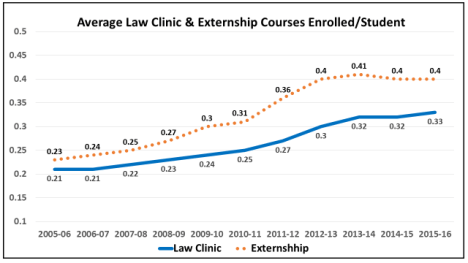
Law clinic and externship enrollment reflect this growth. Clinic enrollment is up 57% and externship up 74% (the ABA stopped requiring schools to report actual law clinic positions “filled” after 2016; only purported positions “available” is now reported). Enrollment in externships has always exceeded clinic enrollment but was particularly strong beginning in 2011, a time when graduate employment rates dropped significantly.
4

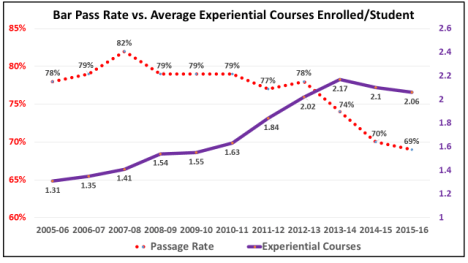
Some have suggested that the recent drop in bar passage may be due to increased enrollment in experiential courses and the possible substitution by students of skills courses for typical doctrinal coursework. However, the next graph indicates that bar passage rates were fairly steady from 2006-2013,[3] a time when experiential course enrollment increased by over 50%, and the recent decline in bar passage coincided with decreased experiential enrollment. In addition, David Moss (Wayne State) and I will be publishing the results of our joint study of ten years of law graduate performance on the bar exam which finds no association (positive or negative) between taking experiential courses and passing the bar.
5

Others posit that rather than the increase in experiential course enrollment, the bar passage decline may be due to the decreased LSAT credentials of entering J.D. students, an association seen in the next graph plotting the median LSAT of entering students against bar exam results three years later.


6


When the ABA was debating the increase in required experiential coursework in 2014, it also considered a request to require every student to obtain a real-life practice experience through a law clinic or externship. Although the ABA declined to require every J.D. student to graduate with a clinical experience, there has nonetheless been a dramatic increase in the number of schools that require or guarantee enrollment in a law clinic or externship course before graduation, increasing from just 12 schools in 2005 to 68 in 2017:


7


Because of the growth in available positions for students in law clinic and externship courses over the past decade, many more schools also could easily require or guarantee a clinical experience to every student. In their most recent reports to the ABA, 90% of schools had sufficient capacity in their existing law clinic and externship courses to adopt a requirement or guarantee without adding any additional courses or slots for students. Yet, only 33% of schools currently ensure that each graduate may have a clinical experience in spite of evidence showing that a clinical experience can be provided to all students without the need to increase tuition.[4]


8


It took the ABA over 70 years to recognize that the purpose of law schools, like all other professional schools, is to prepare its graduates for successful entry into their profession, not just success on a licensing exam. The recent adoption of a skills requirement was an important step toward that preparation. But, a mere six credits is hardly sufficient training in the “professional skills needed for competent and ethical participatin as a member of the legal profession” that the accreditation standards require.[5] Let’s hope it’s not another 70 years before law students are finally provided the enhanced professional skills training that they truly need to successfully begin the practice of law and is common in other professional schools, including a mandatory clinical experience for all graduates.


[1] Peter A. Joy, The Uneasy History of Experiential Education in U.S. Law Schools, ___ Dick. L. Rev. ___ (forthcoming 2018), available at https://papers.ssrn.com/sol3/papers.cfm?abstract_id=3129111.

[2] Enrollment data available at http://www.abarequireddisclosures.org (2011-2017) and ABA-LSAC Official Guide to ABA-Approved Law Schools (2005-2010).

[3] Bar exam statistics available at http://www.ncbex.org/publications/statistics/statistics-archives.

[4] Robert R. Kuehn, Universal Clinical Legal Education: Necessary and Feasible, 53 Wash. U. J.L. & Pol’y 89 (2017), available at https://papers.ssrn.com/sol3/papers.cfm?abstract_id=2942888.

[5] Am. Bar Ass’n, 2017-2018 Standards and Rules of Procedure for Approval of Law Schools, Std. 302(d), available at https://www.americanbar.org/groups/legal_education/resources/standards.html.

Keeping Up with the Henthorns

Written by Albany Law School Professor, Melissa Breger.

Keeping up with current case law can be a true treasure trove for classroom teaching. It can breathe life into an otherwise ordinary topic. And truth is so often more compelling than fiction.

A few years ago, while reading the Evidence Law Faculty ListServ, I learned about the case of US v. Harold Henthorn. (Thank you to Ann Murphy, Gongaza Law!)

 Henthorn had been recently tried federally for the intentional murder of his wife, Toni Henthorn. He claimed his wife of 12 years, Toni, accidentally fell off a remote 100-foot cliff in Colorado. The team of AUSAs on the case wrote a brilliant motion to try to introduce FRE 404(b) evidence. The motion was granted.

Click here to review the motion.

The prosecution sought to introduce:

  1. Evidence that Lynn Henthorn, also Harold’s well-insured (former) wife of 12 years, “accidentally” and mysteriously died under a Jeep in the middle of the night in a remote location;
  2. Evidence that Harold took out very hefty life insurance policies as beneficiary for his wives, as well as for his former sister-in-law (of whom he was also romantically interested); and
  3. Evidence that a 40-foot wooden beam “accidentally” hit Toni Henthorn from the roof of the remote lake cabin in the middle of the woods some years earlier.

The trial court agreed to allow in the previous events where Lynn died and Toni was injured, and the fact that life insurance was taken out on both of Henthorn’s wives with himself as a beneficiary. The Court did not allow in the claims that Henthorn also took out an insurance policy on his sister-in-law’s life. The Court required limiting instructions on the pieces of evidence it allowed in at trial.

In class, I explain to the law students the story of the Henthorn family, but I do not have them actually read the cases or the motions until after we have discussed the case in class. (After class, all of these materials are posted and distributed). In the classroom, I have the law students analyze each piece of evidence that the prosecution is trying to enter into evidence under FRE 404(b).

Click here to review Rule 404(b).

This exercise offers a rich, nuanced vehicle for discussion to explore the very important Rule of Evidence, FRE 404(b), in comprehensive detail. The rule, also misleadingly called the Rule of “PRIOR BAD ACTS” reads:

Character Evidence.

404 (bCrimes, Wrongs, or Other Acts.

(1) Prohibited Uses. Evidence of a crime, wrong, or other act is not admissible to prove a person’s character in order to show that on a particular occasion the person acted in accordance with the character.

(2) Permitted Uses; Notice in a Criminal Case. This evidence may be admissible for another purpose, such as proving motive, opportunity, intent, preparation, plan, knowledge, identity, absence of mistake, or lack of accident. On request by a defendant in a criminal case, the prosecutor must:

(A) provide reasonable notice of the general nature of any such evidence that the prosecutor intends to offer at trial; and (B) do so before trial — or during trial if the court, for good cause, excuses lack of pretrial notice.

At the same time there were eerie similarities between the events, there were also obvious differences. The defense certainly had much room to dispute the idea that there was any common plan or scheme here. The events were also decades apart in timing.   The trial court allowed in the acts with limited instructions that they be considered only under “planning, intent, and lack of accident.”

When the 10th Circuit reviewed the case, the Court noted that prior events were “extraordinarily similar to the charged offense.” In terms of the large span of years between the events, the Court noted “acts “quite remote to the crime[] charged have frequently been deemed by us and our sister circuits to be relevant if they were sufficiently similar to those crimes.”

Click here to review the 10th circuit case.

The case, while truly tragic and disturbing, has provided future lawyers with a wealth of material for learning complicated concepts about FRE 404(b), The Doctrine of Chances and the admissibility of prior crimes, wrongs and other acts.


Drafting Exams With Test-Taking Speed in Mind

It’s time to write final exams again. It’s also time to struggle with what role test-taking speed should play in our assessments.

William Henderson’s Study

As Professor William Henderson’s ground-breaking study demonstrates, test-taking speed – how fast students can read and answer test questions– is often an independent variable when students take in-class timed law school exams.

As Professor Henderson cautions, given the high stakes nature of law school exams, we need to be cognizant of the test-taking speed variable and consciously decide whether it is one we think is important in terms of the substance or skills being assessed. As he notes, test-taking speed may have limited relationship to how lawyers use doctrine and legal analysis and it also may have a discriminatory impact.

Potential Solutions

Some faculty members address the test-taking speed issue by giving take-home exams or papers. Others do not want to give take home exams for a host of reasons, including the belief that the material does not lend itself to a take-home exam or concerns about policing academic honesty.   For those of us giving timed, in-class exams, are there ways to decrease the impact of test taking speed? Below I share a few ideas. I also invite those of you who have grappled with this issue to share what you are doing.

A. Pre-release exam instructions

One way to help students at least prepare for time constraints is to release exam instructions ahead of time. In many classes, the exam  instructions identify how many questions and provide suggested time allocations. This information, shared in advance, can help students plan their time before they take the test.

B. Pre-release a couple of questions

In addition to pre-releasing instructions, 24 hours before an exam, I pre-release a couple of short answer questions [worth 10-15% of the total raw score points]. This allows students to prepare answers to those questions ahead of time.  For those questions, I minimize the test-taking speed issue.

I allow collaboration on the pre-released questions so I do not need to police students. I also warn students about the dangers of collaboration and letting others lead you down the wrong path.

C. Time yourself

I also take the test myself, timing how long it takes me to answer a question or set of questions. I double or triple the time allotted based upon how long it took me, or in some cases how long it took a colleague who gave my exam a test run. For example, if it takes a professor about two minutes per question for a set of multiple choice questions, I allot four to five minutes per question for my students.

Some may argue that allowing five minutes per multiple choice question does not prepare students for the bar exam – an exam in which students have under two minutes to answer often fairly complex multiple choice questions. That point is correct and it raises the interesting question of whether one’s course grade should be capturing bar exam taking skills.  It also raises the bigger question about whether test-taking speed is a variable that we, and bar examiners, should be assessing.

Reliability and Validity concerns

Significant time to answer a question necessarily means a test with fewer questions. For some, this prompts reliability and validity issues [fewer questions may reduce the reliability and thus the validity of an exam]. On the other hand,  test-taking speed as an independent variable also raises questions about test validity.

Making Sure We Understand the Issues

These are complicated issues and different faculty may have different answers to the test-taking speed questions. The key is not necessarily how we answer these questions – it is that we are asking ourselves the questions as we draft our exams.

Artificial Intelligence, Algorithmic Knowledge and the Future of Law Schools

Written by: Christian B. Sundquist, Professor of Law at Albany Law School

When thinking about the future of law schools, the unceasing technologicalization of legal practice and education, embodied in part by law-based artificial intelligence and the emergence of “lawyer-bots,” deserves critical analysis. A common fear, articulated by many, is that looming improvements in artificial intelligence will render the majority of traditional legal jobs obsolete, thus dramatically calling into question both the existence and traditional mission of law schools.

Indeed, it is well known that law firms and lawyers across the world have begun integrating law-based artificial intelligence systems into their practice to improve efficiency and the delivery of lower-cost basic legal services to clients. IBM’s “ROSS” AI system, touted as “the world’s first artificially intelligent attorney,” was developed to provide answers to legal questions (culled from its analysis of legal databases) and monitor case law and other developments. E-Discovery technology has advanced to the point where an AI system such as COIN (a JP Morgan software program) can perform (in mere seconds) document reviews of complex matters that used to require 360,000 human hours. Online legal services companies, such as LegalZoom, provide outsourcing of basic legal drafting and other tasks. A recent study demonstrated that a law-based AI system was able to more quickly and accurately identify potential legal issues in a series of non-disclosure agreements than seasoned contract attorneys. And automated “lawyer-bots,” such as DoNotPay, which help people sue Credit Reporting agencies and contest parking tickets, are quickly proliferating.

The practice and education of law, of course, has long been impacted by emerging technologies that have changed how lawyers approach certain tasks. For example, the development of efficient online legal research tools (such as Westlaw and Lexis) dramatically reduced the number of billable hours a lawyer spends on researching basic legal issues (and, perhaps, the nature of legal research itself). Similarly, the advancement of e-Discovery methods over the last decade (coupled with technological improvements that expanded the controversial outsourcing of low-level legal tasks) have largely eliminated the need for junior lawyers to devote a significant portion of their time reviewing sensitive documents by hand.

Such emerging technologies can be seen as eliminating the need for lawyers to perform certain tasks and services (such as basic legal research, the drafting of basic legal instruments, etc.), and thus negatively impacting legal employment opportunities. However, the same technology can be embraced as improving the efficiency and cost of legal practice, while (perhaps) expanding access to justice and allowing lawyers to devote more energy to complex legal and analytical issues.

We cannot stop the march of the lawyer-bots, but we can do our best to prepare students for the newly emerging techno-legal landscape. Whereas the traditional legal model was based on the transmission of information and descriptive knowledge (which has now largely been displaced by technology), the new legal model must be based on critical analysis, creative problem-solving and emotive client-based lawyering (which cannot yet be so easily replaced by “narrow” systems of artificial intelligence). The law schools of the future (today) will need to ensure that students are being prepared to:

  • engage in high-level critical analysis (such as the ability to develop, understand and articulate policy arguments), engage in complex oral and written advocacy, and appreciate theoretical (jurisprudential) explications of the law;
  • provide creative solutions to complicated legal problems (such as providing individualized advice to clients and engaging in interdisciplinary group problem-solving activities); and
  • provide emotive client-focused representation (such as by further developing professionalism and negotiation skills and enabling students to interact with a diverse range of persons).

The compiling and interpretation of legal information by new technology, nonetheless, is still subject to potential coding bias in the algorithms and assumptions that underlie law-based artificial intelligence systems. Much has been written about such machine-learning bias and how the production of algorithmic knowledge can replicate existing patterns of social inequality (by reinforcing gender and racial stereotypes). For example, the emergence of predictive policing models (such as PredPol, used by law enforcement to identify the likelihood of future criminal activity) and predictive risk assessment software (where judges around the country are beginning to use such algorithmic knowledge to determine criminal sentencing based on the likelihood that a person will commit a future crime) have been heavily criticized on privacy and racial justice grounds. As such, law schools also owe their students a duty to help them identify and critically interrogate the core assumptions that foster the development of such algorithmic knowledge, while enabling students to work closely with AI programmers to develop and implement future legal technology


Are we prepared for the new generation of students inspired by Dr. Martin Luther King’s legacy?

Yesterday marked the 50h anniversary of the day that a man fatally shot Dr. Martin Luther King, Jr., outside his hotel room in Memphis. Dr. King had traveled there to address poverty and workers’ rights – global issues of inequality that were playing out in a local arena. Not quite three years earlier, Dr. King stood next to President Lyndon Johnson as he signed the Voting Rights Act into law. The Act was a crowning achievement of a strategic fight. Peaceful activists waged the long battle to overcome legal barriers that prevented African Americans from exercising their right to vote. But the battle left real victims, bloodied from counter attacks often waged with weapons intended to cause serious bodily injury or death. (For a well-written account of the strategy, see Louis Manand’s piece in the New Yorker: https://www.newyorker.com/magazine/2013/07/08/the-color-of-law.)

In 2018, a new group of civil rights activists have marched to protect themselves and their peers from these same weapons of death and destruction. These activists are young high-schoolers, and they have been attacked for being “brainwashed” and not “fully rational actors.” Their youth, the very thing that made them uniquely vulnerable to easily acquired assault weapons, has been used to diminish their message.

But youth have been leaders of transformative moments throughout our history. From racial segregation to the Vietnam War to nuclear weapons, students have led protest movements and created change. This new movement has garnered attention. Leaders recently met with members of Congress. They were mocked by Laura Ingraham and encouraged by Pope Francis. Supporters showed up in marches around the world. They are on a roll, and they seem completely capable of continuing the momentum. (For an interesting article on youth-led movements see Rebecca Onion’s article in Slate: https://slate.com/news-and-politics/2018/02/weve-had-the-same-debate-over-teen-activism-since-the-civil-rights-era.html.)

But students’ protests aren’t just focused on Congress and the NRA. College students occupied Howard University’s administration building with a list of demands, some as reasonable as developing a better system to address sexual assault and mental health issues. These students seem tenacious and confident that their collective power can make change. (See Adam Harris’s article “How the Howard University Prostests Hint at the Furure of Campus Politics”: https://www.theatlantic.com/education/archive/2018/04/protest-howard-university/557270/.

Many of these students will join the new surge of law school applicants who want a legal education so they can change the world. Are we prepared? Will our curricula provide these students with tools from different disciplines to help them understand what ails the nation from a variety of different perspectives? Will we create enough experiential learning opportunities to meet this generation of change agents’ needs? Will our career development offices preference Big Law over lower paying public interest jobs? When students’ activist dreams leave them with overwhelming debt, how can we help?  As we attempt to comply with educational mandates, will we abandon hard-to-measure learning outcomes? Are we equipped to teach our students leadership skills in a tech driven society? Will we provide all students a safe and inclusive place to learn? Will our teaching inspire resiliency in the face of stubborn resistance?

Law school teachers and administrators would be wise to listen to these young voices. It’s our responsibility to teach the next generation of legal actors. We must be prepared with new ideas. (And many have already have started the conversation, like Katie Redford, in her article, Attention, Law Students: Our Country and Our Planet Need You to Lead, 69 Stan. L. Rev. 1831 (2017).) We must be willing to learn new skills and solve old problems. Otherwise, our attempts at legal education may impede their progress rather build their platforms for success.

The Kids Are Alright

Regardless of your position on gun regulation, the work of the students of Marjory Stoneman Douglas High School in Parkland, the latest victims of yet another act of senseless gun violence, has to be inspiring, if not a little humbling.  They are putting adults to shame, literally and figuratively.  Their eloquence, passion, and even their social media smarts, are creating a moment of reckoning in this country.  The so-called “adults in the room” cannot hold a candle to these students’ capacity to mobilize, empathize, reach across difference, and move a nation to action.

Many seem surprised by this. As an educator who teaches many millennial law students, I am not.  I see my students accomplish amazing things, and am constantly inspired by their intelligence, willingness to roll up their sleeves, and go to work.  Moreover, as a former law student myself (although, admittedly, nearly three decades ago), I saw students work together in the face of resistance, and the stories I have read about the work of the Parkland students and the thousands more who have taken up this fight resonate and are reminiscent of work that has occurred and will continue to occur, carried out by eager and passionate students who won’t take no for an answer and continue to “Call BS” when necessary.

What we are seeing in action is perhaps the greatest student project ever undertaken.  From the outside looking in, it looks like the students are working collaboratively and sharing the spotlight among themselves and with others outside their immediate circle.  They appear incredibly supportive of one another, are pressing ahead in support of a cause larger than themselves though grounded in their personal experiences of tragedy, and are reaching out to others to build bridges across geographies and communities. They are accomplishing slow and steady wins that help to build momentum, sustain their energy, and create confidence to take on the next challenge. In short, they are doing all of the things that a group needs to do in order to produce meaningful change.

In academia, many fear the group project.  But it is how the world functions, and how humans have been operating for millennia.  In fact, our capacity for cooperation is probably what makes us human.

Such group activity can also can have its downsides, and not just in terms of the free rider who benefits from the work of others.  Rather groups can take on a life of their own, and distorted and harmful collective understandings can emerge as a result.  In the wake of the collective tragedies of Nazism and Stalinism, “groupthink” became a source of serious academic study. But on the brink of World War II, Hungarian sociologist Karl Mannheim wrote about how industrialization and urbanization was impacting our collective capacity for this sort of groupthink as follows: “life among the masses of a large town tends to make people much more subject to suggestion, uncontrolled outbursts of impulses and psychic regressions than those who are organically integrated and held firm in the smaller type of groups.  Thus industrialized mass society tends to produce the most self-contradictory behavior not only in society but also in the personal life of the individual.”

The students of Parkland and the many others who are emerging into the broader spotlight are organizing themselves at the local level, school-by-school and community-by-community, and helping the rest of us see the disastrous and ruinous groupthink that has captured the collective imagination around gun control.  And they are doing it in remarkable ways, sustaining their collective energy in the wake of tragedy.

Recent research into how groups can work effectively, carried out by Google in what it called “Project Aristotle,” identified a series of common components in effective groups, including the following:

  • Dependability: getting things done on time and accurately;
  • Structure and Clarity: having clear goals and clear roles;
  • Meaning: the work is personally important to the team members;
  • Impact: team members think their work matters and will bring about change;
  • Psychological Safety: team members feel safe to take risks and be vulnerable in front of others.

From the outside looking in, the Parkland students and the many others who have been working for meaningful responses to gun violence who have gained greater attention because of the Parkland tragedy, appear to meet these criteria for successful groups.  They pulled off hundreds of simultaneous rallies across the country in a matter of weeks.  They could not have done so had they not had some structure and clarity to their work, did not see the importance of their work, and did not derive meaning from it.  And it would appear that they are incredibly supportive of each other, both within their own groups and in relation to each other.  For example, during Saturday’s march in Washington, when a student, Samantha Fuentes, who was wounded in Parkland, was addressing the crowd, she paused a moment, turned away from the lectern, and vomited.  Other students rushed to her side, urged her to keep going.  She emerged from being doubled over to proclaim: “I just threw up on international television and it feels great!”

The students leading this campaign should be an inspiration to everyone who wants to bring about change, and can help us understand how we can do it collectively, because it is in such group efforts that real change is possible. I have written about my own experience as a law student working on a case, brought by a law school clinic, that challenged the U.S. government’s treatment of Haitian refugees in the early 1990s, a case which ultimately went to the Supreme Court.  In ways that echo the work of the Parkland students, but by no measure on the same scale or with the same impact, the team effort there, led by students, invoked many of these themes as well, and can help show how law schools can harness the collective capacities law students have for bringing about change.

In an oft-quoted phrase, Margaret Mead said to “never doubt that a small group of thoughtful, committed citizens can change the world; indeed, it’s the only thing that ever has.”  How such groups should actually go about doing that is another question, and the Parkland students and the thousands of others who have been inspired by their work, or who have finally gotten the attention they deserve, may just show us the way.

Podcasts on law student well being

Dean David Jaffee shares exciting news about a new podcast series on law student mental health.  Below is his announcement:

“I write to share with you a new podcast series, The Path to Law Student Well-Being,sponsored by the Law School Assistance Committee to the American Bar Association Commission on Lawyer Assistance Programs (CoLAP).

The inaugural two-part episode is available here, just below the live Twitter Town Hall taking place this Wednesday.

This episode features two short conversations with Dean & Professor of Law Michael Hunter Schwartz of the University of the Pacific’s McGeorge School of Law and Professor Larry Krieger of the Florida State University College of Law and is moderated by Professor Susan Wawrose of the University of Dayton School of Law.

  • In the first part of this episode, Dean Schwartz and Professor Krieger suggest ways individual faculty members can notice, engage with, and support students they suspect are in distress.
  • The second part identifies steps faculty can take to promote student well-being through their teaching in the classroom and includes simple actions for law school administrators.

The podcast series is a response to the call for action in the 2017 National Task Force Report The Path to Lawyer Well-Being: Practical Recommendations for Positive Change, which was sent to all law schools last fall and sets out specific action items for the legal community, including some specific steps for judges, regulators, employers, bar associations, lawyer assistance programs, and law schools.

We hope you will share the news of these new podcasts widely with your faculty, staff and colleagues to help bring awareness to the ABA’s Law School Mental Health Day tomorrow, March 28, and to encourage discussion and action within the law school community around the critically important of topic of law student well-being.”


Don’t Just Keep Swimming–Dive In

Another law school closed this week. I opened my Twitter feed today to search for newsy ideas for this post and discovered this story announcing the closure of Savannah Law School. The legal market has undergone tremendous change the last 10 years, and legal education is impacted in ways that are still unfolding. How do we sustain a system that sometimes seems built on shifting sands?

Years ago one of my students submitted an essay featuring the tag line “Just Keep Swimming” from the film Finding Nemo. It was a metaphor for her coping with a tough semester that included a major flood in our law school’s clinic space. I’ve reflected on that many times when I’m overwhelmed by my workload, or what I perceive–possibly wrongly–as student apathy, or the employment market for our new graduates, or any number of other #firstworldproblems. But as I pondered this somewhat existential question today in preparation to draft this post, a different approach came to mind. Like the turn of a kaleidoscope, my perspective changed to the metaphor of a deep dive rather than a slog-like swim.

The phrase “deep dive” is perhaps overused. I find it useful, though, when contemplating projects that require me to screen out distractions, focus on a goal, and exercise a bit of grace. Preparing to teach each class period is like that for me. I turn off my email, close the door, vigorously re-read the material and refine my notes. I get creative with PowerPoint and put myself in the shoes of the student–what images would bring this doctrine to life? Which sentence of a court’s decision captures its holding so perfectly that it deserves a spot on my slide?

We are educators of people who will contribute to our legal system’s continuing evolution. We have tremendous opportunities to shape their work style, expectations, and self-awareness as future lawyers. And our profession is self-regulating. After they graduate, they are largely autonomous.  We should dive into the sea of legal education every day with elegance and precision.  Drop us a comment–what does a deep dive look like for you?

March 30th is Final Deadline for Proposals — Emory Law’s Conference on Teaching Transactional Law and Skills (June 1-2, 2018)

Hello All.

The end of the school year is fast approaching and we want to give you one last chance to submit a proposal demonstrating what you are doing to foster excellence in the teaching of transactional law and skills.

Therefore, we’ve extended the proposal deadline through Friday, March 30, 2018.

Please submit your proposals as soon as possible. After March 30th, we’ll turn all of the proposals over to our Program Committee, who will notify those accepted and begin putting together the Program Schedule.

Even if you do not submit a proposal, please register for the conference now.

We are reaching far and wide to embrace the whole community of transactional law and skills educators, so please encourage your colleagues – including new teachers and adjunct professors (both at reduced registration fees) – to join us. It will be a wonderful time to gather, talk, share, teach, learn, and celebrate.

Sincerely,

Sue Payne, Executive Director

12


Re-assessing the “drive” to measure learning outcomes

A recent NY Times editorial, “The Misguided Drive to Measure ‘Learning Outcomes” by Molly Worthen, prompted revisiting the purpose-driven nature of what are labeled “educational” trends and this trend in particular – especially as it relates to legal education. Although quantifying “learning outcomes” has been pushed at the secondary and undergraduate levels for a while, it is now being required of legal educators.  As a lawyer and legal educator faced with the direction to set and measure learning outcomes, I have found myself conflicted in part because I find its limitations and the funneling nature of metrics incongruous with its language of education drawn from Bloom’s taxonomies.  There is also a current of politicization in the “drive.” In the end, the unique responsibilities of law school faculty as lawyers and in planning and implementing a school’s educational program is significant. Those roles inform the use and effectiveness of setting goals and actively paying attention to our effect on students – after getting past the lingo, of course.

At the outset, I found myself skeptical of the trend’s origins as an “educational” tool at all.  As the Worthen piece points out, although the push to quantify undergraduate learning is about a hundred years old, the real drive grew in the 1980’s. That decade’s impetus for quantification of teaching came during a time known for materialism, yuppies, the rapid growth of technology, and then President Reagan’s promise to return  prayer to school. Given this origin in an era of consumerism and growing talk of “liberalism” in higher education, it is readily inferrable that assessing learning objectives was the product of accreditors and the institutions they control with financial and conservative goals; see, David Clemens “Student Learning Outcomes and the Decline of American Education,” August 31, 2016, fostering assessment less as an educational goal and more as a means of control.

Moreover, the idea of “measuring outcomes” is inherently a business or economics concept or a concept more aptly used when discussing computers; it thus seems inapposite in legal education unless education is truly primarily a business or the language is adapted.  Outcomes, inputs, and outputs are terms used when major donors, for example, look for data-driven proof that their resources produce something.  Outputs are readily measureable.  Outcomes, the effect on people served that occurs because of the resource use, are much less readily measureable.  A donor then withdraws support when outputs don’t exceed inputs or outcomes are unmet.  Worthen notes that outcomes measurement was extended to undergraduate education because of accrediting agencies that demanded a form of learning assessment as a means of demonstrating fitness to receive federal student financial aid – a sort of stand-in for the donor as fund provider.  The telling part of the development of learning outcomes measurement is its push from employers.  Worthen wrote “Employers report repeatedly that many new graduates that they hire are not prepared to work, lacking the critical thinking, writing and problem-solving skills needed in today’s workplace” quoting then President Bush’s 2006 Commission on the Future of Higher Education’s Report.  I’m hard pressed to find teachers or professors who demanded development of assessments.

The direct pressure to produce learning outcomes in legal education comes from the ABA – likewise after major law firm employers similarly decried a lack of practice readiness in student graduates. Their complaints arose concurrent with a downturn in the economy that led those same employers to reduce their internal practice training.  With law schools pushed to the consumer, business model of delivering education, the slide into measuring outcomes has occurred despite criticism.

And, much of what is written about measuring learning outcomes other than by its developers is highly critical. Several early critical articles start from the position that significant aspects of education are simply not measurable because in part, education is a process, not a product a la Jerome Bruner. Thus, they argue, attempting to “measure” learning outcomes is inconsistent with good education. E.g.,  James Mckernan, Some Limitations of Outcome-Based Education. Journal of Curriculum and Supervision. Volume 8. 343-353 (1993).  That critique suggests measuring learning outcomes assumes knowledge can be broken down into “micro-outcomes” in disregard of the epistemology of knowledge (Mckernan) as theorized by some like Herbert Dreyfus to include background and experience that cannot be readily measured. Others criticize outcomes measurements for shifting the emphasis from learning to some kind of outcome at all, thereby ignoring the open-ended nature of education and encouraging rigidification of curriculum and perspective.  E.g., The Unhappiness Principle (November 29, 2012)  https://www.timeshighereducation.com/the-unhappiness-principle/421958.article . In a related way, still others have criticized the move toward measuring “learning outcomes” because a teacher’s success is dependent on whether students learn regardless of what students bring to the classroom referencing post cognitive learning theory and because targeting “outcomes” encourages teaching to the middle or bottom of a class to meet stated outcomes while ignoring other students.

Worthen notes as criticism the “obsession with testing that dominates primary education [has] invaded universities” pointing out a focus and resource shift to assessment rather than education.  Consistent with this concern about emphasizing testing and assessment over exploration, other authors have pointed to apprehension about how pressure on students to succeed according to measured external standards without cultivating personal morality has led to law student depression and cynicism. See Lawrence Krieger, Institutional Denial About the Dark Side of Law School, and Fresh Empirical Guidance for Constructively Breaking the Silence, 52 J. Legal. Educ. 112 (2002); see also Larry Natt Grantt and Benjamin Madison, Self-Directedness and Professional Formation: Connecting Two Critical Concepts in Legal Education (draft).

At least one critique focused not on educational soundness but more on the regulatory purpose of measuring assessments.  In a piece written for a conservative nonprofit institute, the author wrote “learning outcomes and assessment are not about education at all; they are about control.” David Clemens “Student Learning Outcomes and the Decline of American Education,” August 31, 2016 https://www.jamesgmartin.center/2016/08/student-learning-outcomes-decline-american-education/.  The author went on to note how political sides view outcomes differently though both sides see the outcomes as a tool for control.  “The right sees [learning outcomes] as a way to enforce professor accountability, increase ‘productivity,’ and get rid of bad teachers and junk courses.  The left sees [learning outcomes] as a golden opportunity to promote progressivism through ideological outcomes that students must internalize in order to pass.” The same author went on to note by way of example how selecting outcomes such as “build awareness of the history and context of diversity and social justice in [the State]” are “not the sort of thing” that “my conservative friends had in mind” for student learning outcomes.

Assuming in law schools we somehow adapt the economics terminology to legal education, measuring learning outcomes seems to be a policy that will continue for a time.  In legal education, of great significance, of course, is the responsibility of faculty for setting the program of education. Even revisioning learning goals as learning outcomes, the questions remain: in law school, what is meant by education, what can and what should be measured, and what is there about law and law practice that should form the basis of legal education whether measured.    In a short piece “What is Education? Insights from the World’s Greatest Minds,” https://www.psychologytoday.com/blog/the-moment-youth/201405/what-is-education-insights-the-worlds-greatest-minds, Marilyn Price-Mitchell, Ph.D. offers, among other things, the following about education:

            “The principle goal of education in the schools should be creating men and women who are capable of doing new things, not simply repeating what other generations have done.” Jean Piaget

            “Education is what remains after one has forgotten what one has learned in school.” Albert Einstein

            “Education is the most powerful weapon which you can use to change the world.” Nelson Mandela

            The law, unlike computers and math, is like the people who make it – reasoned but imperfect, biased, aspirational, short-sighted, flawed, reflective of society, and constantly changing; legal education goals should reflect those dynamics.  Although some schools have sought regional accreditation from the same entities that accredit undergraduate schools, legal education itself remains distinguishable from education at other institutions if only because it is governed by a professional set of standards unique to legal education.  The ABA Standard 302 obligates accredited law schools to establish minimum learning outcomes in the following areas: (a) Knowledge and understanding of substantive and procedural law; (b) Legal  analysis  and  reasoning,  legal  research,  problem-solving,  and  written  and  oral communication in the legal context; (c) Exercise of proper professional and ethical responsibilities to clients and the legal system; and (d) Other professional skills needed for competent and ethical participation as a member of the legal profession.  “Micro-outcomes” are not required, and “understanding” is one of the outcomes under the ABA.  It seems counter-intuitive and inconsistent with the goals of legal education that “micro-outcomes” set for other university degrees should somehow supersede ABA standards. For example, though “understanding” seems not to be an appropriate outcome under Middle States standards, it is clearly an outcome under ABA standards. Certainly for purposes of remaining ABA compliant, it seems appropriate to read general education standards in light of the specialized standards of a legal education if only to ensure bar passage and ethical participation as a member of our profession.

Not surprisingly then, beyond knowledge, analytical, and communication objectives, the ABA requires professional skills and ethical responsibilities goals aimed at both clients and the legal system we serve. Consistent with the idea that the law is about people, the people who make and the people who serve and are served by it, ABA Interpretation 302-1 further states that other law schools may determine other professional skills including, among others, “cultural competency.”  Thus, it would seem that while “build[ing] awareness of the history and context of diversity and social justice” may not have been what was initially in the minds of those who pushed for measuring learning outcomes as a way of “increasing productivity,” awareness of cultural differences and building cross-cultural competencies is nevertheless a specifically enumerated learning outcome that law schools may set. Any outcomes created under ABA standards are significant to the how students may come to learn not only the rules, but to view the law in context and in practice.

Despite the economics origin and terminology of “measuring” “outcomes,” and the difficulty in measuring some learning goals in law school – at least those goals in addition to passing the bar exam – perhaps as a colleague suggested, we might recognize the opening to address the context in which law is made and practiced more.  Consistent with our oath’s commitment to uphold the Constitution and ethical participation in our profession, decide what can be achieved in addition to knowledge and understanding of procedural law and practice skills.  Start with the aspirational; establish goals that begin with awareness that can be measured, and then hope for the enlightenment that comes from the experience after awareness all the while recognizing we may not need to measure everything.


Deep Dive into Experiential Education in U.S. Law Schools

In May 2017, Eduardo Capulong (Montana) moderated a lunch presentation at the AALS Clinic Directors Conference on the new experiential education requirement found in ABA Standard 303, which requires one or more experiential courses totaling at least six credit hours.  Standard 303 also explains that an experiential course must be a simulation course, a law clinic, or a field placement.

For my presentation, I prepared an abbreviated history of how the ABA Standards addressed experiential education over the past several decades.  What I found most interesting as I explored the history was the hostility to experiential education by some legal educators from the inception of university-affiliated law schools in the 1870s.   After the presentation, some clinic directors and associate deans for experiential education came up and said that they found the history interesting and that I should write something up.

Well, I responded to their suggestion and started digging more into the history of experiential education in U.S. law schools.  The more I dug, the more surprises I uncovered. While I was struck with the hostility toward experiential education in law schools, some of more surprising findings are:

–concurrent with the hostility toward experiential education was a preference for a law professoriate with little or no practice experience starting in the 1890s;

— the AALS membership requirements essentially served an accreditation function in the first half of the 20th Century and the AALS even applied to be accrediting agency for law schools in 1969;

— the ABA Standards did not require law schools’ educational programs to be designed to qualify its graduates for admission to the bar and to prepare them to participate effectively in the legal profession until 1993; and

— something that may not be new but is still surprising, when the ABA first required “substantial instruction” in professional skills in 2005, “substantial instruction” was interpreted to mean only one credit, and some law schools even resisted that minimal amount of experiential education!

I came to realize that the history of experiential education in law schools is primarily a history of some members of the bar, such as Robert MacCrate, and some legal educators pushing the ABA to adopt Standards to nudge law schools to require some experiential education of all law graduates.  Eventually, that digging into the history of experiential education has resulted in a recent draft article The Uneasy History of Experiential Education in U.S. Law Schools.  This article analyzes the history of the ABA involvement in legal education leading up to the first mention of experiential education in ABA accreditation standards. Next, the article traces the development of the experiential education requirement in the ABA accreditation standards, paying particular attention to how the experiential education requirement has evolved from something law schools should offer to something law schools must require. Finally, the article concludes with some suggestions for the future of experiential education in law schools.  If any of this sounds interesting, you may want to check out the article here.  Thank you!

“Will Law Schools See a ‘Trump Bump?'” A Law Student’s Perspective.

Professor Ray Brescia of Albany Law School wrote an enticing article on the possibility that law schools are experiencing an increase in applicants from prospective students in response to the 2016 election, and Trump’s victory. The link is below, I strongly encourage you all to give it a read.

https://lawandsocialinnovation.wordpress.com/2018/02/23/is-the-law-school-trump-bump-a-thing/

While I personally envisioned attending law school and becoming an attorney from a young age, before the notion of a Trump America was conceived, nevertheless, my motivation to succeed spiked following the election.

I was lucky to begin law school in 2016, as it is a fascinating time to learn the law, procedure, and how the President and his administration’s actions may be in accordance or violation thereof.

I know I am not the only law student that feels this way. Regardless of which side of the political spectrum prospective and current law students reside, we are certainly seeing a time at which the motivation to make a difference is at a high. Students are taking action, whether its writing and calling legislators and senators, or forming political rallies to spread their word, or simply just beginning to engage in these conversations. Students are motived to be involved in the law and government on both the local and national level

I don’t know if the increase in law school applicants is a “Trump Bump,” but I do know that law students are responding to Trump, and want to be involved.


Self-Directed Growth

Cultivating self-directed growth in law students is among the most important roles that law schools have. Sure, knowledge of legal topics and analytical skills remains a priority. However, legal academia has increasingly learned that their students need more than that. A 2017 Survey of Law Schools stated learning outcomes demonstrated that a substantial number of schools included self-directed learning and professional development in the law schools learning outcomes. See, Learning Outcomes Database, on St. Thomas Law School Holloran Center website, at https://www.stthomas.edu/hollorancenter/resourcesforlegaleducators/learningoutcomesdatabase/learningoutcomes301c

Self-directedness is perhaps the foundational component on which students begin their growth as professionals. It begins with a commitment to evaluate oneself and accept evaluation of others on skills and competencies crucial to professional excellence. Dean Natt Gantt and I surveyed over 600 first-year law students at six different law schools of various sizes around the country. The results showed that a surprisingly large number, over forty percent, classified themselves in categories that conceded they were not self-directed. See https://papers.ssrn.com/sol3/papers.cfm?abstract_id=2997258 . Because such surveys usually reflect elevated evaluations (due to social desirability bias), the true category of students who lack self-directed skills is likely far greater.

We were sufficiently convinced by our work (and that of Professors Neil Hamilton and Jerry Organ) of the need to make development of self-directedness a priority that we, with our faculty’s approval, began a mandatory first-year course that begins the process of self-directed growth. We partnered with our School of Psychology and Counseling to have that school administer both personality and vocational interest testing. Students then receive evaluations from that department and later are paired with a faculty coach who stays with the student through graduation. The student and professor discuss the student’s self-evaluation of her strengths and weaknesses, as well as a 360 degree evaluation including others who know the student. By the middle of a 1L’s spring semester, our students have developed a written plan for professional development. That plan includes steps the each will take to develop the competencies important to the legal profession. It also includes concrete plans for venturing into the legal world.

The interesting question now is how to measure students’ progress in self-directedness. The preparation of written plans will help in this process. By their second and third years, we hope that students will have learned to take ownership of the need to develop the competencies of an effective lawyer and to pursue opportunities proactively. The challenge for us and for others who have embraced learning outcomes that include self-directedness (and other professional identity competencies) is to generate reliable assessments to determine whether our programs have led to progress in the competencies. Fortunately, a group of law professors from many law schools are working together, with the support of St. Thomas’ Holloran Center, to create rubrics that should allow schools to assess the degree to which students have advanced in self-directedness and the other skills associated with an effective lawyer. Rubrics and assessment tools on self-directedness, as well as other skills associated with professional identity formation, should be available within a year. That may sound like a long time. However, we just celebrated last year the ten-year anniversary of the Carnegie Report. The movement

to make Carnegie’s “third apprenticeship” a reality in law schools is well underway and, one only hopes, will continue to gain momentum.

Help Students Help Themselves: Make Them Put Their Phones Away

I am leading a writing lockdown right now.   Am I locked in a room writing? Not quite.  But I am in a quiet room, with about 25 other people, mostly students, who are similarly focused on a piece of writing.  We are all hoping that at the end of these two hours, we will exit the room with an accomplished piece of work.  But with careful planning and thought, we can make it more likely that will happen, and not just a happy coincidence. One thing we can do to improve focus and concentration: put our phones away!

I’ve written here before about the challenges we and our students face as we navigate the distraction filled world.  I titled an earlier blog post and law review article which dealt with the negative affect of distraction on learning Teaching the “Smartphone Generation”How Cognitive Science Can Improve Learning in Law School      (http://bestpracticeslegaled.albanylawblogs.org/2013/05/18/teaching-the-smartphone-generation/).  At the time that I wrote that law review article, I wanted to call it “Do Smartphones Make Us Dumber?”, but I was advised against that, hence the somewhat more academic and scholarly title. Since the writing of that article in 2013, more research has emerged confirming that our constant attention to phones negatively impacts our ability to pay attention. In fact, this summer, I was tickled to see this headline “Are Smartphones Making Us Stupid” (I guess I could have gone with my title).  My article argued that the constant shifting of attention between work and phone, to check email, text, check social media, etc. was not multitasking, as many believed, but rather, task switching, which negatively impacts mental efficiency.  The new article, which summarized a study recently published by the University of Texas at Austin, came to an even more distressing conclusion: “the mere presence of one’s own smartphone reduces available cognitive capacity”. The study’s authors found that cognitive capacity, that is, the brain’s ability to hold and process data, was significantly improved if his or her smartphone was in another room while taking a test to gauge attentional control and cognitive processes.  Even if the phone was turned off or put face down, the mere sight of one’s own phone seemed to induce “brain drain” by depleting finite cognitive resources.

So, back to the writing lockdown. Here’s how it works.  We invite students to sign up for a two-hour session and to bring a writing project.  We begin the session by encouraging students to put themselves in the best position to accomplish their writing goals.  First, we ask them to identify their goal, that is, to set their intention for what they will accomplish during the session. Second, we have students clear their physical space of any unwanted, unneeded, and potentially distracting material, including encouraging them to put their phones away. Not just turned down, but in a bag or someplace they cannot see it. I briefly explain why, referencing the recent study.  Third, we guide them in two minutes of deep breathing, helping them to prepare mentally for the work at hand. We suggest that distracting thoughts be jotted down so they will not be forgotten, but also need not be nagging at them while they are working.  Finally, we tell them to dive into the work.  This process, I have found, helps set the tone for a productive writing “lockdown”.

By the way, I did not bring my phone to the lockdown, and I accomplished my goal, too:  I wrote this post!

Stone Soup:  Do the Best Continuing Education Programs and Conference Sessions You Can

Don’t you hate it when presenters just talk at you for a whole program?

Adult learners generally do.

That’s why everyone suggests using interactive formats in which the audience regularly participates and doesn’t have just five minutes at the end to ask questions.

I’m sure that most readers of this blog who give presentations are keenly aware of this phenomenon and try to be as interactive as possible, sometimes asking the audience questions during the presentations.

This post describes the Stone Soup Project idea of using continuing education programs to produce and share knowledge about actual practice.

Enrich Your Programs

When your audiences consist of experienced practitioners, you can make your presentations shared learning experiences.  The presenters and members of the audience all can contribute valuable knowledge about actual practice.

As a presenter, you decide what ideas you want to convey.  You also can be strategic in planning questions to elicit things that you want to learn and that would be of interest to the audience.

One of the challenges in using educational programs to collect data is a tension between the goals of having speakers provide material to participants and gathering information from them.  Participants generally want to get information and ideas from the speakers and would be disappointed if the speakers skimp in their presentations.  On the other hand, experienced practitioners often want to share their experiences and learn from their colleagues’ experiences.  So the trick is to find a good balance of presenting and eliciting information.

If you want to use your program to elicit information from the audience, I suggest that you plan to make a record of the discussion and to distribute it after the program.  This preserves the ideas, which otherwise might fade in people’s memories.  It’s easy, doesn’t take a lot of time, and can create real value.

Record the Discussions

In this post, I described how I arranged to record and disseminate CLE presentations about lawyering with planned early negotiation.  I recruited a program organizer to take notes on a laptop, and I gave him this short document describing what to do.  Then I used his notes to write the blog post.

As an alternative, one could make an audio recording, though this approach has some potential problems.  The recording may not yield clear, audible language if the audience is widely dispersed in a large room.  Use of an audio recording also may trigger the need for an review by a faculty’s institutional review board (IRB) as there may be more confidentiality concerns about an audio recording.  By contrast, my instructions to the notetaker are to omit any identifying information and I told the audience that they could ask that their comments not be included in the notes.

Although a senior staffer at my school’s IRB told me that I didn’t need IRB review or approval, I followed the general principles of ethical research.  I produced this document to be given to participants when they checked into the program.  This includes the essence of informed consent documents without some of the Miranda-warning-type language.  I also described the process at the beginning of my presentation, as illustrated in my powerpoint slides.

Faculty using educational programs to collect and disseminate information might consult with their IRBs to determine what, if anything, they need to do to comply with any IRB requirements.

Distribute Insights from the Programs

After a presentation, you would prepare materials to distribute to the participants (and perhaps others).  I like to weave the notes into a short document similar to a magazine article or blog post in which I may add my comments and additional resources.  A simpler alternative is just to distribute unedited notes, though that may not be as useful for readers.

If you are presenting at a continuing education program, your host may arrange to email your summary to the participants and/or post it on its website.

If you present at a conference, you can circulate a sheet for people to provide their legible email addresses, which you can use to distribute the summary.