I DON’T AGREE WITH TODAY’S NYT OP-ED: “How to Make Law Schools Affordable?”

Well, at least not fully! In today’s New York Times Op-Ed page,  Professor  Brian Z. Tamanaha asserts that “[t]wo factors have combined to produce” the student debt situation: “the federal loan system and the American Bar Association-imposed accreditation standards for law schools.” He then goes on to make reform suggestions. You can read the Op-Ed piece here

Although this two-prong format works to make a punchy Op-Ed, I worry that its reductive nature will lead us astray. This assertion does not consider external influences such as US NEWS, the global recession and higher service expectations by consumers. I do agree with Professor Tamanaha, however, that both the federal loan system and the ABA standards need to be “reformed.” (And, as I am not an expert on loan reform, I hope others add comments to this post!) As to ABA standards reform, the Op-Ed is almost misleading by failing to acknowledge that since 2007 and 2008 many, many people have worked on reforming the ABA accreditation standards.

The most powerful, disturbing and accurate part of the Op-Ed is the conclusion:

“If we don’t change the economics of legal education, not only will law schools continue to graduate streams of economic casualties each year, but we will also be erecting an enormous barrier to access to the legal profession: the next generation of American lawyers will consist of the offspring of wealthy families who have the freedom to pursue a variety of legal careers, while everyone else is forced to try to get a corporate law job — and those who fail will struggle under the burden of huge law school debt for decades.”

With that, I fully agree and applaud Professor Tamanaha for reminding us of what’s at stake if we don’t ACT NOW!

DO I HAVE QUESTIONS FOR YOU!

For this entry, I’ve got just questions for you, hoping they prompt a conversation among us about one, several, or ALL of them. The questions concern your experiences incorporating the principles of Best Practices in your non-clinical classes.

At the beginning of the course, did you explain to your students what you were going to do and why?  If so, what did you say?  Did you also offer a written explanation?  Does your experience indicate that your explanations were effective?

Have you noticed differences in your students’ ease in learning the curriculum?  If so, can you attribute it to these methods?  Can you tell us about it?

Are there certain types of class activities preferred by students more than others?  What are they?

What about your students’ responses to these changes in the classroom – have they been receptive (or not)?  In any event, how have you learned of their reactions?  Verbally? In writing?

Have you formulated a specific evaluation form to gather feedback?  If so, could you share it?

Have you’ve used these methods in multiple law schools, so that you’re able to compare responses when you’ve been relatively singular in doing it, compared with when you’ve been one among many?  Can you tell us about these experiences?

Let’s hear from you out there!

[For those interested in reading more about the process of transforming the law school classroom, take a look at Introduction:  Teaching in a Transformative Age:  The Law School of the Future (Seattle Journal for Social Justice, Vol. 10, p. 1, 2011), an introduction to the papers published from the 2010 Conference of the Society of American Law Teachers, Teaching in a Transformative Age:  The Law School of the Future.]

The Mirror Excercise

The Spring 2012 issue of the Law Teachercame out and features an article from Professor Laurie Shanks, Albany Law School.  The article is “The Mirror Mirror Exercise: A Quick and Easy Method to Begin Discussing Race, Gender, Ethnicity, Age and Other Differences with Your Students” (page 25).

The article is also available on SSRN here.

Here is the abstract:

Becoming a competent attorney is a journey that requires law students to face numerous challenges. For a legal skills professor, a major step in the process is helping students become conscious of who they are and how others perceive them. There is a widespread tendency in law schools around the country to avoid frank discussions about race, gender, age, class and ethnicity, even though in reality people habitually use those characteristics to make judgments about others. The fear of being considered racist or classist forces educators into a “conspiracy of silence” about these topics. It is imperative that students in skills courses learn to acknowledge and discuss issues of diversity openly and honestly in order to be prepared to deal with juries, clients, judges, witnesses and adversaries once they are in practice.

This article is provides an exercise, called the Mirror Exercise, which can be used by clinical and legal skills professors to penetrate the silence and help their students acknowledge and discuss their differences and similarities and how they will affect their practice of law.

Engaged Learning and Collaborative Teaching

This topic comes to us from Keith Hirokawa, Professor at Albany Law School.  In a post on the Environmental Law Prof Blog, he discusses his experience of teaching a class via webstream for Professor Jonathon Rosenbloom at Drake Law School.

The post discusses the importance of comfort with technology both for students and faculty, and the classroom dynamics at play where the professor is not physically present.  Here is a short bit:

 I recognize that I may be a newcomer to this type of distanced participation, but I think I can still say that I found the technology surprisingly effective.  Innovative teachers have already developed uses and opportunities for video chatting in the classroom, including: experimenting with collaborative project-based learning between students at other schools; enabling access to guest speakers; conducting interviews with authors, activists, or other subjects of study; engaging students in lessons on cultural difference; allowing students to share experiences or performances; and a host of others.  Students are, or need to be, comfortable with today’s communication technologies and the accompanying opportunities, and we should be willing to bring technology into the classroom.

Click here for the full article.

Before You Ban: Empirical Data on Student Laptop Use

The following comes to us from Professor Kim Novak Morse. Professor Morse is the Associate Director of Writing Support at Saint Louis University School of Law as well as adjunct assistant professor in Pre-Law Studies at Saint Louis University, undergraduate school. This study is a component of her Ph.D. Dissertation. Please direct questions or comments to morseka@slu.edu.

Laptops and law students go hand in hand in the classroom nowadays. I would not be alone when I say, I find myself having a pang of annoyance toward laptop users since their laptop commitment strikes me as disrespectful. Pedagogically speaking, teaching to heavy laptop users frustrates the typical visual cues faculty rely on that demonstrate students grasp of the information being taught. In effect, teaching to classroom laptop users eerily comes close to teaching to an empty classroom (or so it seems).

Beyond frustration, however, more and more faculty are turning toward banning laptops in the classroom citing, at minimum, that classroom discussion is completely stymied, or worse, students are failing to learn.

The outright banning of laptops seemed hasty to me since most of the reasons for doing so were anecdotal, or based on student-self reporting of misuse.  In order to get an objective picture of off-task laptop behavior, I initiated an empirical study. For the entire Fall 2010 semester, in an IRB-approved observational-study, six of my research assistants and I observed five different law classes where students used laptops (total population size of 95).

In the study, we observed two first-year courses, one second-year course, and two third-year courses at one law school. The research assistants sat throughout the classroom and manually timed, with special software, how often students went on or off-task.

Four research questions drove the study:

1. What is the actual extent of laptop misuse in class?

2. Does off-task behavior correlate to final course grade?

3. What classroom conditions promote off-task behavior?

4. What classroom conditions redirect laptop users’ attention away from off-task behavior?

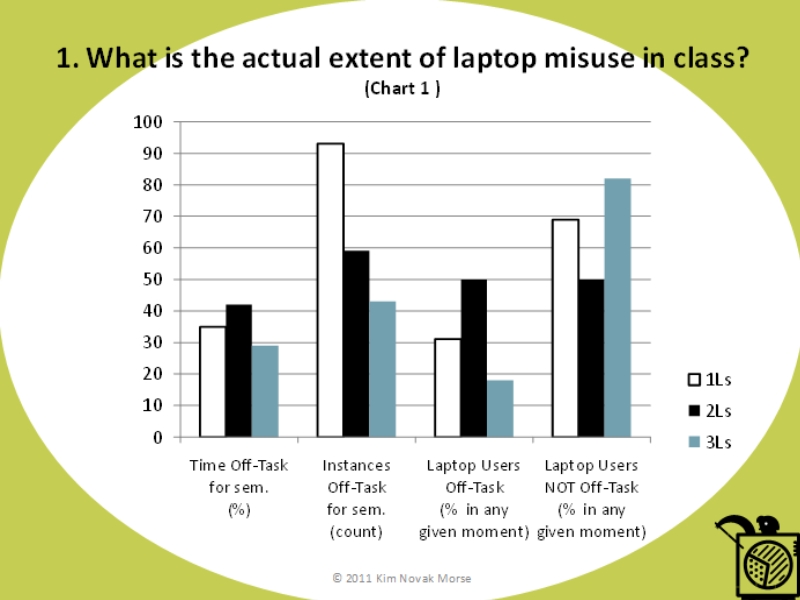
The results from the study reveal that indeed students are off task in class; however, it is not as extensive as we thought, nor is it the population of students we thought it was (of course, this depends on whether you are an optimist or pessimist). Second-year students were off task the most time, at 42% of the entire semester. First-years were off task approximately 35% of the time for the semester while third-years spent approximately 28% of their class time off task. Regarding how many individual students were ON-task at a given instant, roughly 82% of third-years, 69% of first years, and 50% of second-years were NOT misusing their laptops (chart 1).

Interestingly, students who had higher LSATs were off-task more than students with lower LSATs (chart 2 & 3). In fact, higher LSAT students reported that they often are off-task in classrooms and only redirect their attention back to the lecture when they need clarification on topics.

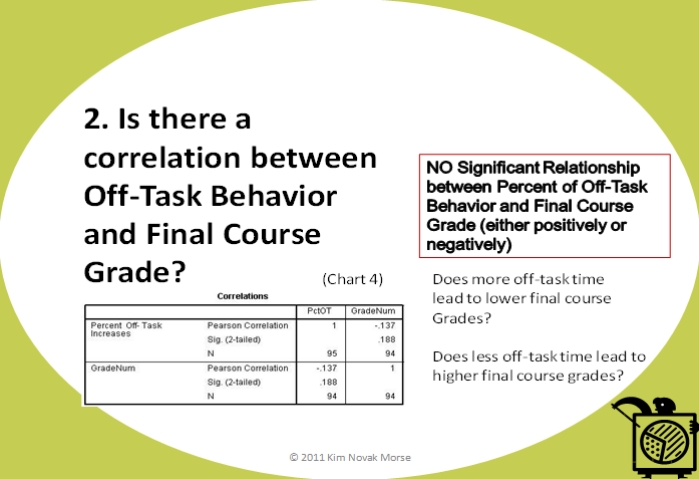
While the numbers indicate that students are off-task, my second research question sought to answer whether more off-task behavior might correlate to lower final course grade. Through statistical analysis, the results indicate that there is no correlation between high off-task behavior and lower final course grade (chart 4). Nor is there a correlation between low off-task behavior and higher final course grade. Such results support the idea that students learn outside of class as well as in class and, though they may miss ideas in class due to off-task behavior, they often learn or supplement it through readings, study groups, clinics, etc.

The study is further instructive to legal educators since it also identifies some of the conditions that promote off-task behavior:

1)    Student laptop users tend to go off-task when X-(anything) occurs for 4 minutes or more…

2)    When professor is engaged in Socratic method with one student, there is an increase in off-task behavior by other students.

3)    When a classmate engages with professor, there is an increase in off-task behavior by other students.

4)    When professor is monotone, or, overly uses one linguistic intonation style, students tend to increase off-task behavior.

5)    Approximately 40 minutes into class, off-task behavior increases.

6)    When professor calls on students in expected order, off-task behavior increases.

Just as students went off-task when certain conditions existed in the classrooms, my study also captured when students re-directed their attention away from off-task behavior. Faculty can employ the following strategies:

1)    “Announcing-the-Good-Stuff” Strategy: Students redirect attention

away from off-task behavior when professor provides big-point-summaries,

rule formations, definitions, and conclusions.

“Ultimately, courts look at X…”;  “The upshot is…”           

2)    Using the “Rupture Strategy”: Students decrease off-task behavior when directed to an item in a book, chalkboard, digital presentation, in-class task, etc.

“Look at page X…”;   “On the chalkboard you see…”; 

“On the screen, notice X…”, “Write a brief X…”

3)    “Changing-up-the-Voice” Strategy: Students redirect attention away from off-task behavior when the professor prefaces content with signal phrases like:

“This would be a good exam question…”

“ I want to flag for you…” , “The critical idea here is…”

Or, by using linguistic mannerisms like intonation, especially rising intonation found in questions:

“And, how would you know   X     ?”;  “Because……..?”

4)    “Problem-Posing” Strategy: Students redirect attention when the professor asks a problem-solving question to the class (less so than targeting one student).

“How might we determine X…?”

“If we alter X, what might Y?”

5)“Keep-the-Show-Moving” Strategy: Students redirect attention away from off-task behavior when the professor manages “the duration of any X” so it doesn’t exceed 4-5 minutes. For example, the professor

1) may present info (5 min or less)

switch 2) ask a question to the class (5 min or less)

switch 3) direct students to book (5 min or less)

switch 4) ask an individual a question and have student respond (5 min or less).

switch, etc.

6)“Moving-into-student’s-space” Strategy: Students redirect attention when professor moves toward off-task individuals (but surprisingly only for a short time).

Some faculty may feel it is just simpler to ban laptops than employ some of the “workaround strategies” offered above. Before doing so, however, I would urge faculty to recall that the study indicates that the majority (82%, 69% & 50%) of the students are not misusing their laptops. In fact, students are listening– counter to the common assumption that everyone is monkeying around.

Measuring What Lawyers Do?

Paul Lippe wrote an article on Legal Rebels about valuing a lawyer’s work entitled “What if Someone Could Measure What Lawyers Do?”

Here is a preview of the article:

Let’s begin by stipulating that within the mix of legal services, some are harder to measure than others. But even so, most legal services are far more measurable than most practitioners would recognize, and most attempts to measure quality, even if imperfect, will improve performance. The assertion that you can never reduce costs without hurting quality is clearly false, and undermines the credibility of the profession. Most of the sensible things that we can do to reduce costs will improve quality as well.

In other credence-good fields, such as medicine and academia, there have been systematic attempts over the last 30 years to begin to measure performance. Medicine is more advanced, and the model most of us know is the 73 year-old standard for Food and Drug Administration approval of the safety, efficacy and cost-effectiveness of drugs, based on the scientific method. For its part, academia has been as resistant to change as law, and the result has been the emergence of U.S. News rankings as a very flawed but pervasive way of comparing universities.

Give it a read and tell us what you think!

The Future of Education: Lessons Learned from Video Games and Museum Exhibits

Here’s an interesting take on education from Don Norman. He is an academic in the field of cognitive science, design and usability engineering, and the author of several books, including The Design of Everyday Things. This address was to graduates of a School of Education and Social Policy, but includes some ideas that may provoke thought in law schools as well.

The Future of Education: Lessons Learned from Video Games and Museum Exhibits

Don Norman

COMMENCEMENT ADDRESS, NORTHWESTERN UNIVERSITY SCHOOL OF EDUCATION AND SOCIAL POLICY: June 2001

You chose a great year to graduate. Education is in the news The President of the United States is for it. The House & Senate just passed new education bills.

Education is hot in business as well. The rise of corporate universities is well established, with companies literally spending billions of dollars to educate their employees. Education is now a business, with multiple companies offering courses and degrees as a successful, profit-making business.

Of course, one of the problems when everyone is for something is that everyone has a different idea of what it is that they are for. Everyone who is for education seems to have a different idea of what to do, hence the challenge. The one thing everyone agrees upon is that our educational system is in trouble. Something has to be done to fix it. But what?

To me, anything that is truly worthwhile is something that is also a major challenge. If you were facing an easy task, why bother? So it’s a great year to be graduating, for anything truly worthwhile, anything that will make a difference, not just to you, but to many, is going to be hard. This is a great year, for there are great challenges ahead of you.

Education Throughout Life

We will solve the fundamental problems only through social policy, through organizational change, and through deep understanding of organizations and the people who comprise and are served by them. We need to change the way we think about education, and through that understanding, change the way we do it.

One erroneous notion is that education only takes place in the classroom, mostly through books and lectures. The basic recipe for education of a nation is very simple:

Take young children:

* Open up the tops of their heads
* Pour in all the information they are ever going to need to know to get along with life
* Continue as long as possible — for 12 to 20 years

Now let them loose upon society, to spend the next 60 – 80 years as productive citizens, never having to be educated again.

A very simple scheme, practiced by nations throughout the world. Simple, and simple-minded.

This standard practice is wrong for lots of reasons. It concentrates all the learning into one period, when the students are not interested, when they don’t care, when they are not ready. It assumes that what is learned today will be available when needed, many years later. And it ignores the powerful social impact of groups, social discussion, and cooperation.

Most of our lives is spent interacting with others. Most of our work is done jointly. In the workplace, we are encouraged to ask others for help. When we do not know the answer to something, we are free to ask for help, to form groups.

Indeed, one of the few places where solitary work is required is in the classroom.

Informal Learning

Informal learning, that’s what we call the learning that takes place out of school. I just spent a day at the Science Museum in London where the staff prided themselves on the social interaction among the museum goers. To me, the most fascinating exhibit was a simple quiz game.

People sat around a circular table, each seat having a button to push, and a dish-size disk they could spin. A computer projector was directly overhead, projecting an image on the table, displaying the game and, on top of each dish and button, whatever meaning it was meant to have at that moment.

So, not only was the technological wonderful — interacting with a computer without being stuck in front of a big screen, keyboard, and mouse, but the game was fascinating.

The table image explained some new technological concept, say the ability to embed chips in children, so that satellite systems could track them and parents would always know where their kids were. The fun began with the quiz: Is this a good idea? Should parents be allowed to do this? Would kids allow it?

You spun the plate to select the answer you wanted to give, then pushed the button. But the clever part was that everyone could see everyone else’s answer, so that the participants would start discussing the issues with one another, sometimes friends against friends, sometimes one group of strangers with another, sometimes parents with their children. (Footnote: Link to London Science Museum website.)

(My photograph of the game at the London Science Museum, taken June, 2001. Only 2 people playing [my photography got in the way]. Click hereor on the picture to see a larger image. The projector is above, pointing down at the table [and not visible in this picture]. The game has 8 playing positions: Note “turn” instructions centered over the rotating dish.)

So, here is a simple game, motivating, interesting. It imparts some real knowledge, and afterwards, the participants can discuss and debate it.

It uses high-technology, but intelligently. It doesn’t flaunt the technology — in fact, participants don’t think of it as technology, they think of it as fun, a quiz where they learn, that they enjoy, and that they recommend to their friends. Notice too that the procedure exploits social interaction. There you go: exams that teach, technology that is hidden, exploiting social interaction and discussion.

ESPN Zone

Look at another form of informal learning: Video games. The other day I visited the ESPN Zone on Ohio St. in Chicago. Now that’s an interesting place — I commend it to you. Filled with machines, filled with games, filled with people — of all ages. It’s all voluntary. In fact, people pay a lot of money to participate. Imagine — paying money to learn! They are engaged, intense, involved. They are performing, playing, competing. And most of all they are learning.

Children, we are told, have short attention spans, caused, of course, by the prevalence of games and TV and commercials in our society.

Nonsense.

Watch people at video games. You can’t tear them away. More importantly, they truly are exercising their minds. They problem-solve. They take notes, read books of hints and strategy. They save the game state, try out a new course of action, and if it doesn’t work, return to the saved game state. And they form social communities, sharing hints, tips, and methods. Many of you will understand, for you do it too.

Video games aren’t restricted to children. Today, the average age of a game player is pretty much the average age of the population, and women play almost as often as men. Different games, perhaps, but games nonetheless.

The only problem with games is that the skills are either for make-believe worlds, often violent, or for sports: skate boarding, skiing, tennis, baseball, football, motorcycling. Nothing wrong with sports, and as the games get better and better, controlled by real skateboards, motorcycles, and so on, they can be quite effective at teaching the skills required to do the real thing. The military uses games in real training, as does the aviation industry, except they don’t call them games, they call them “simulators.” One person’s simulator is another person’s game. The important point is that they teach: effectively, efficiently, and well. And students enjoy them.

“But,” you may be saying, “that’s all very well for simple things, or for sports, but what about for learning the really hard stuff, subjects that take time to master and that are more abstract, such as writing, literature, history, or math?” I believe the same principles apply to almost any topic. Obviously one game does not fit all people or all topics. But any time you get this amount of interest, this amount of sustained, concentrated attention, it is worthy of study. Actually, there already are a number of examples of games that help teach literature or arithmetic, city planning or evolution, history or geography. We need a lot more sustained research and development of these ideas (and note that development is always more expensive and, in some ways much more difficult, than research).

We, as a nation, don’t spend anywhere near the amount on education that we spend on games. And we don’t get the same kind of energy, of commitment, and of excitement that we find on the game field.

The Lessons from Science Museums and Computer Games

Museums and video arcades exploit similar themes: meaningful activities, learning that takes place invisibly, not as the objective, but naturally, effectively. Exploiting social interaction and discussion. Participants don’t think of themselves as interacting with technology, they think they are doing something interesting: discussing an interesting topic, playing basketball, riding a jet-ski, skateboarding. They exploit social interaction and cooperation. The result is high intense concentration, true learning, with people anxious to go back and do it again, paying for it out of their own money.

People learn many things, if only they care about the topic. People are hungry for learning, as long as it isn’t called education. Hence book groups, discussion groups, and clubs of all sorts.

The future of education is outside of education. It is in the everyday life. In business, in the world. In life long learning. But the principles can be applied inside of formal education as well. They require a change in thinking, to move toward problem-centered, meaningful activities in the classroom. To exploit people’s interests and subvert them to lead to natural, inspired learning activities. To exploit group interactions and social themes. To change teachers into guides and mentors. And to recognize that education should take place over a lifetime, not just in the formal classrooms of the first few decades of life.

You already know all that, right? That’s exactly what you have just been taught. The hard part is making it happen, and that’s where you will need all the skills you have learned: social change, social policy, human psychology, and human development. It is not going to be easy.

Wonderful! Nothing like important challenges to get you going, eh?

A GREAT YEAR TO GRADUATE

Change is never easy. It will take a long time. People are very slow to adopt change, especially in things they consider fundamental to their lives. Studies of the adoption of new technologies and procedures show them to take decades to be adopted, whether it be a new consumer technology, a new type of seed or fertilizer. Adopting new methods of education will be even more difficult, even slower to be adopted. But even educational systems change eventually.

One way that the personal computer got into the workplace — over the objections of the information technology groups in companies — was because people used computers in the classroom or at home, discovered how valuable they were, and then sneaked them into corporations.

Why not the same thing in education?

You are graduating from a very unique school. At first glance, it brings together a strange mix of disciplines: education, social policy, organizational change, human development, and several areas of applied psychology. It is a strange mix, but, in fact, it is exactly right, for these areas are all inextricably mixed in the real world of business, education, and everyday life. Real issues never exist in a vacuum. They live in the world of policy, of social practices, of organizations, and of people. If one is to make any progress at all in these matters, one must combine these very disciplines, plus perhaps even a few others, such as technology and business. It is no accident that your faculty have appointments in computer science and close ties to the business school.

The academic education is only the first step toward change: the further steps are up to you. You are the agents of change. You can indeed help make the world a better place, a more intelligent, social place.

It is not going to be easy. It is going to be hard work. And it will take time. It will be a challenge.

So hurry up and start: the sooner you start, the sooner we will get there. And you can literally save the country, save the world.

Assessment Tales: The Bluebooks That Stayed

It’s that time of year when we all have the grading of our last semester’s bluebooks well behind us and the last few students have come in to review their exams. So we have packed up the bluebooks to be archived and they are out of sight and out of mind.

But wait! In the world of assessment, the bluebooks come back! These papers and exams have a wealth of assessment information for us to mine if we only take the time to gather, reflect and use that information.

How can you use your bluebooks for efficient assessment and improvement of student learning?

Many faculty gather holistic impressions as they grade about the performance of the students overall and the areas of difficulty and strength. To improve on this reflective process, faculty can take a few more simple steps:

1. Improve your data collection.

Rather than gathering general impressions as we grade bluebooks, we can mine the bluebooks for some more concrete data. Examine the distribution of performance on individual questions or issues. Note that you need not gather every data point possible from the bluebooks. Often it is helpful to begin with two or three items to analyze. For example, what is the one thing that nearly every student did well on the exam? What were the one or two questions/issues/approaches that many students had problems on? What percentage of the students had these problems?

2. Analyze your data.

For issues students appear to have learned well, look again at your questions. How confident are you that the question truly tested the student understanding? In this respect, essay questions are often easier to evaluate than multiple choice questions, because you can see the students reasoning on the former, whereas consistently correct answers on the latter can be the result of distractors that are patently wrong. What materials and techniques did you use to prepare the students for that question? When during the semester did you teach those matters? If the student performance is improved from prior exam administrations, what, if anything, did you change that may have caused this improved learning?

For issues or questions on which a significant percentage of student performance was deficient, again, begin by reexamining the question, its placement in the examination and the time allocated for responses, to identify other possible reasons for poor performance that are less related to student learning and more related to exam conditions. Look for patterns in the student errors or misconceptions that can help you diagnose what learning conditions led to the student poor performance. What materials and methods did you use to teach this doctrine?

3. Plan for the next class

When students are performing well on a doctrine or concept, especially when that competent performance appears to have been the result of your prior efforts to target and improve learning activities for that material, you may be tempted to rest on your (and your students’) laurels. However, consider that any change to one part of a course can affect other parts and each class brings with it different experiences and preparation.

To improve student learning on areas that have presented difficulties for students, consider not only improving teaching materials or methods related to that area, but also incorporate more formative assessments during the term to help you and the students identify earlier and more clearly the learning deficiencies.

4. What my bluebooks told me this semester:

To illustrate this process of mining bluebooks for assessment, I will discuss this semester’s Professional Responsibility exam. From this semester’s bluebooks, I gathered a range of data on materials well understood and poorly understood. I will share three examples of data to illustrate the process of using bluebooks for an assessment process.

The doctrinal winner this year in terms of student performance was multijurisdictional practice of law. Is this because the students understood these aspects of the course better than others? Reviewing the exam, I noticed that the question testing this subject called for a fairly low level of mastery (basic issue spotting and knowledge of rule) without any sophisticated analysis required. This was a topic for which I had provided a number of practice problems to the students and I had tested the issue in a similar fashion on a prior year’s exam, which I had made available for student review. Moreover, it is a subject that, because my law school is located on a state line, with dramatically different variations on this rule, the students understood that this was a rule that would impact their immediate future, as they chose which state bar exam to take first. What I learned from this is the fairly unremarkable understanding that my law students can and will master at a knowledge-level those topics for which they know they will be tested and for which they also have a more personal motivation to learn well. I concluded that I would and could generalize these understandings to not only raise the bar on testing this doctrine, requiring a more sophisticated understanding, but also would look for other areas in which I could improve student motivation by identifying the specific need-to-know circumstances looming in their immediate future for other rules.

A second topic about which I have been tracking student learning performance for many semesters is the student understanding of the distinction between the evidentiary attorney-client privilege and the ethical duty of confidentiality (among other doctrine). When I first began tracking, as many as 30% of students were demonstrating fundamental confusion on this topic – using language of “privilege” when the subject was confidentiality (or vice versa) or confusing the exceptions to the ethical duty with the crime-fraud exception to privilege. I knew from speaking with other Professional Responsibility teachers that this is a common area of confusion for students. Over the course of several semesters, I worked to improve student learning in this area: including more problems in course materials, writing and assigning a CALI lesson on the subject, and explicitly telling the students that this is something that I am tracking and cheering them on to “make this the 100% mastery year.” The efforts are bearing fruit. This semester was the best yet – only four out of 72 students used the vocabulary of the two doctrines improperly and three of these applied the correct rule even though they were not using the correct terminology in doing so.

An area on which I had thought I was making progress in student learning turned out to be a continuing problem. Students commonly are confused by the rule governing an attorney’s right to withdraw from representation. I have made the same efforts on this doctrine as I have with the privilege v. confidentiality confusions: increasing problems, providing additional outside resources (again, I wrote a CALI lesson on the subject); and providing in-class quizzes to assess understandings while there was still time to improve learning. However, I was puzzled to see 13 of the students declare that an attorney may not withdraw from representation if it would harm the client. What could have been the source of this confusion? Searching through my course materials and lesson plans, I uncovered the problem. A powerpoint lecture on withdrawal from representation when the client fails to pay the attorney contained a page with a bulletpoint list of reasons that courts might deny an attorney permission to withdraw even though the rules would permit the withdrawal. One of the bullet points listed “degree of harm to the client” as a factor the court would consider. Obviously some students had transferred the powerpoint slide into their notes on the general withdrawal rule rather than recognize that these factors were connected only to the judicial discretion to deny an otherwise permissible withdrawal. Again, a well-worn lesson learned anew: as helpful as powerpoint slides can be for organizing discussions and providing visual cues for learning, students will study text of these slides as definitive statements of law rather thumbnails of larger discussions and understandings. Conclusion: no shortcut summary slides!

The True Function of Education

“The function of education is to teach one to think intensively and to think critically. Intelligence plus character – that is the goal of true education.” – Martin Luther King Jr.

Happy Martin Luther King Day!

Unaccredited Law School Sues ABA

The following article, Unaccredited Law School Sparks Debate With Lawsuit Against Bar Association by Katherine Mangan, comes to us from the Chronicle of Higher Education.

The argument is that the ABA and accredited schools are using their market dominance to prevent new schools from gaining accreditation. Here is an excerpt:

A Tennessee law school’s lawsuit against the American Bar Association has sparked considerable discussion in legal-education circles about the ABA’s gatekeeper role in approving new schools.

Lincoln Memorial University’s Duncan School of Law filed its complaint against the ABA in federal court on December 22, just days after learning that the association’s accrediting arm had denied its bid for provisional accreditation.

Duncan, which opened in 2009 with the goal of helping students and potential clients in Appalachia, contends that the ABA is unfairly limiting competition by excluding new schools that want to offer a relatively affordable option for underrepresented students.

But others, including some Congressional critics, say the ABA hasn’t been tough enough in enforcing its standards, allowing too many new schools to open at a time when students’ job prospects are shrinking.

Does the Practice of Counseling Students out of Clinic make a Statement about the place of Clinical Education in the Academy?

I think it does.

In my experience, it is unusual for a professor or dean to encourage a student to forego taking or to drop a so-called stand up or doctrinal class, particularly if it’s required. The opposite situation prevails in clinics, which presently are rarely required; in these classes, the pressure to maintain in clinic a student having grave difficulties is substantially reduced for both student and teacher. That clinics are rarely required means, of course, that they are largely relegated to “elective” status and thereby on a lower hierarchical plane than other, required doctrinal courses. This fact conspires to permit us, professors teaching these clinical courses, to fall prey to viewing them as “less-than” the classes taught along the Langdellian model.

What might be the implications of this observation? At least it would seem that we clinical professors could try to appreciate the significance of what we do and of what we’re imparting in our students. This appreciation will encourage us to encourage our students not to give up if and when “the going gets tough” in the course of handling difficult cases and challenging clients. In addition, this observation can serve as another call, heard frequently these days if not at law faculty meetings at least in the mainstream press, that clinical education be part of the required law school curriculum.

To Counsel or Not to Counsel Students OUT of Clinics?

In our quest to offer and provide as many students as possible the opportunity to participate in clinics while in law school, the notion that a clinical experience is not  appropriate for certain students is not likely to be a popular one. Nonetheless, I imagine I’m not the only clinical professor who has faced this possibility with one or more students.  Under what circumstances should a clinician suggest to a student that the clinical setting may not be the best expenditure of a student’s effort at a particular point in time?  And in these situations, may there be ways in which a student can successfully be maintained in the clinic by reimagining his/her role in it?  Finally, is there something unique about clinics that should enable clinic faculty to even consider such a suggestion?  Or is the notion that it may occasionally be appropriate to counsel students out of participating in a clinic just another indicator that clinical legal education remains marginalized, given that it’s the rare associate dean who  sanctions students to abandon key “doctrinal” classes?

The likelihood of the issue arising increases greatly in a full-year clinic, and in one that accepts second year students, which I teach.  In a one semester clinic, work is usually winding down before it would become clear that a student might need to reconsider the experience. Some second year students have not yet assimilated enough of the ‘zeitgeist’ of lawyering to be able to see the whole picture or theory of a case.

What are some indicators that might suggest to a clinical professor undertake such a delicate conversation?  The most important I’ve come across is a student’s noted and ongoing inability to grasp the relevance of key legal principles to a client’s case. It’s usually not an inability to conduct factual research.  I’ve noticed a problem assimilating the disparate parts of the case into its whole. But in many of these cases, there may be ways of salvaging the situation and maintaining the student in the program. I’ve had success when I’ve refocused the student’s case responsibilities towards more fact-finding.  This serves both the case and the student’s need to be productive and gain confidence.

In a subsequent post I’ll discuss whether the notion of counseling students to withdraw from clinics suggests that clinics remain a marginalized department in law schools and whether  clinicians should resist pressure to advise students to do this.

Connecting the Dots in Legal Education

The New York Times has a new opinion on educating law students, this time from Stanley Fish from Yale.  His opinion focuses on the art of law and states that the study of legal scholarship in his course gives students an understanding of what is at stake in a legal proceeding, and provides a basic understanding of the “game”.  Once the game is understood, a practitioner can then learn the tactics outside the school over the course of a career.  One important quote from his opinion reads:

That is, law is more than an aggregation of discrete tactics and procedures; it is an enterprise informed by a vision of how the state can and cannot employ the legalized violence of which it is the sole proprietor. That vision will come into view in the wake of a set of inquiries. What obligations do citizens owe one another? How far can the state go in enforcing those obligations? What restrictions on what the state can do to (and for) its citizens should be in place? How do legal cultures differ with respect to these issues?

I agree with Professor Fish. Theorizing about the practice of law and the jurisprudence of law is important to a full understanding of what it means to be a lawyer.  In order for students to understand “the game,” however, requires students to connect the theory to the practice. That is exactly what reflective clinical experiences during  law school should do and are doing.

Clinics were not started to help student learn the tricks of corporate law, or make partners more profitable.  Making students “client ready” – a favorite term of Albany’s Interim Dean Connie Mayer – can involve making them think about John Locke’s theory of the “social contract” or about Dickensian notions of the “worthy poor”. 

It has never been “either/or,”  For a time, theory and doctrine was so privileged in legal education that acquiring excellence in the profession was trivialized instead of appreciated. By bringing legal education back in balance, we will not abandon the kind of engaging, reflective thinking which good teachers, good clinical experiences and Stanley Fish offers. 

As Tiny Tim reminded us, “God Bless us Everyone!”

New Article: Alternative Justifications for Academic Support II: How ‘Academic Support Across the Curriculum’ Helps Meet the Goals of the Carnegie Report and Best Practices

Professor Louis N. Schulz, Jr. from New England Law School recently posted an article entitled Alternative Justifications for Academic Support II: How ‘Academic Support Across the Curriculum’ Helps Meet the Goals of the Carnegie Report and Best Practices, Capital University Law Review, Vol. 40, 2011. Here is the abstract:

In the wake of two momentous critiques of legal education, popularly known as the “Carnegie Report” and “Best Practices,” law schools are reconsidering certain basic assumptions about how we educate future lawyers. Even the most forward-thinking reformers, however, struggle with the details of how to implement many of the recommendations of those reports. Providing more formative assessment, for instance, is a laudable objective but one that has serious ramifications in terms of resource expenditures. This article seeks to provide a remedy for many of these struggles: “Academic Support Across the Curriculum.” This piece argues that the reconceptualization of an under-leveraged asset in many law schools, Academic Support Programs (ASPs), can help provide crucial improvements in legal education. By examining the reforms urged by the Carnegie Report and Best Practices, and by detailing the methods of certain exemplary ASPs throughout the country, this piece analyzes how ASPs just might be the answer to many tough questions.

Give it a read and tell us what you think!

Innovations in the First Year: Outcomes, Assessments and Collaboration, Oh My!

In December 2010, the faculty of William Mitchell College of Law approved a pilot curriculum for one section of the first-year class to run in 2011-2012.  The Deans also created a Pilot Assessment Committee, whose task would be to monitor and evaluate implementation of the pilot curriculum.  I am the chair of that committee.

The goals of the first-year pilot section were the following: (i) to define outcomes for each first-year course and for the first-year curriculum as a whole; (ii) to introduce students to a range of critical doctrinal foundations, including transactional, statutory, constitutional, and administrative law; (iii) to integrate core skills, doctrine, and professionalism in each first-year course; (iv) to achieve greater coordination among the doctrinal courses; (v) to achieve greater coordination and integration between the doctrinal courses and the first year research and writing course; (vi) to foster better communication and collaboration among first-year professors; (vii) to enhance communication with students regarding course goals and expected competencies at the end of the first year; and (viii) to concentrate course hours for each class to allow for more intensive, sustained study of each doctrinal area.

The Pilot curriculum has the following course structure for full-time students:
Fall Semester

1. The Common Law Process 4 credits
2. Civil Dispute Resolution 4 credits
3. Statutory Interpretation: Criminal Law 3 credits
4. Writing/Representation: Advice & Persuasion 3 credit

Spring Semester

1. Transactional Law: Contracts 4 credits
2. Jurisprudential and Comparative Analysis: Property 4 credits
3. Advanced Legal Reasoning: Liberties 3 credits
4. Writing/Representation: Advice & Persuasion 3 credit

All faculty teaching in this section has engaged in collaboration to develop “core” objectives for all first-year classes: each class combines “skills” and “doctrinal” objectives. In addition, faculty have collaborated to develop varied and multiple formative assessments; and a common vocabulary to help students in the section realize the connections between different classes. The section faculty has worked hard to emphasize professionalism in the first year.

Members of the Pilot Assessment committee have met with and gathered information from students, faculty, administrators, and staff about the new curriculum.  Based on information we have gathered over the course of the first semester and plan to gather over the first four weeks of the second semester, as well as our understanding of adult learning theory both in law schools, and in other graduate areas, we believe the following:

  1. The emphasis on statutory interpretation helps student learning in all courses;
  2. The introduction of alternative dispute resolution in the first-year better frames the students’ legal education;
  3. Students learn best by the combination of exposure to skills and doctrine in each class. 
  4. The common framework and vocabulary for all classes increases transference of student learning among first year courses, and into upper level courses and experiences

In other words, the pilot curriculum seems to be on track to achieve many, if not all of the goals of the program.

Concerns remain about doctrinal coverage and academic freedom should the pilot curriculum be implemented across the entire first year, so no formal decision has been made yet about how to proceed with this project.  There is a great deal of enthusiasm and momentum, however, and we look forward to seeing the project through and continuing to explore its implementation on a larger scale.

Stay tuned . . .