Hosted by Texas A&M Law, the Network for Justice, and the ABA Commission on Hispanic Legal Rights & Responsibilities

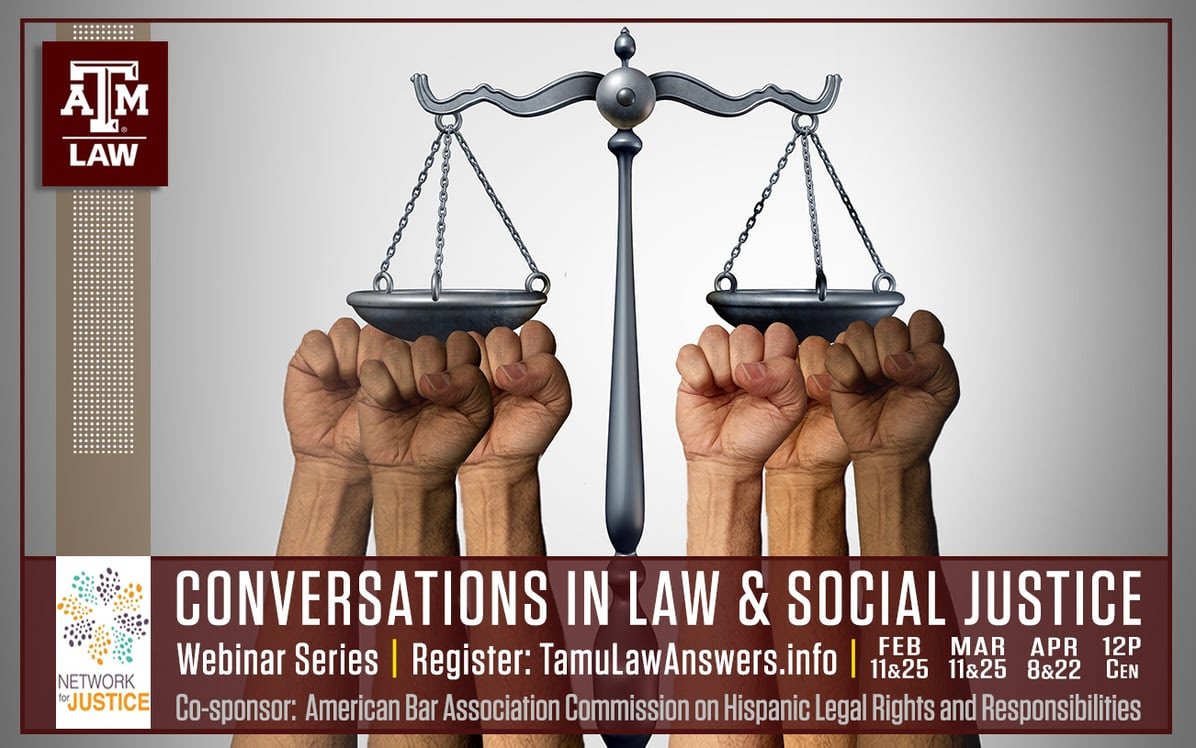
WEBINAR THIS WEEK, REGISTER TODAY:”Training Social Justice Lawyers Today”law and social justice graphicTexas A&M University School of Law, the Network for Justice, and the ABA Commission on Hispanic Legal Rights and Responsibilities present a FREE webinar series to examine pressing issues in social justice and the law, particularly as they impact the Latinx community. Please join us this Thursday to discuss “Training Social Justice Lawyers Today” on April 8, at 12:00 Noon Central.  Registersocial-justice-apr8-webinar-presenters2Presenters:• Carrie Bettinger-López, University of Miami School of Law Human Rights Clinic
• Denisse Córdova Montes, University of Miami School of Law Human Rights Clinic
• Deborah Archer, NYU School of Law
• Moderator: Louise Trubek, University of Wisconsin Law School
      Today’s world demands new approaches to social justice lawyering and new ways to train law students. We’ll discuss needed reform in scholarship, courses and clinical curriculum, and pedagogy. This webinar brings together law school teachers who are exploring how law and lawyers can contribute to the struggle for a more just society.

The Othering of the AAPI Community in America

THIS WEEK
Friday, 9 April 2021
Noon Pacific (3:00 Eastern)

This week’s SALT webinar will explore the long, contested relationship of the Asian, Asian American, and Pacific Islander communities in America from both an historical and contemporary lens.  

Please join a moderated discussion with Dean Sean Scott, Professor Vinay Harpalani and Professor Rose Cuison-Villazor on Friday, April 9, 12-1 pst (3-4 eastern).  Professor Harpalani’s scholarship focuses on the intersections between race, education, and law, as he explores the nuances of racial diversity and identity from various disciplinary perspectives.  Professor Rose Cuison-Villazor is an expert in immigration, citizenship, property law and race and the law.  

REGISTER TODAY

On Experiential Education

By: Luz Herrera

Allison Korn and Laila Hlass’ research, documented in Assessing the Experiential (R)evolution, offers a revealing  snapshot of how law schools have adapted to the ABA accreditation standards that requires six units of experiential education. The survey data provided by experiential educators from 126 law schools in 2018, provide the basis for a series of recommendations the authors make about what law schools should consider as they continue to grow and maintain their experiential program.  One of the many questions they ask us to consider is whether law schools are valuing teaching loads and providing sufficient status for experiential instructors to be sustainable?

The issue of status in experiential education has long been, and continues to be, a difficult subject for law schools, particularly for clinical faculty. In 2000, the AALS president formed a Committee on Good Practices Regarding Clinical Faculty that was charged with convincing law schools to integrate clinicians “as full participants in the legal education enterprise.” The committee, however, did not issue any recommendations or conclusions.  In 2005, the AALS Section on Clinical Legal Education took up the charge and appointed a Task Force on the Status of Clinicians and the Legal Academy to examine clinician status in U.S. law schools and “to recommend appropriate models for clinical appointments within the legal academy.” After reviewing CSALE survey data, the Task Force found various types of positions for clinicians but overall little parity between them and non-clinical faculty. After additional input at town halls and balancing the various views and realities of law schools, the Task Force set forth four core principles to guide status decisions:

“(1) Clinical education is a foundational and essential component of legal education;
(2) The legal academy and profession benefit from full inclusion of clinical faculty on all matters affecting the mission, function, and direction of law schools;
(3) There is no justification for creating hierarchies between clinical and non-clinical faculty; and
(4) The standards for hiring, retention, and promotion of clinical faculty must recognize and value the responsibilities and methodologies of clinical teaching.”

Ultimately the Task Force concluded that the gold standard that exemplified these principles requires clinical faculty to be full-time and placed on a unitary tenure track since tenure offers the greatest security of employment. The Task Force recommended that at least a core group of full-time clinical faculty should be on the unitary tenure track in order to have similar status that ultimately translates into academic freedom, in addition to full voting and governance rights. It urged law schools to develop standards for hiring, promotion and retention that account for the responsibilities and approaches that clinical faculty employ. The Task Force found that separate clinical tenure and long-term contract models were inferior because they usually provided less security and governance rights. It also urged that short term positions and fellowships be limited.

As clinicians advocated for greater status and inclusion in law schools, the American Law Deans Association advocated for greater control on hiring decisions. Control included resisting changes to accreditation standards that required security of position for clinical faculty. The history of the resistance is well documented by Peter Joy in his article, ABA Standard 405(c): Two Steps Forward and One Step Back for Legal Education. Ultimately the ABA Standards Review Committee amended ABA Standard 405(c) to require law schools to offer “full-time clinical faculty members a form of security of position reasonably similar to tenure.” Standard 405(c) permitted law schools to require clinical faculty to have similar responsibilities as other full-time faculty members but still allowed law schools to build experiential programs that included short-term appointments as long as the clinical program was primarily “staffed by full-time faculty members.”

Despite efforts to improve the status of clinical faculty and promote more experiential education, the growth of experiential education at ABA law schools seems to have only further cemented the legal profession’s caste system at most law schools. As Bob Kuehn’s recent blog post explains, the most recent survey data by the Center for the Study of Applied Legal Education (CSALE) shows a reduction in clinical tenure and tenure track positions in the last twelve years. Since 2010, clinic and externship hiring has largely been for contract positions and within the top ranked 25 law schools, tenure is almost non-existent for this group.

Former AALS President Dean Darby Dickerson recently penned a call to Abolish the Academic Caste System within legal education. In her essay she calls on law schools to acknowledge the contributions of non-tenure-track faculty by (1) converting faculty to tenure lines or develop processes that permits these non-tenure line faculty members to convert to tenure-line status; (2) calling on deans to equalize pay of non-tenure track faculty; and (3) shift the law school culture to show more respect for non-tenure line faculty as a way of prioritizing community and not upholding the caste system. She explains that non-tenure line faculty often contribute much more service and teaching than their colleagues. Dean Dickerson recognizes that often these faculty members are not provided equal voice in faculty governance or hiring, given similar faculty development support and the physical location of their offices are often removed from the law school’s core operation. She explains that salaries, job security, and respect for these faculty members are far less equitable. Dean Dickerson also acknowledges that not all non-tenure line faculty want tenure.

The  last CSALE Survey supports the view that “insufficient faculty status” is not the top priority for clinicians as it was listed by only 33 percent of the law school clinic respondents and 23 percent of field placement respondents as the major challenge to their program. However, other CSALE responses that ranked higher in the category of major challenges reflect a lack of institutional investment in clinical programs, overburdened clinical personnel, and few clinical faculty lines.

In their article, Korn and Hlass recommend that law schools ensure security status and value teaching loads of clinical faculty. They also encourage us to think about providing support and professional development for clinicians. What are our options when the trend is to hire more contract faculty and adjuncts to teach clinics, externships, and other experiential programs? How do we do that when many deans view the smaller class enrollment of clinics and externships as not equivalent to grading finals in a large doctrinal class? When our academic deans tell us that teaching first year classes is a good marketing opportunity to ensure greater visibility and therefore higher clinic enrollment? When externship expansion is preferred over clinic development because it is much cheaper to bring in adjuncts and convert staff positions to lecturer status?

Security of position is essential for any experiential dean to be effective. There are still many deans who are unwilling adopters of experiential education and who view it as too expensive an investment that does not further the academic integrity. Tenure, whether through the traditional route or a similar clinical track, should offer sufficient security of position to permit the head of an experiential program to fully participate in hiring decisions and to have disagreements with their deans – whether that is the main dean or the academic dean. An experiential dean often has to work with program directors and faculty with a variety of statuses. They must have enough status to feel safe telling a senior colleague with tenure that their seminar cannot be classified as experiential just because they want larger enrollment. However, the success of any experiential programs depends on the sustainability of all those who work in those programs, not just its leader.

It is critical to have a cohort of other faculty teaching in clinic with security of position who can help educate the larger community about the value of our work. Staff attorneys, adjuncts, and fellows are fungible. They can help build a program but there is little security for them. So it is important to be clear when advertising for soft money positions that their role will be different than other faculty as a result of funding and the existing caste system in legal education. To be clear, there are few jobs in our country that offer as much security of employment as some of our jobs. Still, when most around you have security and you don’t, it is something you notice, even if others insist it doesn’t make a difference. 

Having a cohort of clinicians with status at any institution helps facilitate the program’s growth and increases the likelihood of hiring for the program. Still, problems arise when unitary tenure track clinicians are given higher teaching loads than others. A tenure line professor on a unitary track is often expected to meet the same scholarship requirements as their colleagues who do not have to recruit clients, educate and train students to do client work, manage caseloads, and transition client matters at the end of the semester. While there are some schools that have little disparities between faculty on clinical tracks and those on traditional tenure lines, most have clear distinctions just by the virtue of a different title. It is important to provide full-time clinical faculty, regardless of their status, with a manageable workload and plenty of faculty development opportunities such as pre-tenure faculty leaves, summer coverage, administrative staff support, co-teaching opportunities, and staff attorneys.  It is also helpful to support clinical faculty, whether they have status or not, with continuing education and helping them increase their profile in the local and law school community.

Valuing teaching loads is much harder to offer a prescription for because all law schools have different standards and there is not sufficient understanding amongst our non-clinic colleagues of all that goes into teaching a clinic. Still, it is important to insist on fairly balanced teaching loads for clinicians and to provide newer faculty some time to develop their clinic before launching. It is hard to explain to colleagues who teach 50-80 student classes that a clinic of 8-10 students is more or equivalent work. But few of them would trade with us, if given the chance.  

SALT: Social Justice in Action

Social Justice in Action Webinar
SALT is proud to resume our webinar series, Social Justice in Action, featuring law school teachers sharing their expertise on how to educate the next generation of lawyers, support students of color, and dismantle structural inequality and racism in the United States.

This February 26 webinar will explore trauma informed lawyering and teaching. Experts in this field will share insight into how we better can support students, clients, and ourselves in the face of racism, other forms of discrimination, economic and resource inequality, experience with violence, health and housing insecurity, and other trauma. Register below to join us for this month’s important discussion.
 Trauma Informed Teaching & Lawyering Friday, February 26, 3 p.m. to 4 p.m. EST
Register Here 
Featured Panelists
Sarah Katz
 Prof. Katz joined the Temple Law faculty in July 2012. She directs and teaches the Family Law Litigation Clinic. She researches and writes about trauma-informed legal practice, the child welfare system, child custody, intimate partner violence, and other family law topics.
Teri McMurtry-Chubb

 Prof. McMurtry-Chubb researches, teaches, and writes in the areas of critical rhetoric, discourse and genre analysis, and legal history. She has lectured nationally on structural discrimination in educational institutions and the workplace, and is a leader in designing curricula to facilitate diversity, equity, and inclusion efforts.
Andrew Sta. Ana

 Mr. Sta. Ana is the Director of Law and Policy at Day One. Based in New York City, Day One partners with youth to end dating abuse through community education, supportive services, legal advocacy and leadership development. Mr. Sta. Ana works to amplify the voices of young survivors and to promote healthy relationships.
After registering, you will receive a confirmation email
containing information about joining the meeting.

Diversity, Equity, and Inclusion in the Experiential (R)Evolution

G.S. Hans

In Assessing the Experiential (R)Evolution, Allison Korn and Laila Hlass have written an excellent, incisive article on the after-effects of the ABA’s adoption of a standard mandating that law schools require J.D. students to complete at least six credits of experiential coursework. Korn and Hlass observe how titanic a shift this was; while less than the 15 credit requirement that some advocated for, it still reflected a six-fold increase from the prior regime.

All those experiential credits have to come from somewhere, and that’s where Korn and Hlass take up their project. They sought to learn, through an extensive survey, how schools have responded to the new ABA requirement. One of their central contributions in their article is determining exactly how law schools have complied with the new standards. While some schools had little work to do to ensure compliance — either because they already required at least six credits of experiential education or  because they already offered enough courses to allow students to fulfill the ABA requirement — many others created new classes, modified existing courses, or engaged in broader curricular reforms.

Who teaches these classes, and who ensures they run properly? Korn and Hlass examine these questions as well, discussing how schools have relied upon the now-prevalent academic administrator — often a Head of Experiential Education, referred to by various titles — to manage and facilitate the experiential curriculum. The responsibilities that flow from such power are significant and likely to grow, particularly if the ABA revisits the credit hour requirement or if other states follow New York’s lead in creating experiential requirements for bar applicants.

Drawing upon the scholarship of Jon Dubin and the CLEA Faculty Equity & Inclusion Committee, of which I am co-chair, Korn and Hlass discuss the potential diversity and equity concerns that might result. While the data their article describes is impressive, it does not include race or gender information on experiential directors and deans. Our committee is working to rectify that gap, as a lack of data has stymied research — and thus reforms. There are many reasons to seek better diversity and representation from experiential administrators, but the visibility of the role, both as a symbol of a law school’s experiential program and within the administration of law schools, is particularly compelling.

One concern I have, which Korn and Hlass mention, involves the diversity and representation issues for instructors who lack employment security. With law schools potentially entering a permanent cost-consciousness mentality, determining how to finance the need for experiential courses will merit special attention from deans and experiential administrators. Though Bob Kuehn has shown that the reputation of clinics as high-cost relative to other law school expenditures is overstated, law schools may still choose to use adjuncts, fellows, and other short-term faculty to satisfy their ABA requirements in a less expensive way. 

Korn and Hlass note Meera Deo’s warning, in her influential book Unequal Profession, that law schools might seek to grow their diverse faculty in the least secure positions. Some experiential faculty are on the tenure-track or have tenured positions, whilst others have more precarious appointments. Adjuncts and fellows have the least job security of instructional faculty — but might present appealing, lower-cost options for expanding experiential offerings, through practicums, labs, or clinical seats. For some law schools mindful of financial concerns, hiring an adjunct to teach Negotiation as an experiential course to 24 students might seem more appealing than creating three tenure-track clinical faculty lines to offer 24 seats on the standard 8:1 ratio for clinical courses. Given Deo’s concerns, we should keep an eye on whether less-secure positions are being used to comply with the ABA requirement, and whether those positions are being disproportionately filled by diverse faculty.

Korn and Hlass have given us all much to think about in this comprehensive and innovative article, which ties together many strands of current debate within the experiential community. I particularly appreciated its generative qualities — I myself came away with many questions and ideas for future research. These issues will require scholarly engagement and discussion from many faculty and law schools in order to chart a just and equitable path forward for instructors, students, clients, and law schools.

Experiential Education and the First-Year Curriculum

Eduardo R.C. Capulong

One way to describe today’s law school curriculum is in terms of détente—a truce in which law schools have decided that experiential work can happen in the third year so long as the case method reigns supreme in the first.  Students can take clinics or externships later but their first preoccupation would be dissecting appellate opinions for doctrine and reading supplemental materials for context.  Allison Korn’s and Laila Hlass’ survey of experiential courses post-revised ABA Standards 303 and 304 provides us a fresh glimpse of this pedagogical battleground—and, as Tony Amsterdam observed nearly four decades ago—equips reformers with more “political dynamite” to throw at this ossified state of affairs.

Korn and Hlass report that 19 schools expanded and 20% of respondents changed their first-year experiential curricula post-revised Standards.  “Labs” and “practicums” have proliferated, as have deans for experiential education—many former clinic directors now overseeing the entire experiential arc.  These developments, they prescribe, should “ensure not only compliance with the new ABA Standards, but also advancement of a diverse and comprehensive experiential curriculum that bolsters faculty expertise, develops students’ substantive and contextual knowledge and practical skills, and expands access to justice.”  To these ends, they call for ensuring the long-term viability of experiential deans; rigor in the approval, development, and assessment of experiential courses; and diversity of and security of tenure for experiential faculty.  The survey reveals what should be easily correctible oversights, as well, such as including simulation courses in Standard 303(b): since such courses are experiential under its definition, there’s no reason why law schools shouldn’t “provide substantial opportunities” for them just as they must for clinics and field placements/externships.  (Indeed, best practices should call for students taking a clinic and anexternship and a simulation course.)

Above all, Korn and Hlass surface the need for theory—i.e., pedagogical theory, or what my colleague, Julia Hernandez, calls an “antidisciplinary lens.”  The law school is, of course, a key pillar of the American establishment, hence the durability of how things are done.  The reason the formalist cast has endured is that it has served racial capitalism exceptionally well: it abstracts, objectifies, normalizes, and obscures raw, violent power in a set of purportedly neutral rules equally applicable to all.  Reformers have mounted successive challenges against the case method for more than a century.  Yet none has been successful in supplanting it.  That’s the story of social movements fighting hegemony, coinciding with historical forces in ebb and flow.  It’s also the story of reformism: piecemeal changes not quite striking at the heart of their target.  What we need, as Jerry Lopez recently argued, is an “alternative vision.”

Labs and practica in the first year may seem quaint from this perspective.  But like any movement with a visionary goal and immediate realities to confront, they’re promising next steps.  They can form the backbone for the faculty collaboration Korn and Hlass rightfully note as key to an effective experiential curriculum.  They can be tied, for example, to lawyering or legal methods courses that can then form the hub of a reimagined curriculum.  They can be vehicles for developing simulation pedagogy and professional identity, which remain undertheorized.  (I’m not disinterested here: I direct one such program in a school founded on such a model and helped convene a network of Lawyering professors promoting these ideas.)  With the rise of the information economy—including rapid technological changes and the ready availability of legal materials whose use as asynchronous instruction has been hastened by the pandemic—law faculty should be less purveyors than curators of knowledge, less lecturers than coaches or sources of skillful and ethical guidance—i.e., less doctrinal teachers than clinicians. 

I’m hopeful.  The developments Korn and Hlass surveyed coincide with five others that should make us optimistic.  The first is the racial reckoning that many law schools have undertaken in the wake of the Black Lives Matter movement.  The second are the redoubled efforts by critical race scholars to reform the first-year curriculum, including recent work on the white supremacist foundations of legal rhetoric and ongoing work to forge what my colleague Yasmin Sokkar-Harker calls “critical legal information literacy.”  The third is a professional identity movement seeking to systematize instruction.  The fourth are professional competency studies that confirm the soundness of the experiential project—the latest of which, led by Deborah Merritt, was published two months ago.  And the fifth are potential changes to the bar exam recently recommended by the NCBE and summarized in these pages, which call for the “assessment of lawyering skills to better reflect real-world practice and the types of activities newly licensed lawyers perform” and the expansion of those “foundational skills … to include more than just legal analysis and writing [but also] legal research, factual investigation and evaluation (including fact gathering), client counseling and advising, client relationship and management, and negotiation and dispute resolution.”  Taken together, these parallel movements form at least part of our curricular terrain.  Détente or no, they are the leading edges of change and I’m thankful for Korn and Hlass for their important contribution.

Lessons from Critical Race Theory for the Experiential (R)evolution

Robin Walker Sterling

In Assessing the Experiential (R)evolution, new experiential learning directors Allison Korn and Laila Hass conclude that law schools should “define the boundaries of experiential dean and director roles,” and provide faculty members in those roles appropriate administrative and other support; “implement sustainable practices to expand and support experiential faculty, with a focus on including and valuing underrepresented clinicians of color,” and “develop practices to ensure rigor in the process for approving and assessing experiential coursese while appropriately allocating resources to courses and programs.” The authors based their comprehensive recommendations on survey responses from 126 law schools received in the fall and winter of 2018.

Since then, our country has faced both an unprecedented health crisis and protests stemming from long-simmering social unrest. We have been caught in the pincer grip of two widespread pandemics, one old and one new. The novel coronavirus has upended our lives, exploiting fault lines of marginalization to disproportionately affect the communities that many law school experiential programs serve. To date, even as the new presidential administration rushes to deliver doses of the vaccine to vulnerable populations, there are 26.9 million cases of covid-19 in the United States, and more than 460,000 people have died. Communities of color have disproportionately borne the brunt of the virus’s effects. According to the Washington Post, even after controlling for age, sex, and mortality rates over time, Black Americans were 37 percent more likely to die of the virus than whites; Asian Americans were 53 percent more likely; Native Americans and Alaskan Natives were 26 percent more likely; and Hispanics were 16 percent more likely to die than whites.

At the same time, the decades-old systemic racism embedded in policing reached a tipping point, leading to uprisings, protests, and calls for change around the world. On the heels of the shooting of Ahmaud Arbery, unarmed and jogging in Georgia, and of Breonna Taylor, unarmed and asleep in her own home in Kentucky, the suffocation death of George Floyd on a city street in Minneapolis led to the longest and largest period of protests for civil rights in the United States since the 1960s. On one day during the months of protests, June 6, over half a million people protested in nearly 550 places across the United States. The protests have led to significant changes. The Minneapolis City Council promised to dismantle its police department. New York legislators repealed a law that kept police disciplinary records confidential. Jurisdictions across the county banned chokeholds. Colorado disallowed qualified immunity for police in certain situations. Perhaps as importantly, the pendulum has shifted in the public’s acceptance of the Black Lives Matter movement, with support increasing in the weeks after George Floyd’s murder as much as it had in the last two years. In his inaugural address, President Biden listed “a cry for racial justice some 400 years in the making,” along with the coronavirus, the economy, the threat of white supremacy, and climate change as the defining challenges of our time.

As the clinical legal education community undertakes the critical assessment that the authors urge, it might do well for us to strategize around achieving these gains using tenets of critical race theory. Some of the foundational tenets of criminal race theory include: questioning the idea of “meritocracy” and the assumption that standards of “merit” can be neutral under current social conditions; emphasizing taking action to make real change in the world; and understanding that power works hegemonically. All of these are consonant with some of the cornerstone principles of clinical legal education. In particular, Derrick Bell’s theory on interest convergence might be instructive. Professor Bell developed his ground-breaking theory in the context of civil rights, when he argued that the Brown v. Board of Education (1954) decision, which prohibited de jure segregation of public schools, came about because such a ruling benefitted white people. Professor Bell argued that the Brown decision: soothed the anger and potential of political protests Black veterans, who had served their country in World War II only to return home to continued discrimination; advanced American Cold War objectives by making the United States seem more reasonable than Russia to third world countries; and facilitated desegregation, which was now seen as economically advantageous to the South. As Professor Bell (1980) put it, “the interests of Blacks in achieving racial equality will be accommodated only when it converges with the interests of Whites.”

This principle, broadened and restated as the premise that the interests of a more marginalized group will gain traction only when they coincide with the interests of the dominant group, might be applied to the situation of clinical legal education relative to traditional legal academia. If we applied this principle, then goals like educating members of traditional legal academia about the important contributions of clinical legal education, or appealing to traditional legal academia’s sense of unfairness become less important. Instead, our strategy becomes one of figuring out how to recast the academic and administrative gains we are seeking as aligned with the interests of non-clinical legal academia. That is a much larger topic than can be accommodated in this short blog post. But, in the same way that the zeitgeist of the protests of the 1960s Civil Rights Movement created an atmosphere ready for change, these recent protests have done the same. This article, with its comprehensive questions and recommendations, helps clinical legal academia make the most of this moment.

Examining Our Experiential Experiments

By Phyllis Goldfarb

In their new article, Assessing the Experiential (R)evolution, 65 Villanova Law Review 713 (2020), Allison Korn and Laila Hlass describe the ways in which experiential education is experimental education.   Faced with the 2014 ABA regulation mandating that all students earn at least six credits toward graduation in experiential courses, clinical education has been responding experimentally to the need to do more experientially, offering more courses in more forms to more students. At the same time, many law schools have been doing more with less, as the need for experiential growth has been accompanied by the diminished availability of resources.  

We can add to the complexities of this picture our burgeoning crises in global health, democratic governance, lethal racism, economic inequality, planetary survival, and other dangerous and pressing social problems that are implicated in the kind of work that clinical education undertakes.  Involving students in urgent and weighty matters of law and justice has long animated the clinical movement.  Have the ABA’s regulatory moves facilitated or impeded these aims in any way?  How is clinical education faring at this challenging moment? 

Korn & Hlass seek to address questions like these empirically, reporting in their article the findings of a 2018 survey they conducted to gather information about how experiential programs have changed in response to the ABA’s six-credit mandate.  The authors find that our experiential experiments have yielded an array of curricular innovations, especially though not exclusively in upper-level courses.  Their article also confirms the trend in most law schools to name a dean or director of experiential education, presumably to help design and oversee the experiential curriculum and to manage expanding experiential programs.  

The latter finding builds on those analyzed in Barry, Dinerstein, Goldfarb, Maisel, and Morton, Exploring the Meaning of Experiential Deaning, 67 Journal of Legal Education 660 (2018). In this article, my co-authors and I observed that despite a rapid increase in the creation of experiential administrator positions, and the assignment of various tasks to their holders, law schools had not fully conceptualized the nature of the position.  Consequently, the meaning of experiential deaning was in the process of invention and negotiation in each dean’s school.  In other words, these roles were experiments. 

Experiments, of course, are designed to be evaluated.  Applying a clinical method of learning, Korn & Hlass urge that we develop processes for evaluating recent experiments in experiential education, so that we can extract the lessons inherent in our experiences with administering, teaching, and reforming it.  Which changes are working well and worth retaining?  Which should be revisited?  Are institutional goals guiding these decisions?  To the extent that experiential administrators are steering these changes, how have institutional goals informed their work?   Are law schools further developing and defining these administrative positions?  Are these positions evolving in a sustainable way?  What conditions best support their sustainability?

The authors, experiential administrators in their respective institutions, have sought to learn from their own experiences in these administrative positions, to ask pertinent questions, suggest possible answers, and frame an assessment project that would guide them, and all experiential educators, in moving forward as knowledgeably and effectively as we can from where we stand now.  A rigorous assessment project of the sort that they helpfully propose in this article would inform our choices about the future of experiential education.

Having seen over many years how experiential learning can enliven, deepen, and transform legal education, I strongly value the expressive quality of the ABA’s regulatory directives to provide that kind of educational engagement to all law students.  I can envision rich curricular possibilities that these directives might support.  But my underlying fear has been that general law school administrators, especially those lacking awareness of the insight-cultivating aims of clinical pedagogy, would seek bare bones fulfillment of the mandate, finding the most limited and low cost ways to offer all students six experiential credits and shortchanging the educational opportunity that the mandate might represent.  Has that happened?  Korn & Hlass have begun to elicit the sort of information we need and to frame the kind of assessment process that we can use to better understand what the ABA’s regulatory efforts have wrought.

In gathering and analyzing experiential education’s experimental data, Korn & Hlass have taken an important first step toward a process of conscious assessment and collective deliberation that hold promise of improving our experiential programs and of identifying meaningful, inclusive, and sustainable practices for the next stage of development in experiential education.  The experiential education community would be well-served by joining them in this important and productive endeavor.

Assessing the Experiential (R)evolution

by Professors Laila Hlass (Tulane Law) and Allison Korn (UCLA Law)

In the midst of calls for law schools to meaningfully address systemic racism in our institutions and a pivot to virtual and hybrid learning in response to the global COVID-19 pandemic, the time is now to consider new paths forward in experiential education. Furthermore, in the wake of deadly assaults on our democracy, law schools’ should grapple with how to teach  justice and social change formally through curriculum and informally through programming. We hope to spark conversation and action regarding reimagining legal education, specifically contemplating the roles that experiential education and experiential faculty should play in the future of law schools.

For more than a century, law schools did not generally mandate any experiential education, but in 2014, the ABA adopted six-credit mandate, alongside a packet of experiential reforms.  In 2018–2019, as the first classes of law students graduated under the revised ABA Standards, we conducted a national survey of ABA-accredited law schools, asking about changes in experiential education and we received responses from 126 institutions.

Our article Assessing the Experiential (R)evolution, recently published in Villanova Law Review, reports findings from this empirical investigation into the experiential landscape shift since the revised Standards were adopted. From our survey, we learned of a recent proliferation of deans and directors of experiential education. Along with this came continued growth in experiential curricula, including among experiential courses in the first-year curriculum, and experimentation with new pedagogical approaches, such as adopting hybrid experiential courses termed “labs” and “practicums.” These trends of expansion and experimentation raised many questions for us:

  • As law schools increasingly add deans and directors of experiential education, experiential courses, and new tools for course assessment and approval, while experimenting with new course models, are they also working to uplift experiential programming as an essential part of the institution?
  • As law schools hire new experiential faculty and appoint experiential deans and directors, are they being responsive to the clinician diversity imperative, taking steps to identify, recruit, and support clinicians of color?
  • Are law schools not only integrating experiential deans, directors, and faculty into the greater faculty but also ensuring that they have reasonably similar security of position and a voice in law school governance?
  • While investing in integration across law school coursework, have law schools acknowledged that experiential education is core to the law school curriculum?

Our article proposes a series of recommendations aimed at ensuring sustainability for experiential deans and directors, implementing equitable practices for experiential curriculum and faculty development, and assessing curricular changes thoughtfully and deliberately. But this proposal is only a starting point for deeper discussion about how we might approach our experiential programs and renew our collective vision for robust, innovative, justice-centered experiential education. Over the next few weeks, the Best Practices Blog will host reactions to and commentary on these themes from a deep bench of extraordinary colleagues in the experiential community. From building sustainable administrative roles to examining and improving racial diversity among experiential faculty; from increasing experiential offerings for first-year students to highlighting changes within externship and field placement programs – each commentary will help us assess and build on current experiential programs and call on our institutions to better understand and support the increasingly vital role experiential education plays in the legal academy.

How LSSSE Informs Best Practices in Legal Education

Chad C. Christensen and Meera E. Deo

The Law School Survey of Student Engagement is based on decades of empirical research on effective educational practices showing that the more engaged students are, the better their academic and professional outcomes.[1] Since 2004, LSSSE has conducted an annual survey of law students in partnership with law schools across the country.[2] Survey results provide an opportunity for schools to better understand their student population and for LSSSE staff to document, reflect on, and influence trends in legal education.[3]

The LSSSE survey items were created out of best practices in teaching and learning; as such, they align well with Roy Stuckey’s Best Practices for Legal Education and the Carnegie Foundation’s Educating Lawyers – two publications that serve as foundational works of this blog.

For this post, we focus on best practice concepts described by Stuckey in his book and highlighted in Chapter 4, “Best Practices for Delivering Instruction, Generally”.  These recommendations come from Section C, which urges professors to “Create and Maintain Effective and Healthy Teaching and Learning Environments” by adherence to three principles:

  • Have High Expectations
  • Foster a Supportive Environment
  • Encourage Collaboration

Have High Expectations

Two questions on the LSSSE survey focus on high expectations and academic rigor.  The first asks students how often they worked harder than they thought they could to meet faculty members’ standards or expectations.  In 2019, 59% of law students frequently[4] worked harder than they thought they could to meet faculty standards or expectations, reflecting an increase since 2012 (52%). This positive trend indicates that students are being challenged in more meaningful ways than they were in the past and working hard to meet the high expectations of their professors.  

Another LSSSE question asks students to report the extent to which their exams have challenged them to do their best work.  For this question a score of five or higher on a seven-point Likert-scale indicates significant challenge.[5] In 2019, over 90% of LSSSE respondents indicated they were being challenged by exams in class. 

Taken together, this LSSSE data indicate that teachers are demanding a lot of their students, meeting Stuckey’s first suggestion to have high expectations. Students are also working hard and producing their best work to meet the challenges their professors put before them.

Foster a Supportive Environment

Creating a positive and supportive learning environment is critical to student success.[6]  A key component to this is student-faculty interaction – the ways and frequency with which faculty connect and interact with students in and out of the classroom.  Law students report overwhelmingly positive relationships with faculty.  In 2019, over three-fourths (76%) of students reported strong positive relationships with faculty.[7] Furthermore, 91% believed their instructors care about their learning and success in law school and 82% considered at least one instructor a mentor whom they could approach for advice or guidance.

Thus, faculty are creating supportive environments in class and effectively conveying their support to students.[8]

Encourage Collaboration

Teamwork and collaboration also are critical to student learning and the development of important professional skills for effective lawyering.[9]  It is important for students to engage with both faculty and classmates. Though students report positive relationships with faculty, LSSSE data reveal that law students are not collaborating with faculty as often as they could. A majority of students work with faculty on activities other than coursework, although a full 46% never do so.  Even more troubling, almost a quarter (23%) of law students report never having conversations with faculty outside of class. 

Surprisingly, students work with peers at even lower rates than they collaborate with faculty.  Only a quarter (24%) of law students report frequently[10] working with students on projects during class. One-third (33%) frequently work with classmates outside of class, again showing room for improvement.

When considering best practices in legal education, there is much to learn from Stuckey’s suggestions. And faculty have learned! LSSSE data reveal that students are working hard to meet their professors’ high expectations. Faculty also are succeeding in fostering a supportive classroom environment, as measured by overwhelmingly positive student-faculty interactions. However, professors can do more to promote teamwork and collaboration both inside and outside of class and both with students and amongst students themselves.


[1] More information on LSSSE is available at: https://lssse.indiana.edu/.

[2] To participate in the LSSSE survey, please contact the authors of this post or visit: https://lssse.indiana.edu/register.

[3] For instance, LSSSE Reports have shared trends regarding Diversity & Exclusion, The Cost of Women’s Success, and the ways in which Relationships Matter. For more information on LSSSE Reports, see https://lssse.indiana.edu/annual-results.

[4] This frequency includes respondents choosing “Very often” or “Often”.  

[5] Response options for this question range from 1 (“Very little”) to  7 (“Very much”).

[6] Stuckey, R. T. (2007). Best practices for legal education: A vision and a road map. Clinical Legal Education Association. P.87; Chickering, A. W., & Gamson, Z. F. (1987). Seven principles for good practice in undergraduate education. AAHE bulletin, 3, 7.; Wawrose, Susan, A More Human Place: Using Core Counseling Skills to Transform Faculty-Student Relationships (May 1, 2019). 55 Willamette L. Rev. 133 (2018), Available at SSRN: https://ssrn.com/abstract=3088008 or http://dx.doi.org/10.2139/ssrn.3088008

[7] These strong positive relationships are represented by a score of five or higher on a seven-point Likert scale.

[8] Women of color faculty, who typically carry more of the student services load than their colleagues, should be recognized for this work as it has clear implications for student outcomes and institutional success. Meera E. Deo, Unequal Profession: Race and Gender in Legal Academia (2019).

[9] Hamilton, N. W. (2014). Empirical research on the core competencies needed to practice law: WHAT do clients, new lawyers, and legal employers tell us?. The Bar Examiner, September, 14-34; Hamilton, N. W. (2019). Fostering and Assessing Law Student Teamwork and Team Leadership Skills. Hofstra Law Review, Forthcoming.

[10] This frequency includes respondents choosing “Very often” or “Often”.

AALS Panel Preview: Teaching Commercial Law in the 21

Kara Bruce, Professor of Law, University of Toledo College of Law

This year’s AALS Annual Meeting features a number of dynamic panels for the commercial law crowd.  Offerings include an update from the joint Uniform Law Commission and American Law Institute task force on potential UCC amendments to address emerging technologies,[1] a heavy-hitting panel considering “the next post-crisis financial reform,”[2] and a works-in-progress series featuring the work of junior consumer law scholars. The Financial Institutions Section will also host an offsite virtual scholarship workshop on the afternoon of January 6.[3]

I am looking forward to a panel co-sponsored by the Sections on Commercial and Consumer Law, Teaching Methods, and Technology, Law, and Legal Education, titled Teaching Commercial Law in the 21st Century.[4]  Perhaps because commercial law subjects are so difficult for students to access, I have found that my commercial law colleagues are particularly thoughtful teachers, and I invariably pick up good ideas from my discussions with them.

This panel, like many good pedagogical exercises, arose from the consideration of educational outcomes.  Two of our panelists, John McGarvey and Bill Henning, are members of the American Law Institute and Uniform Law Commission’s Permanent Editorial Board, which addresses interpretive problems with the UCC and recommends amendments to the Code.  In that capacity, they have observed several recent appellate court decisions that have flubbed application of core commercial law concepts.  These high-profile cases have led them to question how law schools are preparing graduates in the area of commercial law.  And thus, the panel was born.  Carliss Chatman and I were invited to join what we hope will be an engaging Q&A-style conversation.

Given that no professor can cover the entirety of their chosen field in a survey-style course, our panelists will share what skills and competencies they prioritize in their courses.  We will share techniques for integrating developing technologies, racial justice, and practice skills into the commercial law curriculum.  We will also consider how administrative-level decision-making can support our goal of producing graduates with a baseline competency in commercial law.

Teaching commercial law in the best of times often involves dragging students though a dense thicket of statutory text.  These challenges are magnified during a pandemic, when our students (and perhaps we) may face loss, grief, financial instability, tension, and other hardships.  The panel will conclude by discussing strategies for teaching effectively through the COVID-19 crisis.

We hope that readers of the Best Practices Blog will join us for this panel and contribute to the discussion.  If there are topics you’d like the panelists to address, please reach out to me at kara.bruce@utoledo.edu.


[1] Section on Commercial and Consumer Law, Co-Sponsored by Financial Institutions and Consumer Financial Services: Commercial Law in the 21st Century, Tuesday, January 5, at 11:00 a.m. EST.  See Program for more details. 

[2] Section on Financial Institutions and Consumer Financial Services, Co-Sponsored by Commercial and Consumer Law: The Next Post-Crisis Financial Reform, Tuesday, January 5, at 1:15 p.m. EST.  See Program for more details. 

[3] The panel will take place via zoom from 1-5 p.m. EST on January 6.  Please contact Patricia McCoy for log-in details and additional information.

[4] Section on Commercial and Consumer Law, Co-Sponsored by Teaching Methods and Technology, Law and Legal Education: Teaching Commercial Law in the 21st Century, Tuesday, January 5, at 4:15 p.m. EST.  See Program for more details. 

Looking At Ourselves–How Can Reduce Barriers to Entry in the Legal Profession?

Jennifer S. Bard, Visiting Professor of Law, University of Florida Levin College of Law

Over a series of past posts, I have looked at how law school could be adapted so that it does not disadvantage students who come not already knowing how to play the law school game. As we have known for a long time, some groups of students experience more initial success than others in law school–and these differences are magnified by the effect first semester grades can have on lifelong implications in terms of employment opportunities. Most law students catch on quickly after the first semester, but their self-esteem may have already been severely damaged in what Sara Berman has called “a zero-sum environment where initially-lower performers are not encouraged to improve in consistent and meaningful ways”.

But taking a step back from equalizing the experience of students already in law schools, it may be time to think about who isn’t there–and why. What aspects of legal education, such as the cost and program structure, create barriers to entry?  And how do these barriers to entry worsen an ever growing justice gap in the United States where only a small percentage of people who would benefit from legal representation have access to a lawyer?

The primary barriers are the cost of legal education and how it is structured.. The challenge we face is that there are barriers at every stage of the process, from high school graduation  to college entry and beyond.  Homelessness, substance use, mental health can all be factors in making  higher education inaccessible. Also, we know of the barriers students with disabilities face when they get to law school (or college), but we don’t know how many people who chose not to attend might have done so if they could do so from a more accessible location.  And of course, many scholars have pointed out that systemic racism is itself a formidable barrier in gaining admission to law school. 

We can’t as legal educators end the systemic racism and economic inequalities that block many people from even being eligible to attend law school.  Nor can we always reconfigure our aging infrastructure. But we can take responsibility for what we charge students to attend and how we structure the conditions for completion.

The first step to lowering the barriers within our own control is to recognize them. We need to re-evaluate the very structure of legal education–which can be most easily seen by reviewing the standards that both govern and reflect current practice. My intent is not to criticize the existing ABA standards or those who drafted and uphold them nor to suggest that they be rescinded, and legal education deregulated.   But rather to recognize the consequences and costs of these practices so we can better evaluate their value.  Below is a list of some obvious suspects–I’m sure everyone can generate more.

*Restrictions on Distance Education

With few exceptions, approved law schools cannot confer a degree on a student who does not earn two-thirds of their credits in face to face instruction. This continues to put law school out-of-step with nearly every other degree-granting program in the United States and to both the cost and physical demands of attending law school.

*Expensive Eligibility Requirements:

B.A. Required

Next on the list, we need to consider the cost in time and money of requiring that students earn a B.A. before enrolling in law school.  Lawyers in Europe, South America, Africa, Asia, Australia, New Zealand are all practicing laws at the highest possible levels without seven years of post-secondary specialty training.

 *Length of Degree and Time Limit on Completion

Not only must students complete a B.A., but they must also accumulate 87 credits within 84 months of enrollment.  This of course adds cost in the form of tuition, but it also requires an even greater expenditure of time away from family and limit on the ability to earn a living.

Each of these requirements, indeed each of the Standards which govern legal education, were developed with the best intentions, but if the pandemic has taught us anything, it’s that just because we haven’t done something before doesn’t mean we can’t or shouldn’t find a way to do it now.

Using What We’ve Learned About the Effect of Racism and Economic Disparities on Law Students During the Pandemic

Jennifer S. Bard, Visiting Professor of Law, Levin College of Law

In my last two blog posts, I wrote about how law school’s structure unfairly benefits students who come in knowing how the game is played and those with the resources to play it under the best possible conditions.  I’ve also linked legal education to the systemic bias of the legal profession.

Our current situation, a still spreading deadly pandemic that has so far claimed over 250,000 lives in the U.S., has intensified those inequalities for everyone.  The evidence is already coming in of how the Pandemic is harming first-generation students.  

But it has also provided a clearer window into what was always apparent to student services professionals but not so much to faculty–how much harder the law school experience is for students who come to it with fewer resources of every kind.   

For example, online learning is only as good as the environment in which students learn and we are already seeing effects on students with the least resources. In normal times, all of our students have near 24/7 access to quiet, safe, comfortable places to study, engage in co-curricular activities, meet with faculty, and even take exams. Places without pets, younger siblings, or household chores.  They have lightning fast internet, large monitors, bulk printers, and IT support for when things go wrong.

But of course a lot of what’s going isn’t visible in a 50 minute Zoom session.  On campus, students have access to food either directly, by attending events, or can sometimes be signed up for university meal plans.  But in a world where by some estimates, pre-pandemic as many as half of all U.S. college students experience food insecurity hunger is an increasing peril as is homelessness.   The end of the moratorium on evictions means that as many as 8 million people will lose their homes over the next four months. 

We  also know that during the pandemic college students are facing worse mental health and that for many of our students home is not a safe place as they face abuse from parents and domestic partners. Research is emerging that like other segments of the population, students are drinking more during the Pandemic and are likely part of the increase in overdose deaths.

And then there’s the virus itself. As we all know (and have known for a long time), it very much does infect young adults–and it can hit them hard.   All the factors that contribute to racial bias in health care are magnified by those that put Black, Indigenous, Latino communities at greater risk of infection and, once infected, at greater risk of dying.  In addition, the harm caused by the uncertainty, fear, and loss triggered by living in pandemic conditions.  These are only magnified by our law students who have faced trauma as bar examiners  are caught flat footed and many of the pathways to employment, such as in-person summer placements, were disrupted.

Layered on top of economic disparities issues of systemic racism, sexism, and homophobia, these economic disparities mean that students come into law school with very  different levels of debt. Which itself is affected by racial disparities.   These factors are magnified in law students who come to us after four years of borrowing money for college. (The best information on law school debt is at Accesslex).

The Pandemic will end, and law students will once again have full access to law school facilities. But this glimpse into the real differences in backgrounds and resources should be a starting place for us to look at the law school experience, the gateway to the legal profession.

If any good can come from the experience of being so much closer to our students’ day to day lives, it should be an increased urgency to think about how we can make law school more inclusive. 

In my next post, I will be more specific starting with a proposal reduce the cost of a law degree by moving a year of course work to the undergraduate level.  Doing that would reduce the barriers to entry in the legal profession that saddle lawyers with debt and deprive most individuals in need of legal help from those best trained to assist them. 

Best Practices in 2020

Sean M. Scott, President and Dean – California Western School of Law

As a dean, I have spent a tremendous amount of time over the past six months contemplating best practices as regards to students and how to manage the challenges wrought by COVID 19.  Should we move to pass/fail grading?  How can we incorporate best practices for online learning and teaching into our classrooms?  What are best practices as to the administration of exams? We have spent less time as a community discussing the impact of the virus on faculty, particularly untenured faculty.  The virus has intensified the existing tension between the demands of career and the demands of family.  For those faculty with school aged children, or elderly relatives, those competing demands are likely to negatively impact the faculty member’s ability to diligently pursue their research and scholarship.  What should the legal academy’s response be to those whose research and writing have been derailed because they are home schooling, or caring for elderly relatives whose isolation and physical vulnerabilities create increased demands on caregivers?  The faculty most likely to be facing this dilemma are women, as women regardless of sexual orientation, remain primarily responsible for childcare and elder care. 

Anecdotally, my conversations with my dean colleagues reveal that they are addressing these issues on a case by case basis.  Some faculty on the tenure track are approaching their deans seeking an extension of the tenure clock.  Other faculty are reluctant to seek such an extension, fearful that the request will be detrimental to their bids for tenure.  COVID has exacerbated this long-simmering tension between work and family demands.  What should a best practice be under these circumstances?  My recommendation is that we take the burden off of individual faculty members to make specific requests from their deans, and move towards a policy of granting a blanket one-year extension of the tenure clock for all pre-tenure faculty.  Faculty could opt out of the extension, rather than having to seek an individual accommodation.   As a best practice, it would reflect a profession wide recognition of the sacrifices that faculty who are caregivers must make, and takes a stand that they should not be penalized for meeting the immediate needs of family, the byproduct of which may be the delayed ability to focus on their research and writing. 

Race Ought to Be A Through-Line in Core Law School Curriculum

Darcy Meals, Assistant Director, Center for Access to Justice, Georgia State University College of Law

Long before law school we are taught that, as is engraved in the Supreme Court’s edifice, we are all entitled to “equal justice under law.” It is one of the fundamental ideals of the American legal system. And yet, it so often remains just that: an ideal to which we aspire but at which we have yet to arrive.

More than falling short of a collective goal, however, our nation’s history is replete with examples of racial injustice written into and undergirded by law: federally sanctioned redlining, internment of Japanese Americans, the failure to prosecute or convict police officers for killing Black people at rates three times their white counterparts. These more modern examples stem directly from the “manifest destiny” of our country’s founding and the early establishment of property law principles built on the commodification of Black bodies and seeking to justify taking land from indigenous peoples.

Despite the many overt examples, historical and current, of the ways in which race shapes our legal system, law faculty are often race-avoidant in teaching would-be lawyers. Race may be relegated to a “law and” discussion in upper-level seminars or covered only in reviewing seminal cases like Brown v. Board of Education. But its influence cannot be limited to one course or doctrinal area. Racial bias informs definitions of reasonableness and credible threat, shapes our views of what constitutes intentional infliction of emotional distress, and influences criminal sentencing and civil recovery. Stated or not, the influence of systemic racism pervades the law school curriculum because it permeates the entirety of the American legal system.

When race is absent from class discussions, that silence sends the message that the law is neutral and operates equally for all, when that is not the lived experience for so many. When we fail to incorporate issues of race and racism as foundational in core law school courses, we impede the professional development of future lawyers, who graduate without grappling with difficult but essential questions of how the law can operate to subordinate on the basis of race (and gender, class, age, sexual orientation, gender identification, religion, and ability – and the important intersections of those identities). Our silence about how race informs law and its application does real damage to students and can be particularly alienating – and intellectually violent – for students of color.

To encourage increased engagement with the ways in which race and racism undergird the American legal system, the Center for Access to Justice at Georgia State University College of Law compiled a Racial Justice Resource List. The non-exhaustive list, which will be updated as suggestions come in, is intended for law faculty teaching core (1L) courses who want to include assignments, readings, and discussion on issues of race. The list includes books, book chapters, law review articles, and multi-media for use in teaching how race influences law across the required curriculum. Where possible, the titles are linked to open-access sources. The resource list also provides suggested language regarding classroom expectations and learning objectives and considerations for how to amplify voices and stories that may not have been central in 1L syllabi.

Incorporating race into class assignments or discussions will likely lead to difficult, and even uncomfortable, conversations. Legal academia reflects the inequality otherwise manifest in the legal system: very few tenured law professors are Black. For white faculty, talking about race may run directly counter to the color blindness once expressly taught as virtuous. Leading a discussion, in a public setting, on a topic that has not been part of one’s scholarly expertise – and may not even feel a part of one’s personal experience – may lead to uncomfortable moments. But the work of antiracism requires that we give ourselves and our students the space to have brave and respectful discussions, to ask questions that will increase awareness of bias and how it manifests in the law.

Antiracism ought to inform every facet of legal education – hiring, promotion and tenure, admission, graduation – and it ought to be a through-line in the core law school curriculum. When it isn’t, we risk graduating lawyers who do not understand the origins of the law or its potential impact on clients, we perpetuate systems of inequality as if they were inevitable and deserving of maintenance, and we do a disservice to our students and to the profession, all the while undermining the commitment to equality we so proudly etched in stone.